
8 MIN READ·Dec 19, 2025·Written by Bhavishya Bharadwaj

Summary: This blog explains the record to report process, why strong Record‑to‑Report Services matter, and how automation, outsourcing, and better workflows reduce errors and delays in financial reporting. It links daily financial activities with reliable insight for smarter decisions and healthier financial management.
Record to report turns scattered financial transactions into clear, trusted financial reports that leaders can use for everyday control and long‑term planning.
When finance teams talk about month‑end stress, what usually sits behind it? Most of the time, the real issue is the record to report process. If this core routine is slow or confusing, financial reports get delayed, leaders lose visibility, and the finance team spends night after night fixing numbers instead of guiding the business.
The record to report cycle is the link between daily financial activities and big strategic choices. It turns scattered financial transactions into clear financial reports that everyone can rely on. When this link is weak, planning, budgeting, and risk control all suffer. Many companies now look at their R2R setup with fresh eyes, investing in better processes, record to report automation, R2R process automation, and even record to report BPO support.
In this blog, the focus is on what Record to Report (R2R) actually means, the common pain points, the importance of Record-to-Report Services, some practical best practices, and how outsourcing and technology can simplify life for finance teams.
In simple terms, Record to Report is the financial management process that starts when a transaction is recorded and ends when the company publishes or shares its financial reporting pack. It is not one button or one tool. It is a series of steps that should work together without gaps.
Here is a straightforward way to look at the record to report process:
When people ask, “What is a Record to Report (R2R)?” the real answer is that it is the backbone of the financial management process. If R2R is controlled and predictable, leaders trust the numbers. If it is manual, unclear, or scattered across systems, every close becomes a struggle.
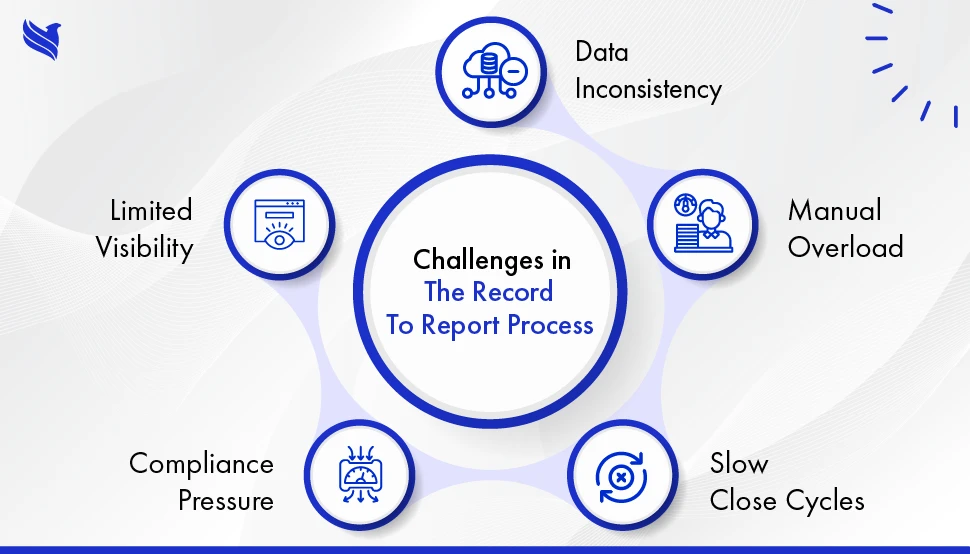
R2R looks clean in a slide deck. Daily operations tell a different story. Many finance teams face the same set of problems again and again.
In a lot of organizations, the record to report process has grown over time without a clear design. New systems were added, new entities were created, and temporary workarounds became permanent. Data lives in multiple tools, spreadsheets, and emails. To get one view of the truth, someone has to download, copy, paste, and reconcile manually. It is easy to see why challenges in financial reporting keep showing up.
The main trouble spots often look like this:
These issues rarely appear on day one. They build up slowly. By the time the pain is obvious, finance leaders know they need a more systematic approach to Record to Report (R2R).
So why give this much attention to R2R? Because strong record to report services deliver benefits far beyond “clean books.”
First, they bring order to every financial transaction. When standard rules are used across the company, entries land in the right accounts, with the right dates and dimensions. This makes later analysis much easier. Second, they support a healthier financial management process. With timely reconciliations, standard checklists, and clear timelines, closing the books becomes a routine event instead of a fire drill.
There is another layer as well. Good R2R services create a dependable base for planning and strategy. When financial reports are accurate and consistent, management can compare periods, spot trends, and understand which products, regions, or services are actually driving profit. The importance of Record-to-Report Services shows up in small ways too: fewer audit queries, fewer surprise adjustments, and fewer “version 6” reporting files floating around at the end of the month.
Improving the record to report process does not always require a huge digital transformation. Many gains come from practical adjustments that make life simpler for the finance team. The most effective habits often look like this:
Even with the best intentions, some businesses do not have enough time, tools, or internal specialists to rebuild R2R on their own. This is where record to report BPO and broader outsource accounting & bookkeeping solutions become relevant.
A specialist provider focuses on finance operations every day. They come with tested workflows, trained teams, and technology platforms built for R2R. When a company partners with such a provider, it doesn’t need to reinvent everything inside. Instead, it taps into ready‑made expertise in accounting & bookkeeping services, compliance, and process automation.
Outsourcing brings a few very practical benefits:
For many growing organizations, combining internal ownership of key decisions with external support for execution turns out to be the most balanced financial management process.
Record to report is not the most glamorous part of finance, but it is the part that touches everything else. A strong record to report process keeps financial transactions organized, reconciliations timely, and financial reports dependable. It reduces recurring challenges in financial reporting and gives leaders a clearer view of performance, risk, and opportunity.
By tightening processes, investing in record to report automation, using AI carefully in financial reporting, and considering record to report BPO or outsource accounting & bookkeeping where it makes sense, companies can turn R2R from a monthly pressure point into a long‑term strength. If the goal is steady, confident growth backed by reliable numbers, then taking Record to Report (R2R) seriously is not optional anymore; it is a basic requirement.
For companies seeking dependable control and real business insight, strengthening R2R delivers results every time. Looking to fix your own process? FBSPL can help you create a solid, stress-free financial management process that works in real life.
Record to report is the cycle where all financial transactions are recorded, reconciled, consolidated, and then turned into formal financial reports that support compliance and decision‑making.
Get the latest insights on insurance operations, policy management, and industry best practices.