
6 MIN READ·Feb 24, 2026·Written by Bhavishya Bharadwaj

Summary: This blog explains the challenges of manual quote generation, outlines how to automate quote and policy comparisons, and examines how AI in insurance improves accuracy and speed. It also details how ProposalOne streamlines insurance client proposals and binder-ready documentation.
Why are insurance submissions still taking so long?
Because many agencies are still building client-facing documents manually.
An agent receives three carrier quotes. One is a 12-page PDF. Another arrives as a spreadsheet. The third contains endorsements buried in attachments. The comparison begins. Copy. Paste. Reformat. Double-check premiums. Recalculate totals. Re-read exclusions. Adjust fonts. Compile everything into a polished insurance client proposal.
Now imagine that happening during renewal season.
The inbox is full. Producers are waiting. Clients are asking for updates. A single mismatch in coverage limits can create embarrassment. A missed endorsement can increase E&O exposure. Every minute spent formatting is time not spent advising.
By the time the document is ready, 20–30 minutes are gone. Multiply that across a busy day and the operational strain becomes obvious.
According to the McKinsey Global Sales Response Study, responding within the first hour makes organizations up to 7 times more likely to qualify an opportunity. In insurance, speed influences outcomes.
Manual workflows create friction:
Speed wins. Clarity builds trust.
This blog explains the challenge with manual quote generation, outlines How to Automate Quote and Policy Comparisons, explores how AI in insurance is transforming comparison workflows, and demonstrates how ProposalOne by FBSPL streamlines quotes, client documentation, and binder preparation in just 5 minutes.
The issue is not just time. It is risk, inconsistency, and scalability limits.
Manual quote assembly may feel manageable when volumes are low. But as submissions grow, inefficiencies surface.
Where does it begin?
Carrier documents arrive in different formats, structures, and layouts. Agents manually search for:
Each step relies on human attention. Under deadline pressure, attention weakens.
A University of Hawaii study shows manual data entry error rates average around 1%. That small percentage becomes significant when applied to coverage comparisons.
Policy comparison introduces further complexity. Agents read documents side by side to confirm:
Without a structured insurance quote comparison tool, the process depends heavily on memory and visual scanning.
Industry research indicates agents spend 30–40% of their time on administrative tasks, including formatting and document preparation. That time does not generate revenue.
Manual workflows create three constraints:
Hiring more staff may increase capacity temporarily, but it does not fix the system.
Manual processes strain under growth.
The starting point is removing repetitive tasks from human dependency.
How to Automate Quote and Policy Comparisons begins by identifying mechanical steps and systematizing them.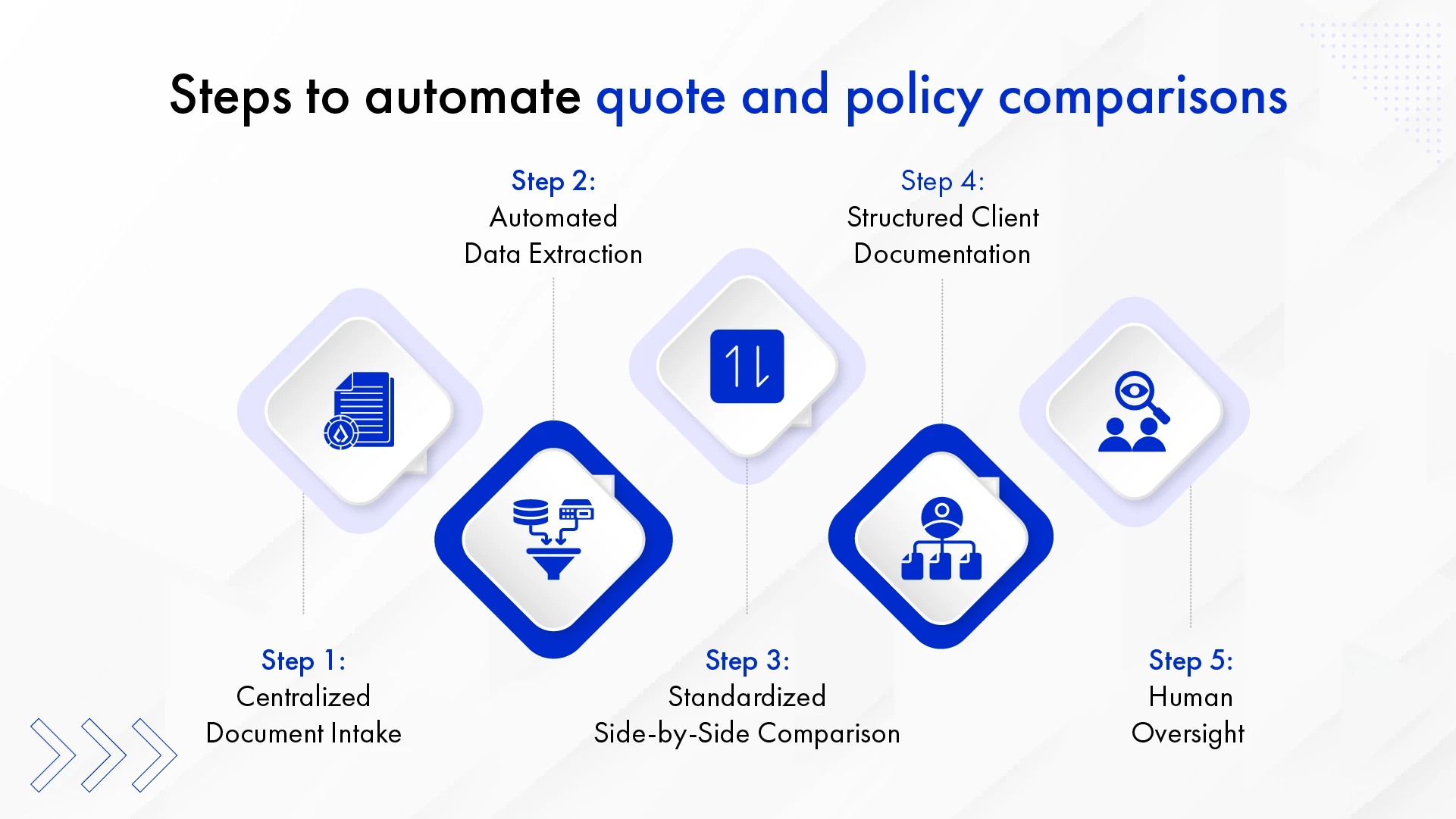
All carrier quotes should flow into one structured system. Email threads and scattered downloads create version errors and confusion.
Modern insurance quote tools use document processing technology to read PDFs and spreadsheets automatically. Coverage limits, deductibles, premiums, and insured information can be extracted without manual entry.
Deloitte research indicates automation can reduce document processing time by 50–70% in financial services.
An effective insurance quote comparison tool should:
Structured comparison removes guesswork.
Automation should generate a clean insurance client proposal that includes:
When agencies Automate insurance quote and policy comparisons fully, turnaround times shrink significantly.
Technology handles repetition. Agents handle interpretation.
AI in insurance is changing how unstructured documents are processed and compared.
Artificial intelligence reads carrier documents, identifies patterns, and extracts structured data at scale.
What changes with AI?
Accenture reports that AI adoption in insurance operations can improve productivity by up to 40%. Applied to quote comparison, this leads to faster client-ready documentation and fewer oversight risks.
Consider operational math.
A mid-sized agency processing 40 quotes per day could reclaim over 13 hours daily if preparation time drops from 20 minutes to under one minute per transaction. That is not marginal efficiency. That is structural improvement.
This is how AI is Transforming Quote Comparison in Insurance; from manual review to intelligent analysis.
This principle drives ProposalOne.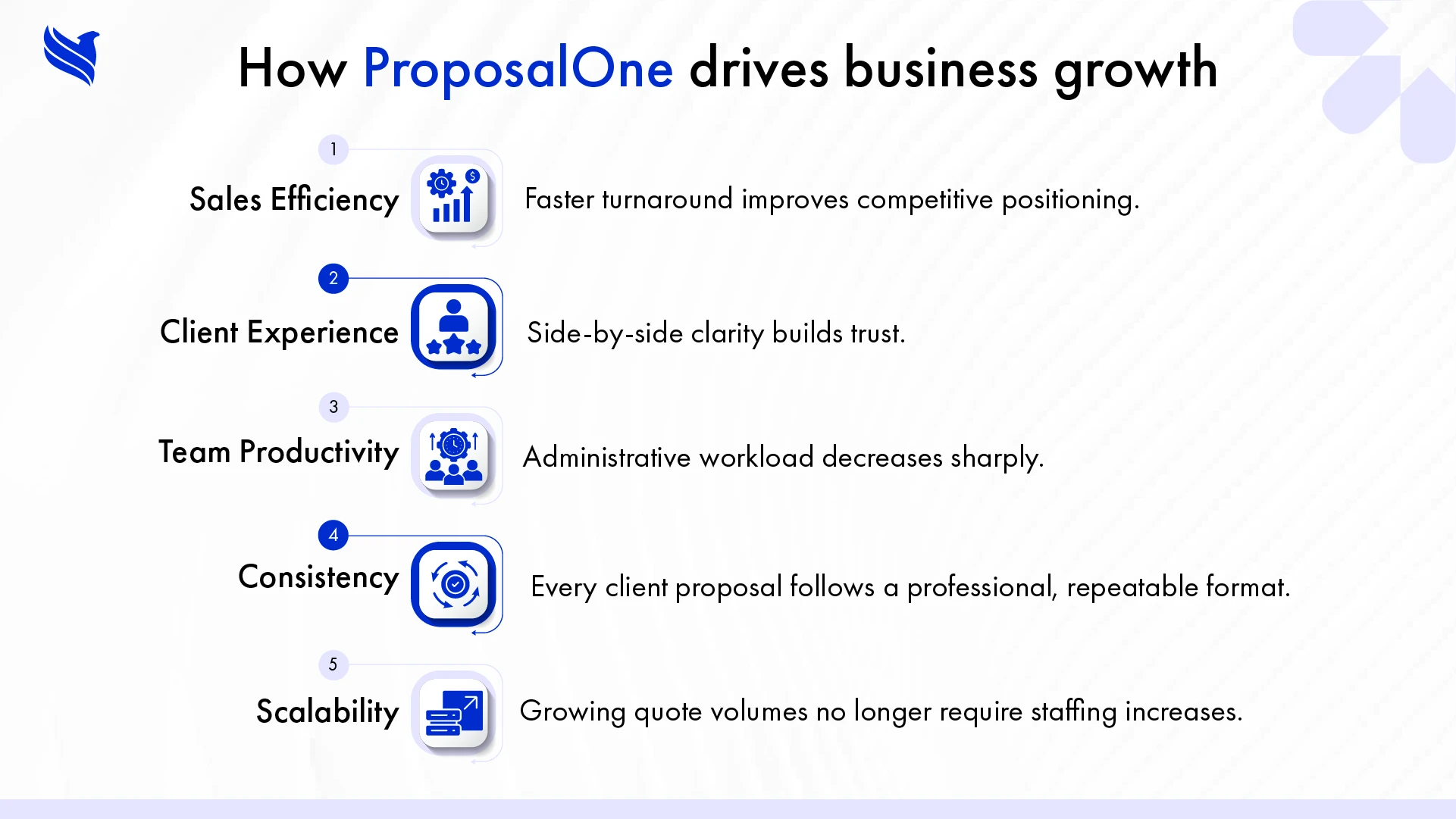
ProposalOne is an AI-powered system developed by FBSPL to automate insurance quote and policy comparisons while standardizing client-facing documentation and binder preparation.
It converts scattered quote files into structured, editable outputs in seconds.
How it works
Multiple carrier quotes; PDFs and spreadsheets; are uploaded at once.
The insurance quote tool extracts:
Manual copying is eliminated.
As a comprehensive insurance quote comparison tool, it:
The system generates a structured insurance client proposal including comparisons, summaries, and editable recommendations.
Coverage alignment and endorsements are clearly structured to support accurate binder creation before binding.
A clean PDF is generated with one click.
Without automation:
With ProposalOne:
ProposalOne applies practical AI in insurance directly to quoting and documentation workflows.
Insurance operations are rapidly evolving toward automation and structured intelligence. Agencies that continue relying on manual quote comparisons risk slower turnaround times, higher error exposure, and operational strain during renewal peaks. Speed, clarity, and accuracy now influence buying decisions more than ever.
By adopting AI in insurance, agencies can automate insurance quote and policy comparisons, standardize client documentation, and improve binder-ready precision. ProposalOne enables this shift by converting repetitive manual tasks into streamlined, scalable workflows. The outcome is faster response times, consistent outputs, and sustainable growth without increasing administrative overhead.
If your agency is ready to modernize its quoting process, connect with FBSPL to explore how intelligent automation can strengthen efficiency, accuracy, and long-term scalability.
Get the latest insights on insurance operations, policy management, and industry best practices.