
9 MIN READ·Feb 17, 2026·Written by Bhavishya Bharadwaj

Summary: This blog compares manual intake forms with smart, AI-powered chatbots used for insurance onboarding. It explains how conversational questionnaires improve data accuracy, reduce follow-ups, speed up quoting, and enhance client interactions, highlighting key insurance chatbot benefits and real-world use cases.
A practical look at how AI-powered chatbots outperform manual forms in insurance onboarding, improving accuracy, speed, and customer experience.
Insurance onboarding has quietly become one of the biggest friction points for agencies. The forms are long. Clients get confused. Staff spend time fixing small mistakes instead of focusing on real advisory work. Because of this, many agencies are rethinking how they collect information at the start of the customer journey.
More teams are now turning to AI-powered chatbots to handle intake in a conversational way. Instead of sending prospects a large form to fill out on their own, agencies guide them step by step through a chat interface. It feels simpler for the customer and results in better data for the agency.
This shift isn’t about replacing people. It’s about removing the small but constant delays that slow everyone down.
An insurance chatbot is a digital tool that uses AI to talk with customers, collect information, and guide them through insurance-related steps.
Rather than showing every question at once, an insurance chatbot asks for details gradually. It can explain a question in plain language, prompt users if something looks incomplete, and make sure answers follow the right format. The experience feels closer to messaging than paperwork.
In practical terms, it works like a virtual assistant on an agency’s website. It greets visitors, gathers the details needed for a quote, and passes that information along in a structured way. This is one example of how AI improves customer experience in insurance; the process feels less confusing and more guided.
Manual intake forms are still common across the industry. These include paper applications, PDFs sent by email, or long online forms with dozens of fields.
They seem simple, but they often create problems. Many clients don’t understand every question, especially when insurance terms are involved. With no guidance built into the form, they either guess, skip fields, or abandon the process halfway through.
When forms are submitted with missing or incorrect information, staff have to follow up. That adds extra emails, calls, and delays before a quote can even begin. Over time, this back-and-forth becomes a hidden drain on productivity.
Manual forms are static. They collect information, but they don’t help the person providing it. That’s where AI-powered chatbots start to make a noticeable difference.
A smart intake questionnaire uses AI to collect client information in a more interactive format. Instead of a long form, the user answers questions in a chat-style flow.
The system responds to what the client enters. If a date is in the wrong format, it asks for correction. If an answer triggers a follow-up question, it asks it right away. This keeps the process moving while still making sure important details aren’t missed.
A questionnaire chatbot like this doesn’t just gather data; it guides the person through the process. That guidance helps reduce confusion and leads to more complete submissions.
| Aspect | Manual intake forms | Smart intake questionnaires (AI-powered chatbots) |
| User experience | Users face a long list of questions all at once, which can feel overwhelming and time-consuming. | Questions appear one at a time in a conversational flow, making the process feel easier and more approachable. |
| Guidance | Little to no explanation is provided. Clients must figure out insurance terms and requirements on their own. | Built-in prompts and explanations help users understand what is being asked and why it matters. |
| Error prevention | Mistakes are usually discovered only after submission, leading to follow-up calls or emails. | Answers are checked in real time, reducing the chances of incorrect or incomplete information. |
| Completion rates | Many users abandon the form midway due to length or confusion. | Step-by-step interaction keeps users engaged, which improves completion rates. |
| Data quality | Submissions often contain gaps, unclear responses, or formatting issues. | Information is structured, validated, and more consistent from the start. |
| Internal workload | Staff spend significant time reviewing forms, correcting errors, and chasing missing details. | Teams receive cleaner data, reducing manual corrections and follow-up efforts. |
| Speed to quote | Delays occur while waiting for corrected or additional information. | Faster, more accurate intake helps move prospects to the quoting stage sooner. |
The insurance chatbot benefits are not just technical improvements; they have a real impact on both customers and agency teams.
One major benefit is improved engagement. When people feel like they’re having a conversation instead of filling out a form, they’re more likely to stay involved until the end. This leads to more completed intakes and fewer lost opportunities.
Another important advantage is better data accuracy. Since the chatbot can guide users and check their answers instantly, agencies receive more reliable information right from the beginning.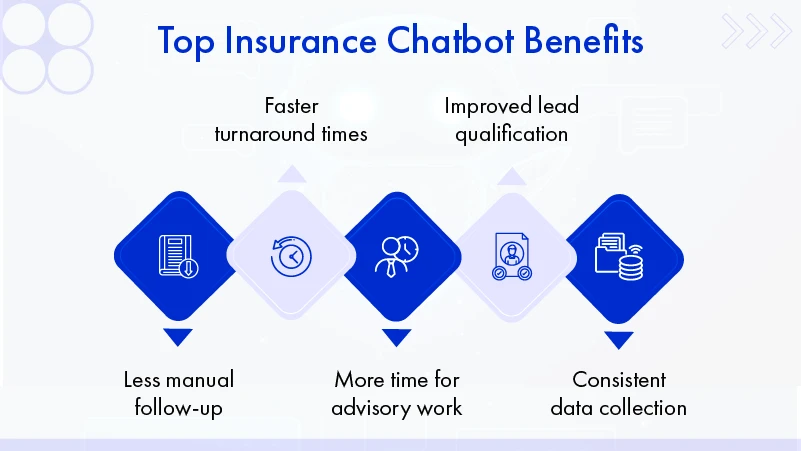
There are also strong operational gains:
On top of that, the experience simply feels more modern and convenient. That’s one of the clearest ways AI improves customer experience in insurance; by making the first step feel smooth rather than stressful.
Why the insurance industry is adopting AI chatbots comes down to a few practical realities.
Customer expectations have shifted. People are used to quick, chat-based interactions in many parts of their lives. Filling out long forms with no guidance feels outdated by comparison.
At the same time, agencies are under pressure to respond faster. The sooner a quote is prepared, the better the chance of winning the business. AI-powered chatbots help speed up the earliest step; collect accurate information.
Workloads are another factor. As inquiry volumes grow, agencies look for ways to handle routine tasks more efficiently. An insurance chatbot can manage initial intake without adding more administrative strain.
There are several real-world use cases of insurance chatbots that show how versatile this technology can be in daily operations.
One of the most common uses is new client intake. The chatbot gathers the information needed for quotes in a structured format before an agent gets involved. This shortens the time between inquiry and response.
Another important use is early-stage qualification. A chatbot can ask a few basic questions to understand the prospect’s needs and determine the next best step.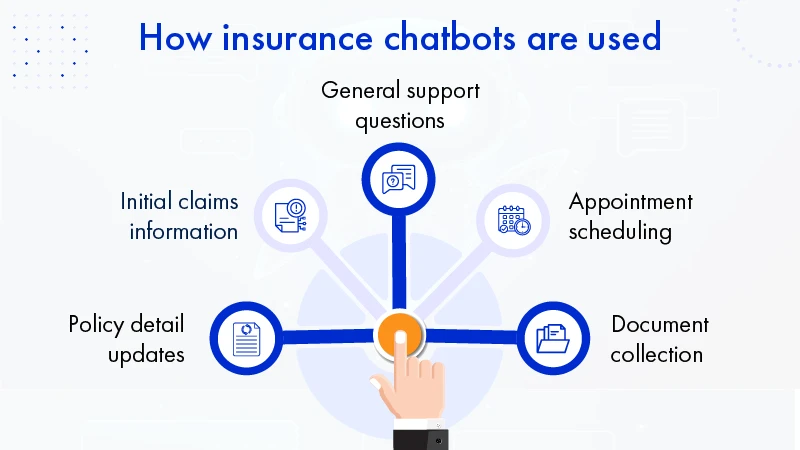
Beyond intake, chatbots also support ongoing service tasks:
Across these scenarios, AI-powered chatbots make interactions simpler and more accessible. This is another strong example of how AI improves customer experience in insurance while helping agencies operate more efficiently.
Manual intake processes often create small delays that add up.
Long forms lead to drop-offs before completion. Missing fields lead to follow-up emails. Simple formatting mistakes hold up quotes. Staff end up spending time on corrections instead of advisory work.
A chatbot reduces many of these issues early. It guides users through each step, checks answers in real time, and makes sure required details are provided. That helps keep applications moving instead of getting stuck at the starting point.
One example of this approach is PhoenixQ by FBSPL. It’s a Smart Intake Questionnaire designed for insurance agencies, using conversational AI to collect and validate information as prospects move through the intake process. The structured data can then flow directly into agency systems, helping reduce manual handling and improve overall accuracy.
Manual intake forms have done the job for years, but they often create friction right at the beginning of the customer journey. Long forms, unclear questions, and repeated follow-ups slow things down for both clients and agency teams. In contrast, AI-powered chatbots offer a more guided and efficient way to collect information, helping agencies start conversations with better data and fewer delays.
By using a questionnaire chatbot, agencies can improve completion rates, reduce errors, and respond to prospects more quickly. The growing list of insurance chatbot benefits and the wider shift explained in why the insurance industry is adopting AI chatbots show that conversational intake is quickly becoming a standard practice. Most importantly, this approach clearly shows how AI improves customer experience in insurance by making the process simpler, faster, and less stressful.
If your agency is looking to modernize onboarding and reduce the back-and-forth that slows down quotes, it may be time to explore smarter intake options. Solutions like PhoenixQ from FBSPL are designed to help agencies move away from manual forms and toward a more efficient, client-friendly start.
Get the latest insights on insurance operations, policy management, and industry best practices.