
6 MIN READ·Nov 07, 2025·Written by Bhavishya Bharadwaj

Quick summary: This blog shows why the human touch still matters in AI services. It talks about the balance between technology and empathy, how context, intuition, and personal understanding help agencies and insurers build trust and create meaningful digital transformation.
Explore how a people-first approach to AI services can transform productivity, reduce risks, and keep your clients’ trust at the center of every decision.
Can machines ever replace human understanding? It’s a question every business leader quietly wrestles with while embracing automation. Across industries, AI services have become the cornerstone of digital transformation. Agencies, insurers, and enterprises alike rely on AI tools to speed up decision-making, streamline workflows, and cut costs. Yet amid this transformation, one essential element keeps surfacing, the human touch in AI.
The rush toward AI adoption has been remarkable. Automation now manages policy administration, data processing, and customer support. But the more intelligent systems become, the more people notice what’s missing, empathy, intuition, and judgment. When technology runs ahead of humanity, experiences start to feel mechanical, not meaningful.
This is why forward-looking organizations are shifting focus toward AI + Human Touch, blending automation with empathy, precision with perception. Machines handle the predictable; humans handle the personal. It’s this combination that defines the future of Artificial Intelligence Services.
Outsourcing plays a crucial role here. Strategic AI outsourcing allows agencies and insurers to scale operations while ensuring that every interaction still feels thoughtful and human led. In this blog, we’ll look at why human centered AI is becoming a decisive factor for success, and how to find the right balance between technology and human touch.
A few years ago, efficiency meant automation. Today, it means alignment, the ability for people and machines to work together seamlessly. As systems grow smarter, the role of human oversight becomes not smaller, but sharper.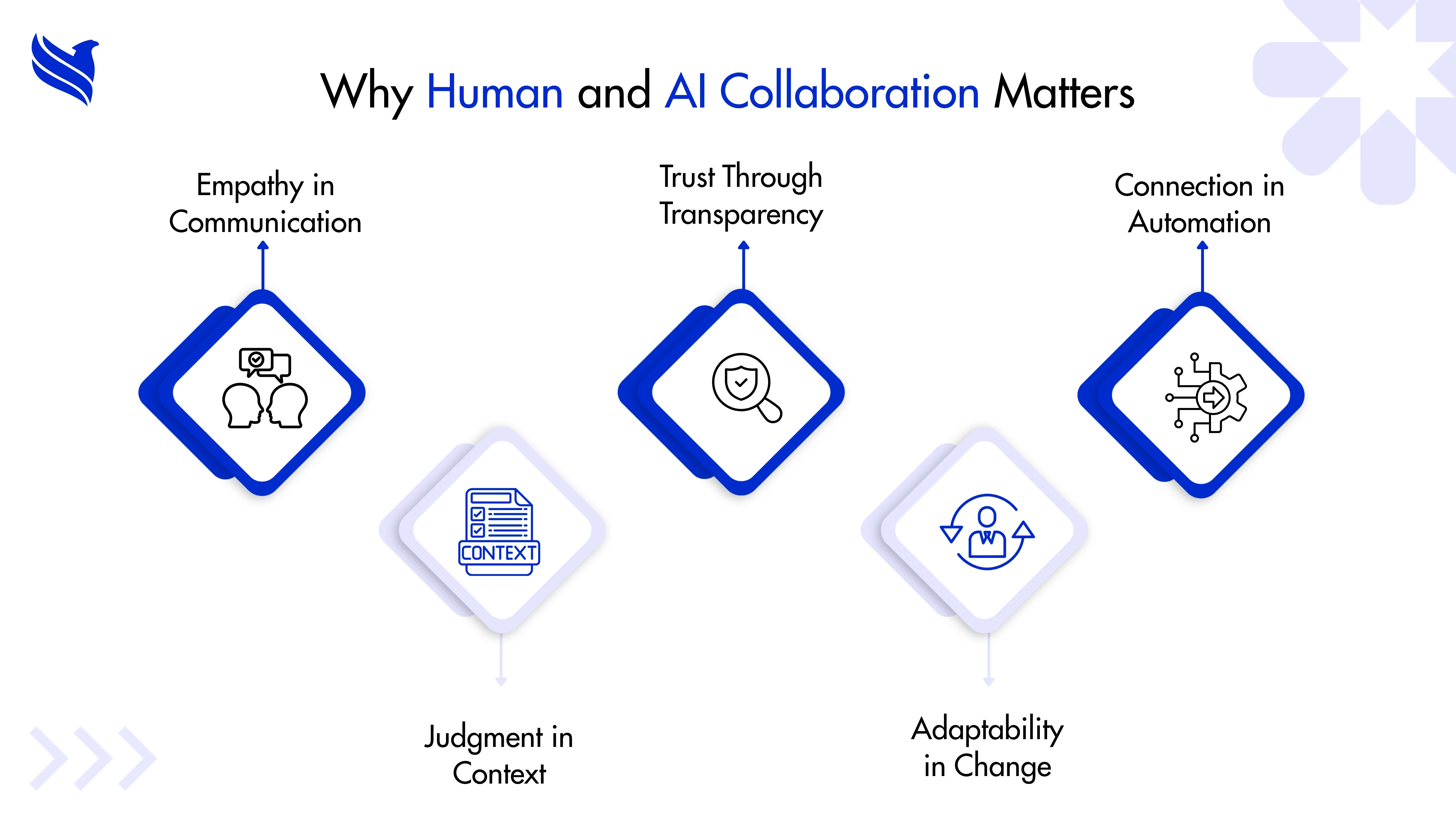
What makes human and AI collaboration so powerful?
This is the essence of human centered AI: technology guided by empathy, designed for people, and refined through real-world experience.
Automation has solved countless operational challenges; speed, accuracy, and scale are at record highs. But with every process optimized, another issue quietly grows disconnection.
Clients feel it when service becomes purely transactional. Employees feel it when decision-making loses its human pulse. Organizations feel it when brand loyalty fades, even though performance metrics rise.
The dilemma isn’t that automation is failing, it’s that it sometimes succeeds too well. When technology becomes the face of a business, the warmth behind that face starts to fade.
To restore balance, leaders are reframing Artificial Intelligence Services not as replacements for people but as extensions of them. That means:
The organizations that mastered this balance are proving that automation without connection isn’t progress; it’s regression disguised as innovation.
Behind every intelligent system stands a network of people, analysts, engineers, managers, and service professionals who make sense of the data. This is the quiet truth about the importance of human touch in AI: machines execute, but humans elevate.
When AI tools handle the repetitive, people can focus on the meaningful. In an insurance context, that might mean comforting a policyholder after a loss, or spotting a risk pattern that an algorithm misses. Across industries, AI + Human Touch defines not just efficiency, but humanity at scale.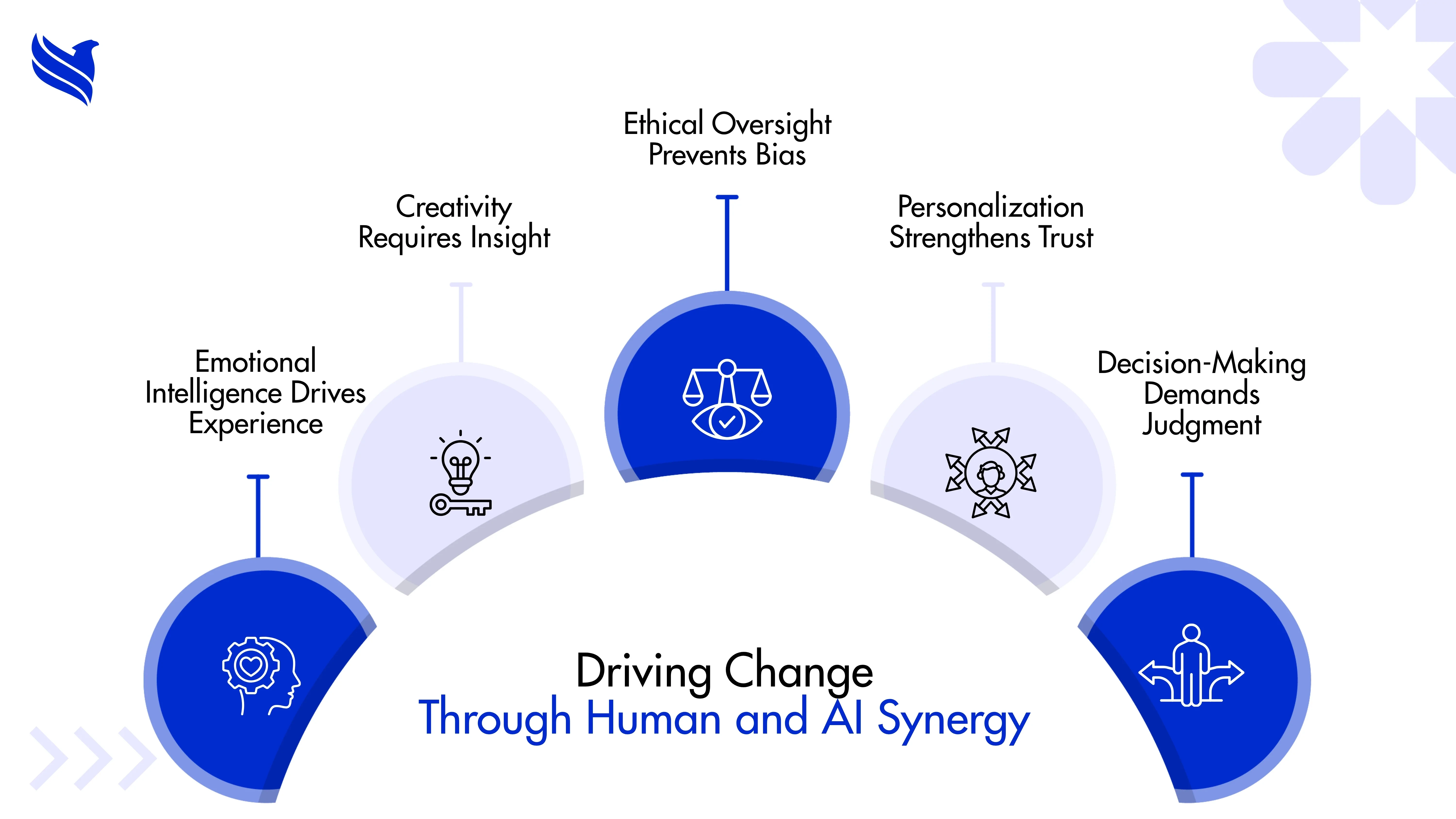
Here’s why the human role remains irreplaceable:
Technology can measure sentiment but not feel it. In customer service or claims, tone and empathy influence satisfaction more than response time.
AI can generate ideas, but humans understand nuance. True innovation emerges when data insights meet human intuition, the essence of human centered AI.
Algorithms mirror their training data. Without human oversight, bias can quietly shape outcomes. Humans bring accountability and moral reasoning into every automated process.
AI enables hyper-personalization, but only people can interpret how that personalization should feel. The technology and human touch combination ensures clients feel valued, not profiled.
In insurance, healthcare, or finance, decisions can’t always be binary. Humans evaluate fairness, urgency, and emotion, factors machines can’t quantify.
The future isn’t man versus machine; it’s human and AI, working in tandem. As automation expands, the human role evolves from execution to orchestration, guiding systems toward ethical, contextual, and empathetic performance.
Finding a capable AI outsourcing partner is no longer just about technology; it’s about philosophy. The right collaboration can determine whether automation enhances or erodes your company’s human values.
Consider these traits when evaluating partners:
Outsourcing is not about handing over control. It’s about co-creating intelligence, letting experts manage complexity while your teams focus on strategy, relationships, and innovation.
Every business transformation begins with technology, but it sustains itself through people. The future belongs to organizations that understand this partnership, where machines make work easier, and humans make it meaningful.
Human touch in AI will remain the differentiator between efficient and exceptional. As automation deepens, clients will remember the conversations that felt genuine, the claims that felt fair, and the brands that still felt human.
To thrive in this next chapter of digital transformation, leaders must see AI not as a finish line but as a foundation, one strengthened by empathy, ethics, and insight.
The future isn’t artificial; it’s augmented.
When you’re ready to build intelligent systems that think fast but care deeply, partner with FBSPL, where AI + Human Touch drives transformation with heart, not just hardware.
Because not everything in business can be measured by logic or data. When AI services handle the numbers, humans bring sense, care, and intuition. In industries like insurance, where trust drives every conversation, that mix of technology and human touch is what keeps relationships real and lasting.
Get the latest insights on insurance operations, policy management, and industry best practices.