
7 MIN READ·Dec 30, 2025·Written by Bhavishya Bharadwaj

Summary: This blog walks through holiday season pressure points and shows how an outsourcing checklist helps. It explains where support teams struggle, how to plan tasks for partners like FBSPL, and what to avoid so peak season does not overwhelm daily operations.
Back-office operations rarely slows down during holiday season; a clear outsourcing checklist helps teams stay calm, protect customers, and get through the rush in one piece.
Is the holiday season exciting for your customers but slightly stressful for your team? For many companies, the last quarter of the year looks less like a celebration and more like a constant rush of tickets, orders, reports, and last‑minute requests. Workloads jump, teams feel the pressure, and even small delays can affect revenue and reputation.
Outsourcing support, when planned properly, gives breathing room in this crowded period and helps keep service stable instead of reactive. In this post, explore a practical outsourcing checklist for the holiday season, common mistakes, and how a reliable outsourcing partner can step in when operations reach peak pressure.
The holiday calendar often exposes weak areas long before the year ends. Teams know the rush is coming, yet many businesses still enter the season underprepared. A few pressure points repeat every year and slowly drain performance.
These holiday season challenges do not just create stress; they reduce the capacity to handle new opportunities when demand is at its highest.
A strong outsourcing checklist for the holiday season keeps the focus on practical steps instead of vague intentions. Think of it as a working document that guides how to use outsourcing for business in a focused, measurable way.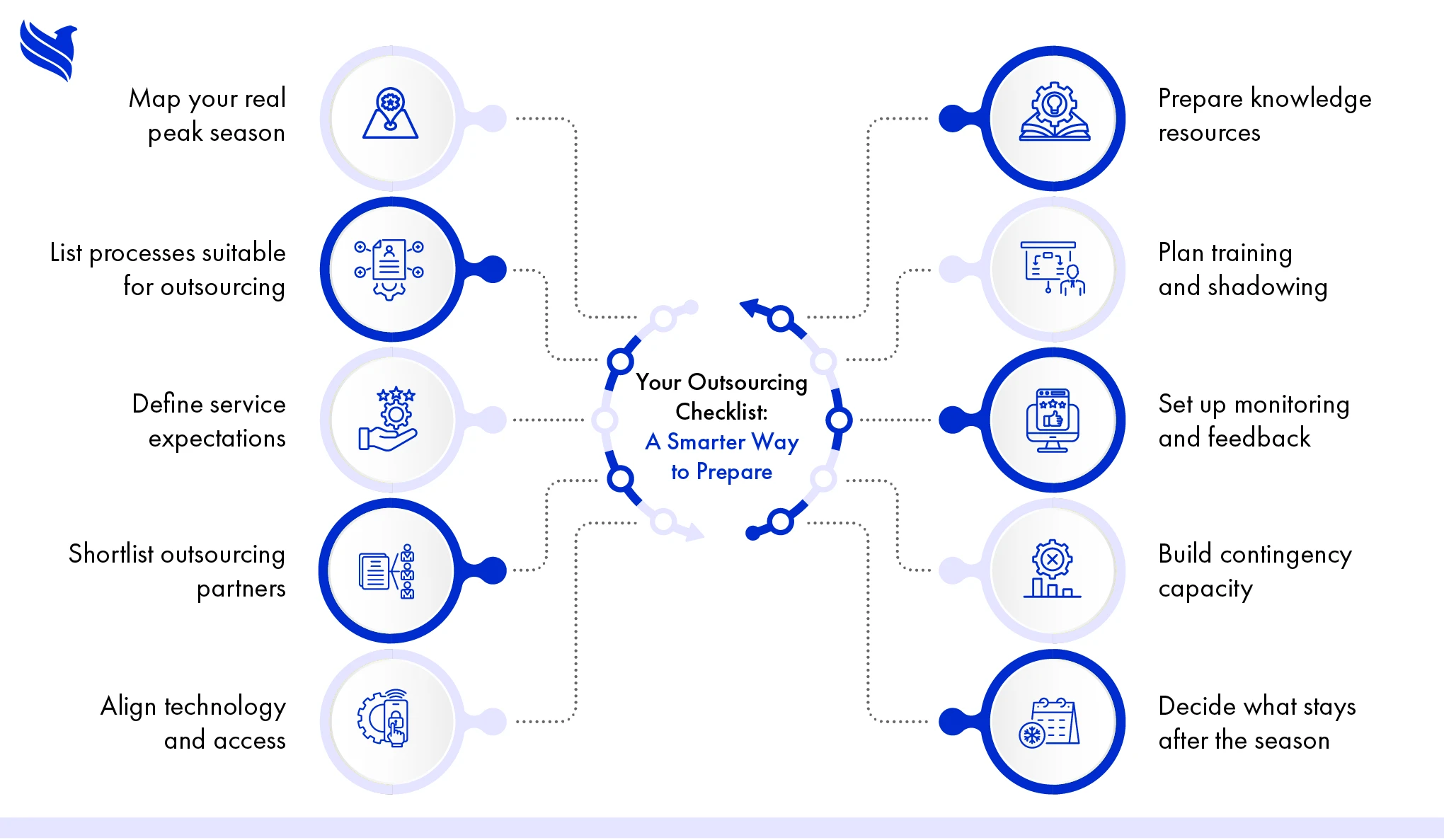
Start with data from the last one or two years. Which weeks saw maximum order volume, ticket inflow, or payment activity? Which teams logged the most overtime or missed the most deadlines? This gives a clear picture of where outsourcing during peak season will make the biggest difference.
Not every activity should move outside the core team. Shortlist tasks that are repeatable, rules‑based, and time‑sensitive, such as:
This becomes your first‑level outsourcing checklist, outlining what can be handed over with clear SOPs.
Before onboarding any provider, write down what “good support” looks like for your organization in this season:
These details help an outsourcing services partner understand not just what to do, but how success will be measured.
Look for outsourcing support that has real experience with holiday or campaign‑based surges, not just general BPO experience. Check for:
Providers like FBSPL outsourcing, for example, work with recurring seasonal campaigns, which helps them prepare teams quickly and reduce training time.
Smooth outsourcing during peak season depends heavily on systems access. Decide:
A short tech checklist, accounts created, permissions tested, sample transactions run, avoids chaos when the real surge begins.
Internal staff often carry process knowledge in their heads. Outsourcing peak season tasks requires that knowledge to be documented. Create:
These documents cut down on supervision time and keep customer experience consistent.
Instead of sending a long deck and expecting immediate performance, schedule short, focused training sessions with the outsourcing team. A useful pattern is:
This staged approach makes outsourcing for business more reliable and avoids early‑stage errors.
An outsourcing checklist is incomplete without tracking. Define:
Instead of micromanaging, this gives structured visibility into how the outsourcing support is performing.
Even with planning, some days will be tougher than expected. Include in your checklist:
This is where the Outsourcing Advantage really shows up: the ability to pull in additional trained people faster than you could hire or train internally.
Finally, note which outsourced activities improve efficiency so much that they are worth continuing all year. Many businesses start with seasonal outsourcing and end up keeping certain processes with their partner because the cost‑to‑value ratio remains strong even in normal months.
Even with a solid checklist, a few common missteps can weaken outcomes. These usually show up only when volumes spike.
Avoiding these mistakes increases the Outsourcing Advantage and helps both teams operate as a single extended unit.
When outsourcing is structured thoughtfully, the impact during peak season goes beyond just “extra hands.” It reshapes how the business experiences busy weeks.
Well‑trained outsourced teams keep queues manageable, so customers receive timely responses even on high‑traffic days. Back‑office work such as reconciliations, data updates, and documentation continues moving instead of getting postponed until January. Leaders regain time to focus on pricing, campaigns, and strategic clients instead of jumping into daily ticket triage.
For many organizations, especially those handling insurance processes, finance operations, or e‑commerce workloads, partnering with a specialist like FBSPL outsourcing brings additional benefits: process mapping, gap identification, and suggestions that improve workflows for the next season as well. Over time, outsourcing services become part of a broader capacity strategy, not just a quick seasonal fix.
Peak season always leaves a mark. Some teams end it exhausted, still clearing backlogs in January; others come out of it clearer about what worked, what broke, and what needs support next time. A practical outsourcing checklist, plus a partner that understands your workflows, simply shifts you into that second group. It keeps day‑to‑day work moving while customers are most active and your internal team is juggling targets, audits, and year‑end reviews.
If your goal this year is fewer late‑night escalations, fewer “we’ll fix it after the holidays” promises, and a bit more control over your peak calendar, this is the right moment to line up help, before the rush hits. Talk to FBSPL about outsourcing services that fit the way your business already runs, so the next holiday season feels demanding, but not chaotic.
Typical starting points are customer emails and chats, simple phone queries, order validation, data entry, and routine finance activities such as follow‑ups on payments or invoice checks, because these follow clear rules and can be documented.
Get the latest insights on insurance operations, policy management, and industry best practices.