
7 MIN READ·Jan 09, 2026·Written by Bhavishya Bharadwaj

Summary: Insurance teams today are juggling more policies, more data, and higher service expectations than ever before. Processes built for a simpler time are starting to crack. This blog share insights into why operations are changing, where delays come from, and how smarter workflows are helping teams work faster and more accurately.
Insurance operations are changing; gradually, but irreversibly.
Across agencies, MGAs, and carriers, operational teams are feeling the pressure from all sides. Policy volumes are rising, margins are tightening, compliance demands are increasing, and changing customer demands now expect speed, transparency, and accuracy as a baseline; not a differentiator.
What once worked; manual reviews, spreadsheets, rekeying data across systems; is no longer sustainable.
According to McKinsey, operational costs account for 25–30% of total insurer expenses, and inefficient workflows are among the biggest contributors to that overhead. At the same time, Deloitte reports that over 60% of insurance leaders believe legacy processes are the biggest barrier to growth.
This is why insurance operations are undergoing a fundamental reset.
Not driven by flashy technology; but by a need to survive, scale, and stay competitive in a next gen insurance environment. And at the center of this shift is AI in insurance, not as a replacement for people, but as a force multiplier for operational teams.
The traditional insurance operations model wasn’t designed for today’s complexity.
IBM estimates that bad data costs organizations an average of $3.1 million annually, largely due to rework and inefficiencies (IBM Analytics).
Operational friction isn’t visible on balance sheets; but it shows turnaround time, error rates, and client experience.
This leads many leaders to ask:
What is the biggest challenge facing the insurance industry?
Increasingly, the answer is operational scalability; not demand.
Many organizations believe they’ve modernized simply by digitizing documents. But digitization is not a transformation.
True insurance digital transformation happens when workflows become intelligent, not just electronic.
Digitization vs Intelligent automation
AI doesn’t just move data; it interprets it.
For example, instead of copying premiums from a policy document into a system, AI can:

This is why the future operating model isn’t AI alone, but AI + human oversight.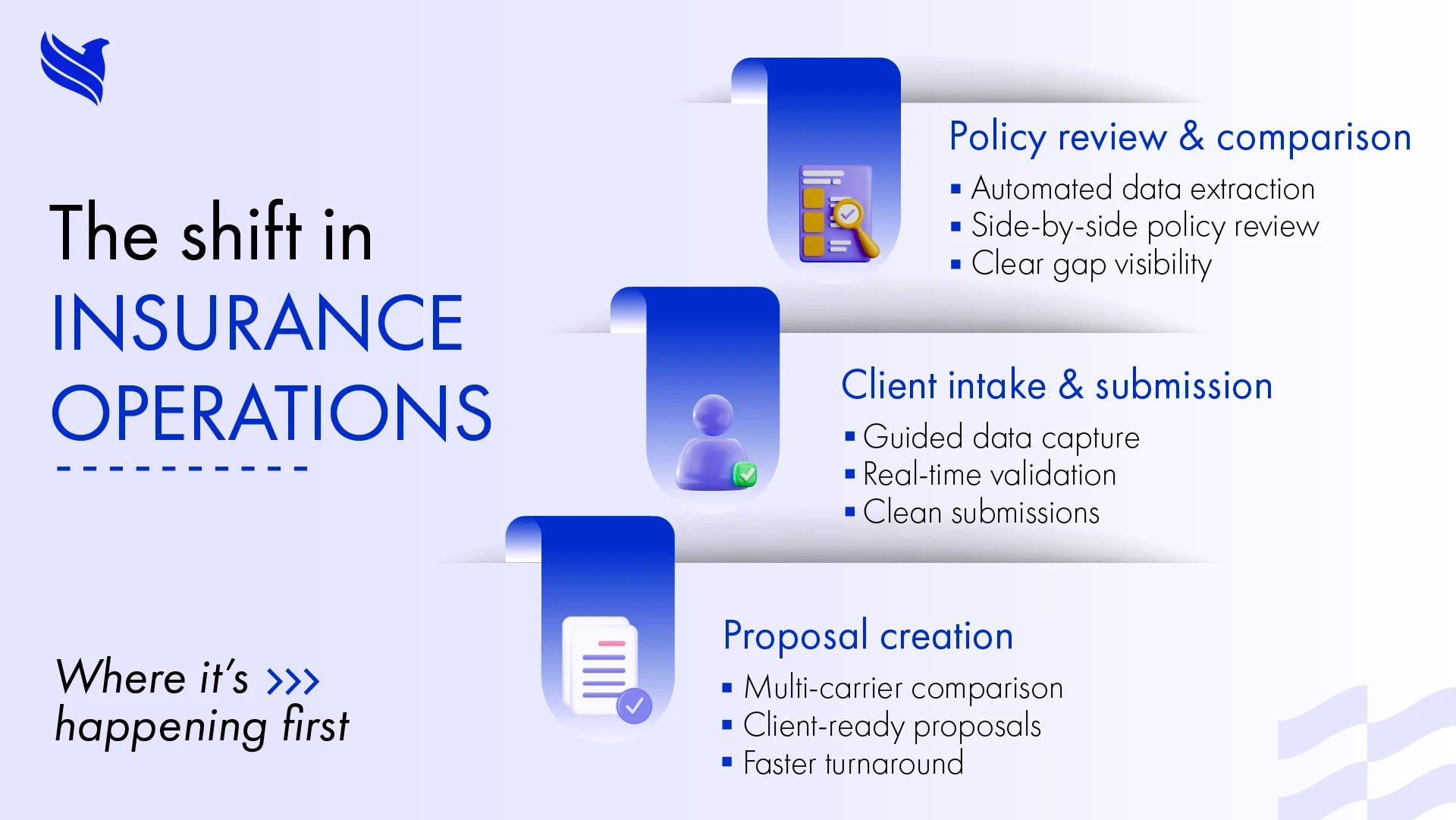
The shift toward next gen insurance operations becomes most visible in three workflows that define daily productivity:
These aren’t edge cases; they’re the backbone of insurance operations.
The challenge
Policy review remains one of the most time-consuming tasks in insurance operations. Teams manually scan lengthy documents, compare renewals, check endorsements, and verify limits; often under time pressure.
This process:
Advanced policy review capabilities now use AI to assist teams by automatically reading and structuring policy documents.
These systems can:
Instead of replacing reviewers, AI highlights what needs attention; allowing teams to validate, decide, and move faster.
Operational impact
The challenge
Incomplete or inaccurate submissions are one of the biggest sources of downstream inefficiency.
According to Accenture, insurers lose up to 20% of operational productivity due to poor-quality intake data and rework (Accenture Insurance Operations Study).
Back-and-forth emails, missing fields, and incorrect inputs delay quotes and frustrate clients.
How AI changes the workflow
Modern intake experiences are moving beyond static forms toward guided, conversational workflows powered by AI.
These experiences:
By the time data enters core systems, it is already structured, validated, and usable.
Operational impact
Reality Check: If intake data is flawed, every downstream process pays the price.
The challenge
Proposal creation is often manual, inconsistent, and slow; especially when dealing with multiple carriers and formats.
Sales teams spend hours compiling quotes, aligning coverage details, and formatting proposals; while prospects wait.
How AI changes the workflow
AI-enabled proposal workflows now streamline the entire process by automatically reading and comparing quote information across carriers.
These workflows can:
The result is faster responses without sacrificing accuracy or clarity.
Operational impact
Timeline comparison:
Manual proposals (hours) → AI-driven proposals (seconds)
The real transformation happens when these tools work together.
Connected AI workflows mean:
This creates standardized operations across carriers, teams, and geographies; critical for scaling without chaos.
What this shift means for insurance leaders
For leaders, this shift changes the nature of operations work.
According to PwC, insurers that invest in AI-driven operations see up to 30% improvement in operational efficiency (PwC Insurance Insights).
The current shift is only the beginning. The next phase of insurance digital transformation will include:
Operations will become proactive, not reactive.
Future reality: Insurance teams won’t just process work; they’ll anticipate it.
This shift isn’t theoretical.
At FBSPL, we work closely with agencies, MGAs, and carriers to implement real-world AI in insurance operations; focused on outcomes, not experimentation.
Our approach centers on:
By combining domain expertise with AI-first tools, FBSPL helps insurance organizations transition confidently into next gen insurance operations.
Manual-heavy insurance operations are quickly becoming a competitive disadvantage.
As complexity increases and customer expectations rise, AI in insurance is no longer a question of “if”, but “how fast.”
The organizations adapting fastest aren’t replacing people; they’re removing friction. And those who act now will define what next gen insurance truly looks like.

One major challenge is keeping operations efficient while handling growth. When systems don’t talk to each other and work depends heavily on manual effort, scaling becomes difficult without increasing costs or errors.
Get the latest insights on insurance operations, policy management, and industry best practices.