
8 MIN READ·Jan 06, 2026·Written by Bhavishya Bharadwaj

Summary: This blog walks through common AI integration mistakes across insurance operations: unclear goals, messy data, legacy platforms, limited governance, and low buy‑in from staff. The focus stays on real‑world basics so AI supports underwriting and claims instead of creating new problems.
Insurance firms face real risk when AI projects run on weak data, vague goals, old systems, and ignored people issues. Learn why.
In many insurance organizations, artificial intelligence arrives with big expectations and uncomfortable results. Budgets are approved; platforms are purchased, yet core processes remain slow, fragmented, or more confusing than before. Claims still pile up, underwriting still drags, fraud detection remains patchy, and frontline teams quietly revert to spreadsheets and email threads. The gap between promise and impact usually traces back to a familiar set of mistakes in AI integration, not to the technology itself.
A more careful look at these mistakes helps insurance businesses plan AI integration in insurance with less hype and more operational sense. Clear goals, realistic data work, modest starting points, and solid governance make far more difference than any other shiny tool. The following sections outline common AI implementation mistakes and practical angles to avoid them, while keeping a steady focus on sustainable value rather than short‑lived experiments.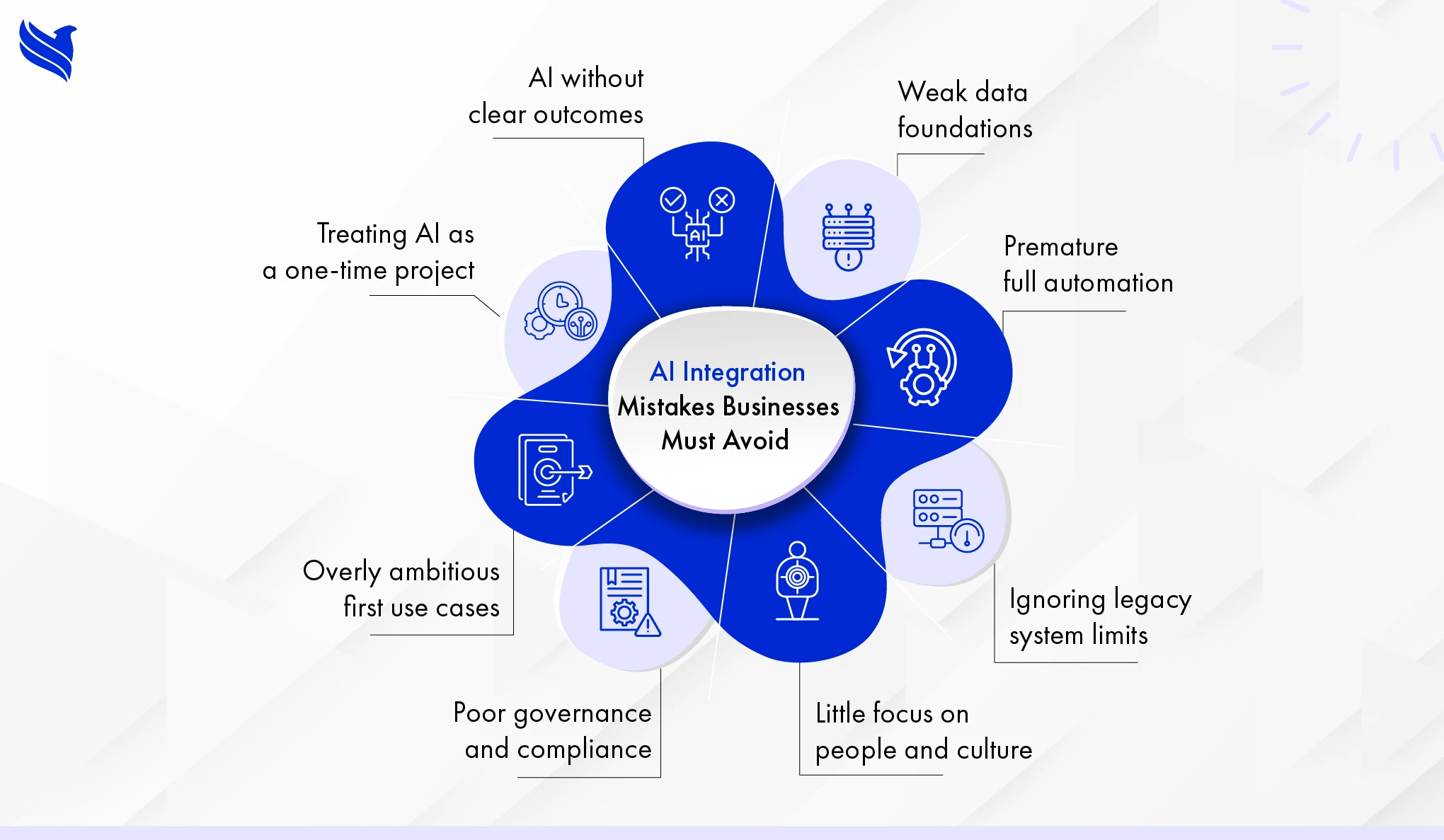
AI projects in many carriers begin from enthusiasm instead of defined outcomes. A budget appears under “innovation,” a vendor pitches advanced artificial intelligence services, and a pilot starts before anyone has pinned down the actual business result. After months of effort, a dashboard exists; some models run, but core KPIs look almost unchanged.
A more grounded approach sets concrete operational targets first. Examples include a fixed percentage drop-in claim rework rates, specific reduction in new business turnaround time, or a clear improvement in broker satisfaction scores. These outcomes anchor decisions about which AI-powered services to adopt, which processes to re-design, and which metrics to watch. Without such anchors, AI in insurance becomes a loose experiment rather than a tool with a job.
Insurance operations rest on large volumes of historical data: policy details, claims histories, endorsements, intermediaries, inspections, and more. That data often sits in inconsistent formats, with missing fields, legacy codes, and informal workarounds. When this raw mix is pushed directly into models during AI integration, results look sophisticated on screen but weak in actual decisions.
Robust AI integration in insurance demands deliberate data preparation. Typical steps include harmonizing codes across systems, resolving duplicates, filling or flagging missing fields, and defining a single source of truth for key attributes such as risk location, coverage limits, or loss of history. Data governance policies then keep that foundation stable over time. Insurance AI implementation challenges usually shrink once training data properly reflects reality instead of decades of ad‑hoc fixes.
Automation appeals to leadership teams under pressure to cut costs and speed up decisions. However, shifting critical underwriting or claims outcomes entirely to algorithms too early invites operational and reputational trouble. Edge cases, ambiguous documentation, emotional circumstances, and coverage of disputes remain common in insurance, and these rarely fit neatly into a training dataset.
A more sustainable model treats AI in insurance business as a decision assistant rather than an automatic judge. Routine, low‑value tasks, sorting documents, extracting values, flagging outliers, pre‑classifying loss types, fit AI-powered services very well. Complex questions, declining a long‑standing client’s claim, adjusting a contested bodily injury reserve, interpreting unusual policy wording, remain under human control, with AI supplying structured information and options. This balance reduces error, builds trust, and still captures meaningful efficiency gains.
Most insurers operate on a patchwork of legacy platforms. Core policy administration, claims, and billing systems may date back decades. Different business lines often run on different stacks. Point solutions for rating, document management, and CRM add more layers. AI integration in insurance that assumes seamless data flow in such an environment rarely matches reality.
Practical planning starts with a map of the current landscape. That map notes which systems hold critical data, how files move between departments, and where “shadow processes” (spreadsheets, shared drives, email) fill gaps. AI implementation challenges reduce when integration scopes stay modest at first, connecting AI tools to one or two key systems through stable interfaces, rather than promising a complete real‑time view of every policy and claim from day one. Over time, successful pilots justify broader integration of work or phased modernization.
New technology often receives detailed technical documentation and minimal cultural preparation. Screens change, workflows shift, but training covers only which buttons to press. Meanwhile, quiet worries spread across underwriting desks and claims units: Will automation affect role security? Will judgment still matter? Does experience still count?
A healthier pattern treats change management as part of AI integration, not an afterthought. Frontline staff contribute to mapping present workflows, pointing out friction, and suggesting priorities. Demonstrations focus on how artificial intelligence services reduce tedious tasks, manual indexing, repetitive data checks, routine status communications, rather than replacing entire roles. Training sessions highlight updated responsibilities: interpreting AI output, handling exceptions, and focusing on relationship‑driven work with brokers and policyholders. When teams see a future for their expertise inside AI‑enabled operations, adoption rises naturally.
Insurance markets operate under strict regulatory oversight and public scrutiny. AI in insurance, if deployed without strong governance, can introduce risks faster than it removes them. Unclear model ownership, missing documentation, and vague accountability around automated decisions all create problems during audits, complaints, or disputes.
A robust governance framework covers several pillars. Model owners and approvers are named. Documentation describes data sources, feature selection, testing methods, and limitations. Monitoring routines track drift, bias indicators, and error patterns over time. Clear rules specify when human review is mandatory; for example, for decisions above a certain financial threshold or involving sensitive personal information. Transparent communication explains where AI-powered services contribute to decisions, while still affirming that responsibility for outcomes remains with licensed professionals and authorized management.
Early AI projects in some insurers target highly visible, complex areas such as fully automated FNOL‑to‑payment journeys or dynamic pricing for every segment at once. Ambition sounds attractive but quickly collides with real‑world constraints: messy data, cross‑department dependencies, and risk concerns. The result is often an extended pilot that excites vendors yet frustrates internal stakeholders.
A more measured entry chooses narrow, high‑volume, well‑defined processes. Examples include: automatic routing of inbound documents to the right queue, extraction of key fields from standard submission formats, prioritization of claims needing immediate attention, or basic anomaly flags in bordereaux and financial reports. These use cases show tangible benefit quickly, reveal integration issues safely, and offer a solid base for further AI integration in insurance once lessons have been absorbed.
Many initiatives treat AI in insurance business as a discrete project with a start and end date. A vendor is engaged, a solution is deployed, a go‑live email circulates, and attention moves on. Models then run on slowly evolving data, with only occasional checks when something obviously breaks. Over months, performance drifts, business rules change, and earlier assumptions no longer hold.
Successful insurance AI implementation treats models as living components of the operation. Regular reviews bring together business users, data specialists, and risk teams to examine outputs, exceptions, and user feedback. Metrics track both quantitative results (cycle times, error rates, loss ratios) and qualitative signals (customer sentiment, staff confidence). Adjustments follow naturally: retraining on fresher data, refining rules, or even retiring certain AI-powered services that no longer fit the portfolio or strategy.
AI now sits at the center of many insurance strategies, yet results still vary widely. In this blog, the focus has been on the hidden pitfalls that derail AI integration in insurance: unclear objectives, weak data foundations, over‑automation, legacy system constraints, cultural resistance, poor governance, and overly ambitious first use cases. Each of these factors can quietly turn promising AI in insurance business initiatives into expensive experiments that never scale.
A more disciplined route treats artificial intelligence services as tools in service of specific outcomes; cleaner operations, faster and more accurate decisions, and better experiences for brokers and policyholders. Thoughtful planning, modest starting points, continuous monitoring, and respect for human judgment turn AI implementation challenges into manageable steps instead of roadblocks.
For insurance organizations seeking structured support on this journey, from process mapping and data preparation to solution selection and roll‑out, FBSPL offers specialized AI-powered services and AI consulting services tailored to real insurance operations. Connect with FBSPL to design AI integration that strengthens the business rather than testing it.
Early results often show up in document sorting, data extraction from submissions, simple claim triage, and routing work to the right team. These tasks are repetitive and rule‑driven, so automation fits naturally.
Get the latest insights on insurance operations, policy management, and industry best practices.