



A step-by-step framework for accurate policy comparisons in modern insurance
19 MIN READ/Feb 23, 2026

Summary: This guide outlines a clear, step-by-step approach to reviewing insurance policies with accuracy and consistency. It explains common challenges, highlights the value of structured processes and technology, and shows how smarter tools help teams save time, reduce risk, and deliver stronger client recommendations.
A practical guide to simplifying policy reviews, reducing errors, and using smarter processes to compare coverage accurately and confidently.
Have you ever compared two insurance policies that looked similar at first glance, only to discover important differences hidden deep in the fine print? In insurance operations, even small variations in coverage wording, deductibles, or endorsements can significantly impact the protection a client actually receives. That’s why policy comparison has become one of the most critical, and challenging, parts of the decision-making process.
Manually reviewing lengthy policy documents takes time, focus, and experience. When teams are handling multiple renewals, new quotes, and endorsements at once, the risk of oversight increases. Important details can be missed, comparisons may become inconsistent, and the overall policy analysis process can slow down productivity across the agency.
Industry studies suggest that manual document review tasks can consume up to 30–40% of an insurance operations team’s time, especially during renewal cycles. When teams are stretched, even small oversights in coverage comparison can lead to costly errors or client dissatisfaction.
To stay efficient and maintain accuracy, many organizations are rethinking how they approach this task. Some are turning to structured workflows and technology, while others are choosing to outsource parts of the review process to reduce internal workload without compromising quality.
In this guide, we’ll walk through a step-by-step framework for comparing insurance policies accurately, explore common challenges, and explain how modern solutions can make the process faster, clearer, and more reliable.
The smart way to break down and compare policies
Understanding how to evaluate two or more insurance policies side by side requires more than a quick glance at premiums. A structured approach ensures nothing important is overlooked and helps professionals make confident, well-informed recommendations. Here’s a practical framework you can follow.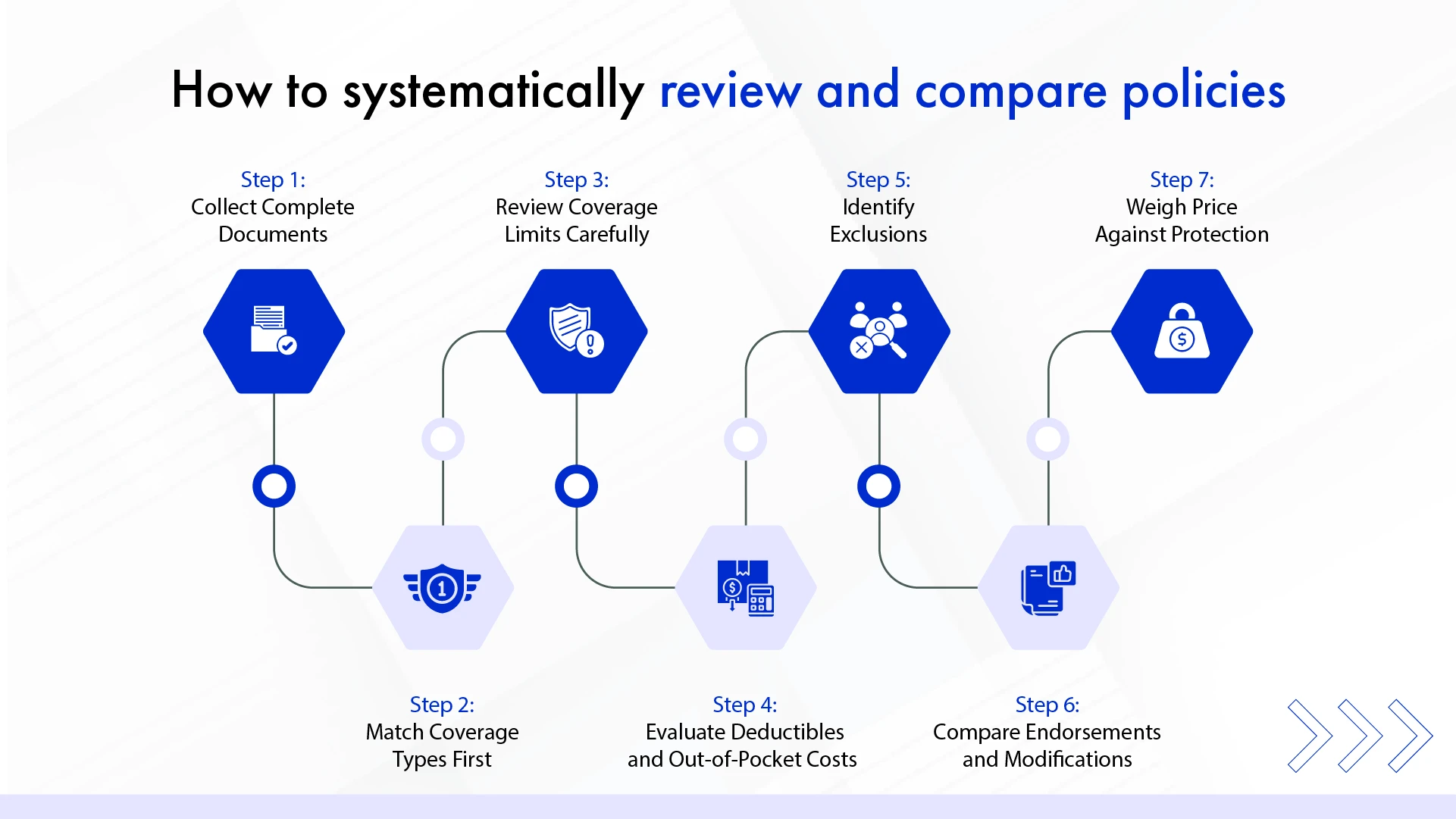
Step 1: Collect complete documents
Start by gathering every relevant document. This includes the full policy form, declarations page, schedules, and all endorsements. Missing even a single attachment can lead to an incomplete understanding of coverage. Organization at this stage prevents confusion later.
Step 2: Match coverage types first
Before reviewing numbers, make sure the policies are built on comparable coverage structures. Check that liability, property, and optional protections are aligned. Comparing mismatched coverage types can lead to misleading conclusions about value or protection.
Step 3: Review coverage limits carefully
Next, examine limits and sublimits. Look at per-occurrence limits, annual aggregates, and any special caps for specific risks. Differences here often matter more than price and can greatly influence how well a client is protected during a claim.
Step 4: Evaluate deductibles and out-of-pocket costs
A lower premium might come with a higher deductible. Consider how much financial responsibility the insured would carry before coverage applies. True value comes from balancing premium savings with potential out-of-pocket exposure.
Step 5: Identify exclusions
Exclusions define what is not covered, and they often vary in subtle but meaningful ways. Read these sections closely. Even a small wording difference can change how a policy responds to real-world scenarios.
Step 6: Compare endorsements and modifications
Endorsements adjust the base policy, either expanding or restricting coverage. Reviewing these side by side reveals where two policies truly differ. This is often where the most significant distinctions appear.
Step 7: Weigh price against protection
Finally, step back and evaluate the overall balance between cost and coverage strength. The lowest premium does not always deliver the best value. A clear, methodical review process leads to more confident decisions and better client outcomes.
Agencies that follow a structured review process report up to 25% fewer policy servicing errors and faster turnaround times compared to ad-hoc review methods.
Where policy reviews get complicated
Even with a clear framework in place, comparing insurance policies is rarely a simple task. What appears straightforward on the surface often becomes complex once the details come into focus. Understanding these challenges helps explain why so many insurance professionals struggle to maintain speed and accuracy at the same time.
- Dense and technical language
Insurance policies are legal contracts, and their wording reflects that. Sentences are often long, layered, and filled with technical terminology. A minor difference in phrasing can change how coverage applies in a claim scenario. Carefully interpreting this language requires time and concentration, especially when multiple documents must be reviewed back to back. - Inconsistent formatting across carriers
Every carrier structures policies differently. Section titles, definitions, and endorsement placements vary widely, which makes side-by-side review difficult. One policy might list key limitations in a central section, while another hides similar information within endorsements. This inconsistency slows down the review process and increases the risk of overlooking important details. - Endorsements that change everything
Endorsements frequently contain the most meaningful changes to coverage, yet they are also the easiest to miss. These additions or modifications may adjust limits, introduce new exclusions, or redefine coverage terms. Because they are often spread throughout lengthy documents, tracking how endorsements interact with the base policy can be challenging. - Time pressure and workload volume
Insurance teams rarely have the luxury of unlimited review time. Renewal seasons, new business submissions, and mid-term changes create heavy workloads. Under pressure, reviewers may rush through documents, increasing the likelihood of missed nuances or incomplete evaluations. - Risk of human error
Even experienced professionals are not immune to fatigue and oversight. Reading long, detailed documents repeatedly can lead to reduced focus. A single overlooked exclusion or incorrectly noted deductible can affect recommendations and client outcomes.
Research across document-heavy industries shows manual data extraction error rates can range between 3–7%, a small number that can have major consequences in insurance coverage decisions. - Difficulty extracting key data
Important figures like limits, premiums, and deductibles are not always presented in consistent formats. Some may appear in summary pages, while others are embedded within detailed sections. Pulling this information manually adds extra steps and increases the chance of transcription errors. - Lack of standard comparison methods
Without a structured system, different team members may follow slightly different review approaches. This inconsistency can make it harder to maintain quality standards and produce uniform summaries for clients.
Together, these challenges highlight why policy reviews are so demanding. They require attention to detail, strong interpretation skills, and significant time investment; all while operating under tight deadlines and high expectations.
How technology turns complexity into clarity
As insurance documents become more detailed and workloads continue to grow, relying solely on manual review processes is no longer sustainable. Modern technology is transforming how professionals approach policy evaluation, helping them work faster while maintaining high standards of accuracy and consistency.
Faster reviews without cutting corners
One of the most immediate advantages technology offers is speed. Automated systems can scan lengthy documents and pull out key information in seconds. Instead of manually searching for limits, deductibles, or endorsements, reviewers can focus on understanding the differences that truly matter. This allows teams to handle higher volumes of work without sacrificing quality.
Consistency across every review
Manual comparisons often vary depending on who performs them. Technology introduces standardized workflows, ensuring that every review follows the same structure. This consistency improves reliability and makes it easier to explain findings to clients or colleagues. When the process is repeatable, results become more dependable.
Clear side-by-side views
Digital tools present information in structured layouts that make differences easier to see. Rather than switching between multiple documents, reviewers can view comparable details in one place. This visual clarity speeds up decision-making and reduces the chance of missing subtle variations.
Smarter detection of differences
Advanced systems can automatically highlight discrepancies between documents. Changes in coverage limits, new exclusions, or modified terms are flagged for closer attention. This helps professionals focus their expertise where it’s needed most, rather than spending time searching for differences manually.
Reduced administrative burden
Repetitive tasks like data entry and formatting summaries consume valuable time. Automation handles much of this groundwork, freeing up professionals to concentrate on advisory work and client communication. The result is a more efficient workflow that supports both productivity and service quality.
Better documentation and reporting
Technology also improves how findings are documented. Structured summaries and reports can be generated quickly, making it easier to share clear comparisons with clients. These records create transparency and support internal tracking, which is especially helpful during audits or reviews.
Scalability for growing agencies
As agencies expand, the volume of policies to review increases. Technology allows teams to scale operations without needing to increase staffing at the same rate. By streamlining routine analysis, organizations can handle growth more smoothly while maintaining performance standards.
Supporting human expertise
Importantly, technology does not replace professional judgment. Instead, it supports it by removing time-consuming manual steps and reducing the risk of oversight. Professionals still interpret results, advise clients, and make final decisions; but with better information at their fingertips.
By bringing speed, structure, and clarity to the process, technology helps turn one of the most demanding back-office tasks into a more manageable and reliable workflow.
Protecting accuracy, privacy, and trust
When reviewing insurance policies, accuracy is only part of the responsibility. Professionals must also ensure that every step of the process protects sensitive information and aligns with regulatory expectations. Strong compliance and data security practices are essential to maintaining client trust and avoiding costly mistakes.
The importance of regulatory awareness
Insurance operates in a highly regulated environment. Documentation must be handled carefully, and recommendations should be based on complete and accurate information. Keeping organized records of how policies were reviewed and compared supports accountability and helps during audits or internal checks.
Maintaining clear documentation
A structured review process makes it easier to maintain detailed records. Clear summaries, consistent comparison formats, and documented findings provide a reliable trail of information. This not only supports transparency but also helps resolve disputes or questions that may arise later.
Safeguarding client information
Policy documents often contain personal details, financial data, and coverage specifics that must be protected. Secure storage systems, restricted access controls, and encrypted communication channels are key to preventing unauthorized access. Whether reviews are handled in-house or with external support, maintaining confidentiality should always be a priority.
Managing document versions
Insurance policies evolve through endorsements and revisions. Comparing outdated documents can lead to incorrect conclusions. A reliable system for tracking versions ensures that the most current policy information is always used during evaluations.
Version control failures are a common contributor to compliance issues, with internal audits in financial services showing that outdated documentation plays a role in nearly 20% of reporting discrepancies.
Reducing risk through structure
Inconsistent review practices increase the chance of missing compliance-related details. A standardized workflow supports thorough evaluations and helps ensure that no critical information is overlooked.
By combining careful documentation, secure data handling, and structured processes, insurance teams can deliver accurate results while upholding the highest standards of compliance and client protection.
What a modern policy review system can do
As policy documents become longer and more complex, having the right support system in place makes a significant difference. A well-designed solution should do more than simply display documents; it should actively help professionals interpret, organize, and evaluate information with greater speed and confidence. Here are the core capabilities that make a real impact.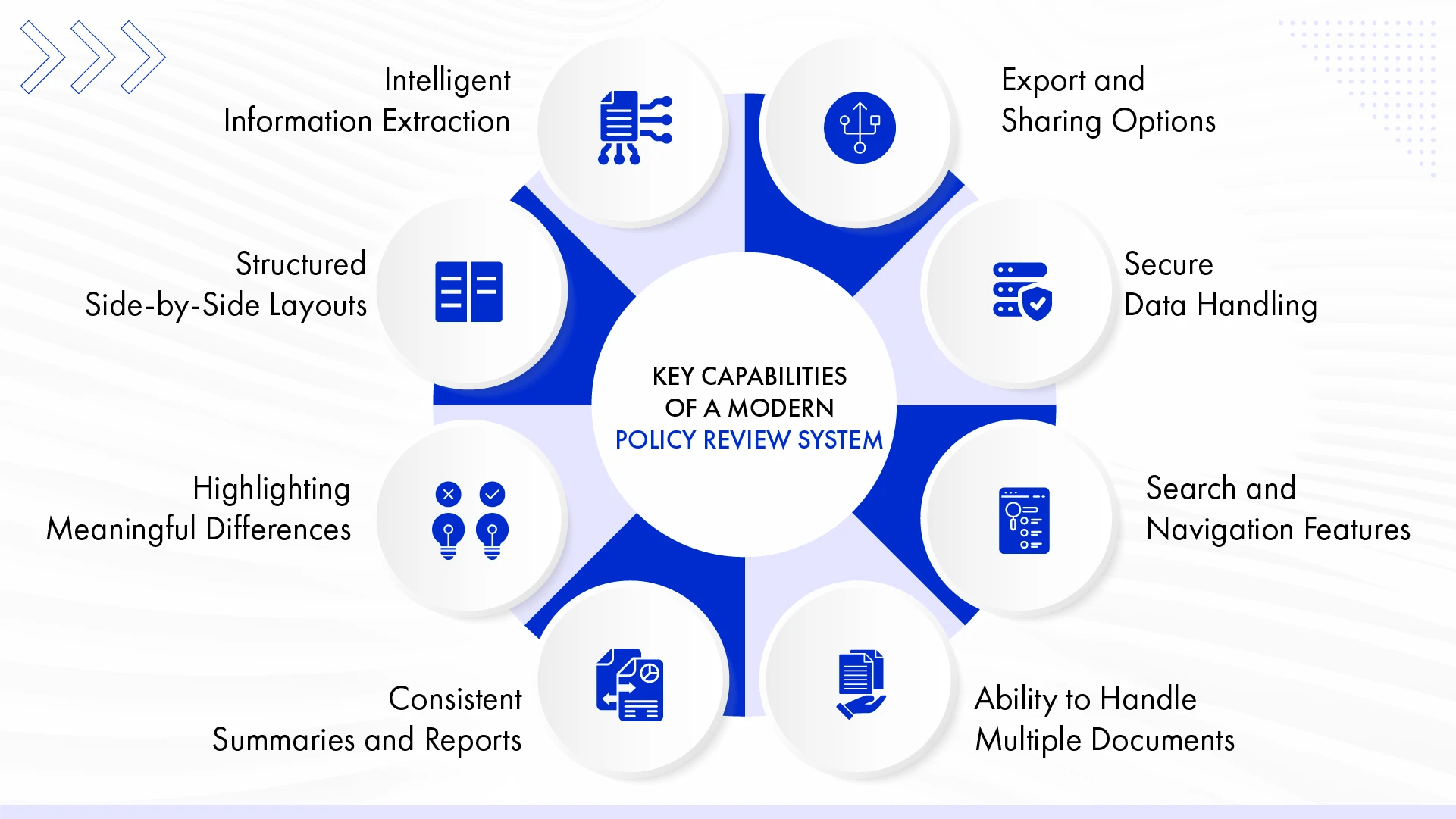
- Intelligent information extraction
A strong system should be able to identify and pull out key data points automatically. Premiums, deductibles, coverage limits, and endorsements should be recognized without requiring manual retyping. This not only saves time but also reduces the risk of transcription errors that can occur during manual entry.
Automated extraction tools typically achieve 95%+ data capture accuracy, significantly reducing the risk of missed or incorrectly recorded policy details. - Structured side-by-side layouts
When reviewing multiple policies, clarity is everything. A modern solution should organize information in a clean, side-by-side format that aligns similar coverage elements. This layout allows reviewers to see differences instantly rather than flipping back and forth between lengthy documents. - Highlighting meaningful differences
Not all variations carry the same weight. The system should help identify where real changes exist, such as modified limits, new exclusions, or altered terms, and bring those areas to the reviewer’s attention. By focusing attention on meaningful differences, professionals can use their expertise more effectively. - Consistent summaries and reports
Clear communication is essential when sharing findings with clients or internal teams. A capable system should generate structured summaries that present key details in an easy-to-understand format. Consistency in reporting builds trust and ensures that comparisons are easy to follow. - Ability to handle multiple documents
Often, more than two policies need to be reviewed at once. A useful solution should be able to manage multiple quotes or renewal options together, making it easier to evaluate various choices without repeating the same steps over and over. - Search and navigation features
Instead of manually scanning every page, reviewers should be able to search for specific terms or coverage sections quickly. Smart navigation tools make it easier to move through large documents and locate relevant information without wasting time. - Secure data handling
Since policy documents contain sensitive information, any system used in the process must prioritize data protection. Secure access controls, encrypted storage, and controlled sharing features help maintain confidentiality and regulatory compliance. - Export and sharing options
Once a review is complete, the ability to export findings into clear, shareable formats adds significant value. Whether preparing client presentations or internal documentation, flexible reporting options streamline communication.
Together, these capabilities transform a complex, time-consuming task into a more organized and manageable workflow, allowing professionals to focus on analysis and client service rather than administrative effort.
From planning to practice: Bringing smarter reviews into your workflow
Adopting a more structured and technology-supported approach to policy evaluation doesn’t have to be disruptive. With thoughtful planning and gradual implementation, agencies can strengthen their review processes while keeping daily operations running smoothly. Here’s how to integrate a modern system into your existing workflow.
Step 1: Assess your current process
Start by understanding how policy reviews are currently handled. Identify who performs them, how long they take, and where delays or errors tend to occur. This evaluation highlights inefficiencies and helps define clear goals for improvement, whether that’s reducing turnaround time, increasing consistency, or improving documentation.
Step 2: Define your objectives
Once gaps are clear, set measurable goals. For example, you may want to shorten review time per policy, reduce rework caused by missed details, or improve the clarity of comparison summaries shared with clients. Clear objectives guide your selection and implementation decisions.
Step 3: Choose the right solution
Look for a system that aligns with your operational needs and integrates well with existing tools such as agency management systems or document storage platforms. Ease of use is just as important as technical capability. A solution should simplify the process, not add complexity.
Step 4: Prepare your team
Even the best tools are only effective when people know how to use them. Provide training that focuses not only on system features but also on how the tool supports better decision-making. Encourage team members to see the technology as a support system rather than a replacement for their expertise.
Step 5: Start with a pilot program
Instead of switching everything at once, begin with a small pilot group or a specific line of business. This controlled rollout allows your team to test workflows, gather feedback, and identify any adjustments needed before full-scale adoption.
Step 6: Standardize workflows
As the system becomes part of daily operations, create clear guidelines for how and when it should be used. Define steps for document upload, review procedures, and reporting standards. Consistency ensures the benefits of the new process are fully realized.
Step 7: Monitor and measure performance
Track progress against the objectives you set earlier. Monitor review times, error rates, and team feedback. These metrics help demonstrate the value of the new approach and reveal opportunities for further improvement.
Organizations that track operational metrics during technology adoption see up to 30% faster process stabilization compared to teams that implement tools without performance monitoring
Step 8: Scale gradually
Once the pilot proves successful, expand usage across teams and policy types. Gradual scaling allows your organization to adapt comfortably while maintaining quality. Continue offering support and refresher training as new team members join or workflows evolve.
Step 9: Encourage collaboration
Modern systems often make it easier for multiple team members to review and comment on documents. Encourage collaboration between reviewers, account managers, and advisors so insights are shared and decisions are well-informed.
Step 10: Keep improving
Technology and workflows should evolve together. Regularly revisit your process, gather feedback, and adjust as needed. Continuous improvement ensures your agency stays efficient, accurate, and responsive to client needs.
By following these steps, agencies can integrate smarter review practices in a way that enhances productivity, supports staff, and strengthens overall service quality without overwhelming existing operations.
Habits that lead to more reliable policy reviews
Even with structured processes and modern tools in place, the quality of a policy review still depends on the habits and discipline of the team performing it. Establishing best practices ensures that every comparison is thorough, consistent, and aligned with client needs.
- Always review the full document
It can be tempting to rely only on summary pages, but key differences often appear in detailed sections and endorsements. Make it a standard practice to review the entire policy package, including attachments and amendments, to avoid overlooking important changes. - Focus on coverage before cost
Premiums naturally draw attention, but coverage quality should come first. A lower price may hide higher deductibles or tighter limitations. Evaluating protection levels before considering cost leads to more balanced and responsible recommendations. - Document findings clearly
Consistent documentation improves communication and reduces confusion later. Use standardized formats to record limits, exclusions, and notable differences. Clear summaries make it easier for colleagues and clients to understand the conclusions reached. - Double-check critical details
Important figures such as deductibles, sublimits, and special conditions should always be verified. A quick second review of high-impact details helps prevent errors that could affect client outcomes. - Keep communication open
Encourage collaboration between reviewers, account managers, and advisors. Sharing insights ensures that policy differences are understood from multiple perspectives, leading to stronger decision-making. - Stay updated on policy changes
Insurance products and endorsements evolve over time. Regular training and knowledge sharing help teams stay aware of new coverage options or wording trends that may influence evaluations. - Combine technology with expertise
Digital tools can speed up reviews and highlight differences, but human judgment remains essential. Professionals should interpret results, ask the right questions, and consider the client’s unique risk profile before making recommendations.
By developing these habits, teams create a culture of thoroughness and accountability. Consistent best practices not only improve review accuracy but also strengthen client trust and long-term service quality.
Why specialized insurance technology makes a bigger impact
As agencies work to improve how they review and evaluate policies, many begin with tools they already know; spreadsheets, shared folders, or basic document readers. While these methods may seem convenient, they often struggle to handle the true complexity of insurance documents. Policies are not simple forms; they are layered contracts where wording, structure, and endorsements all interact in ways that can significantly affect coverage.
Manual comparison methods rely heavily on individual effort. A reviewer must read through lengthy documents, identify key details, and record differences by hand. This takes time and intense concentration. Even experienced professionals can miss subtle variations after reviewing several policies in a row. As workloads increase, maintaining consistency becomes harder. Different team members may focus on different elements, leading to uneven summaries and potential gaps in evaluation.
Generic document tools provide limited help. They may extract text or allow side-by-side viewing, but they are not built to understand insurance-specific structures. These tools cannot easily distinguish between base coverage language and an endorsement that modifies it. They also don’t organize findings in a way that reflects how insurance professionals think about coverage comparisons. As a result, much of the interpretation still has to be done manually.
A purpose-built solution takes a different approach. PolicyOne, developed by FBSPL, is designed specifically for reviewing and comparing insurance policies. Instead of treating documents as plain text, it recognizes the structure and key components that matter in a coverage review.
PolicyOne focuses on personal lines such as Home, Auto, and Renters. It automatically pulls out important details; premiums, deductibles, limits, and endorsements; and arranges them in a structured format. This allows professionals to quickly see where policies differ without manually searching through dense wording. Meaningful variations become easier to identify, saving time and improving confidence in the results.
Another major benefit is clarity. PolicyOne generates organized summaries that make it easier to explain differences to clients. Instead of presenting complex documents, agents can share straightforward comparisons that support informed decisions.
By combining automation with insurance-specific design, specialized technology delivers a more consistent, efficient, and reliable review process than manual methods or generic software ever could.
Turning careful comparisons into confident client decisions
Accurate policy evaluation is no longer just a technical exercise; it is a key driver of trust, efficiency, and better client outcomes. Throughout this guide, we explored a structured framework for reviewing coverage, the common challenges that slow teams down, and the ways modern technology can simplify complex analysis. By following a clear process, focusing on meaningful differences, and maintaining consistent documentation, insurance professionals can make more confident and reliable recommendations.
We also saw how manual reviews and generic tools often struggle to keep pace with today’s document volumes and complexity. Purpose-built solutions offer a smarter path forward by reducing repetitive effort, improving clarity, and helping teams stay organized without sacrificing professional judgment. When the right support systems are in place, agencies can spend less time searching through paperwork and more time advising clients.
In a competitive environment where precision and speed both matter, improving how policies are reviewed can create a real operational advantage. Structured workflows, best practices, and modern tools work together to raise the standard of service and strengthen client relationships.
If your team is looking to streamline reviews and improve consistency, exploring specialized solutions can be a valuable next step. FBSPL provides advanced, insurance-focused technology designed to support faster, clearer, and more reliable policy evaluations; helping your team turn complex documents into confident decisions.


Bhavishya Bharadwaj
Bhavishya Bharadwaj is the Digital Marketing Manager at FBSPL, bringing over a decade of experience across insurance, outsourcing, accounting, and digital transformation.

.png&w=3840&q=75)