



How can business intelligence and analytics solve your data challenges?
16 MIN READ/Feb 05, 2026

Summary: This guide explains how Business Intelligence and Analytics transform data into actionable insights, addresses common challenges, outlines effective strategies, highlights key benefits, explores software selection, and shows how outsourcing and emerging trends enhance decision-making and organizational growth.
Every organization collects data. Sales figures, customer records, operational numbers, and performance logs. The problem starts after that. Leaders expect answers and receive reports. Teams expect clarity and get charts. Somewhere between collection and interpretation, meaning gets lost.
Business intelligence and analytics were meant to close this gap. Instead, many companies now sit with more dashboards than decisions. Data exists, but confidence does not. The issue is not ambition or investment. It is how intelligence is defined, built, and used across the business.
This growing frustration explains why conversations around Business Intelligence Services have shifted. The focus is no longer just on tools, but on outcomes, clear metrics, usable insights, and systems that actually support decision-making. For some organizations, this shift has also led to Business Intelligence outsourcing, not as a shortcut, but as a way to regain control over scattered data efforts.
What is Business Intelligence and Analytics?
Every business collects data. Very few actually understand it.
Business intelligence and analytics exist to close that gap. Not by adding more reports, but by making information usable. Business intelligence focuses on visibility. It gathers existing data and presents it in a way that shows what is happening across the business. Sales figures, customer activity, operational results, these views help teams see where things stand today and how they arrived there.
Analytics works differently. It does not stop at outcomes. It looks for reasons. Patterns are examined. Relationships are tested. The aim is to understand why results look the way they do and what could happen next. Forecasts, risk signals, and decision support come from this layer. This is where the difference between Business Intelligence vs. Business Analytics becomes clear. One explains the present. The other prepares for what follows.
Problems arise when both are treated as the same thing. Dashboards get overloaded. Reports multiply. Answers stay unclear. Numbers appear, but confidence does not.
Strong business intelligence services take a quieter approach. Fewer metrics. Clear definitions. Shared data sources. The focus shifts from producing outputs to supporting decisions. This is how organizations move from data overload to dashboard clarity.
When done right, business intelligence and analytics fade into the background. Decisions become easier. Discussions become shorter. Data stops being debated and starts being used.
Challenges companies often face while BI adoption
The promise of business intelligence is clear. The reality, less so. Many organizations encounter similar obstacles, regardless of size or industry. These issues explain much of the disappointment surrounding BI initiatives.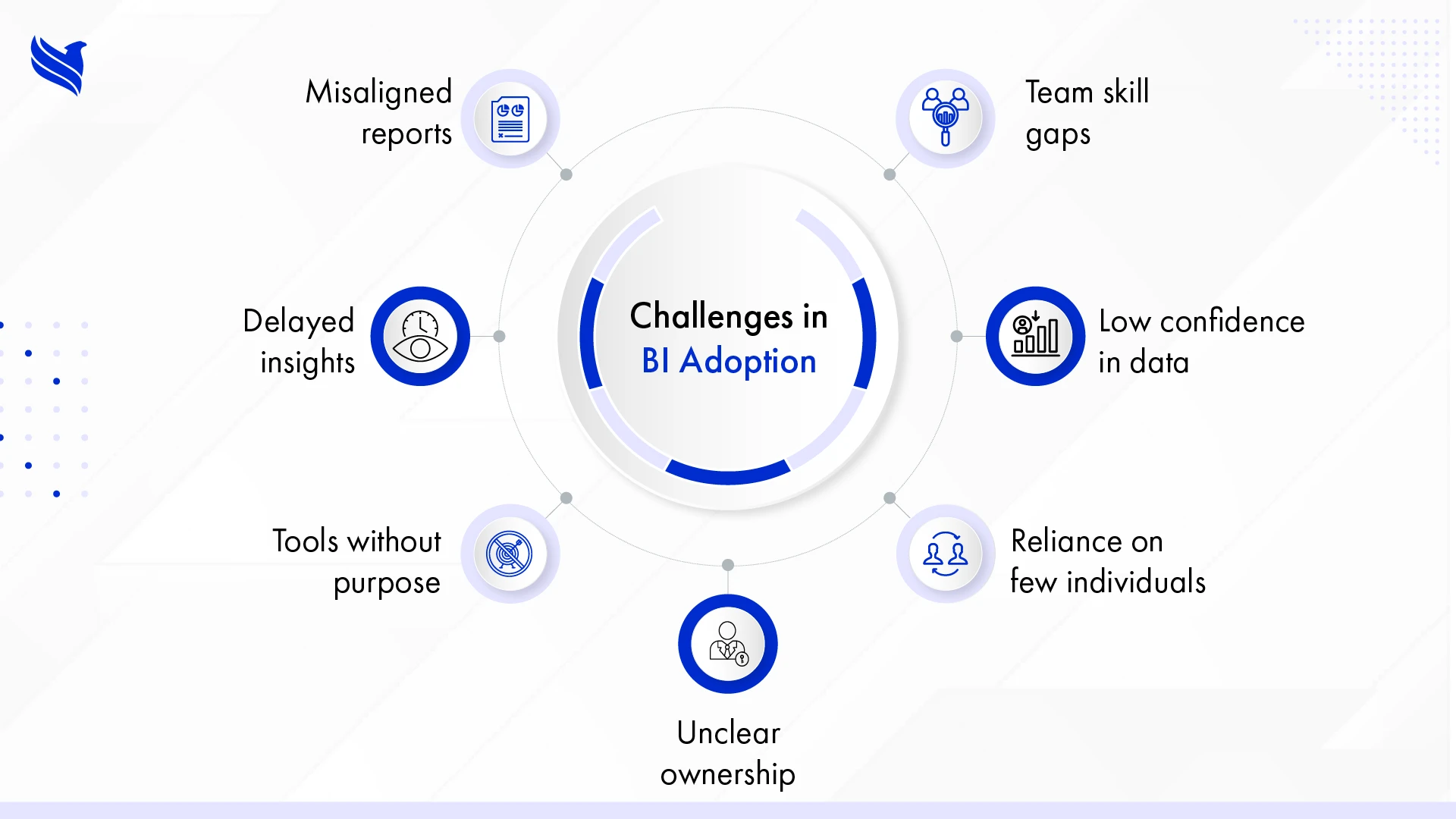
- Too many reports, too little alignment
Different teams build their own views of performance. Sales tracks growth one way. Finance tracks it another. Operations uses a third version. None are wrong, but none fully match. Time is spent reconciling differences instead of acting on insights. - Delayed insight
Reports often arrive after the moment to respond has passed. By the time a trend appears in a monthly review, the underlying issue has already shaped results. Speed matters, and traditional BI cycles often move too slowly. - Tools before purpose
New platforms are introduced with high expectations, but without clear questions to answer. Dashboards get filled because space exists, not because information is needed. Over time, users stop checking them altogether. - Unclear ownership
Data accuracy, report updates, and metric definitions lack a single owner. When numbers look off, responsibility is spread thin. Fixes wait. Trust erodes. - Dependence on a few individuals
Knowledge about data sources and reports often sits with one or two people. When they are unavailable, progress stalls. Business intelligence becomes fragile instead of reliable. - Low confidence in outputs
When figures change from one report to another, teams stop relying on them. Experience and intuition quietly replace analytics, even when data exists. - Skill gaps inside teams
Understanding data requires more than technical ability. It requires business judgment. Many teams lack the time or support to develop this balance, especially when BI is treated as an add-on task.
These Current challenges in BI and analytics explain why organizations revisit their approach. The question What are the benefits of business intelligence and analytics only has meaning when these barriers are addressed. For many, external Business Intelligence Services help establish structure, consistency, and accountability; elements that internal efforts struggle to sustain over time.
What are the benefits of business intelligence and analytics?
Discussions around BI often get stuck on tools. Platforms, dashboards, integrations. None of those matter unless they change how decisions are made. The real benefits of business intelligence and analytics show up quietly—in fewer debates, faster responses, and better use of time. Below are the benefits that consistently make a difference when BI is done with intent.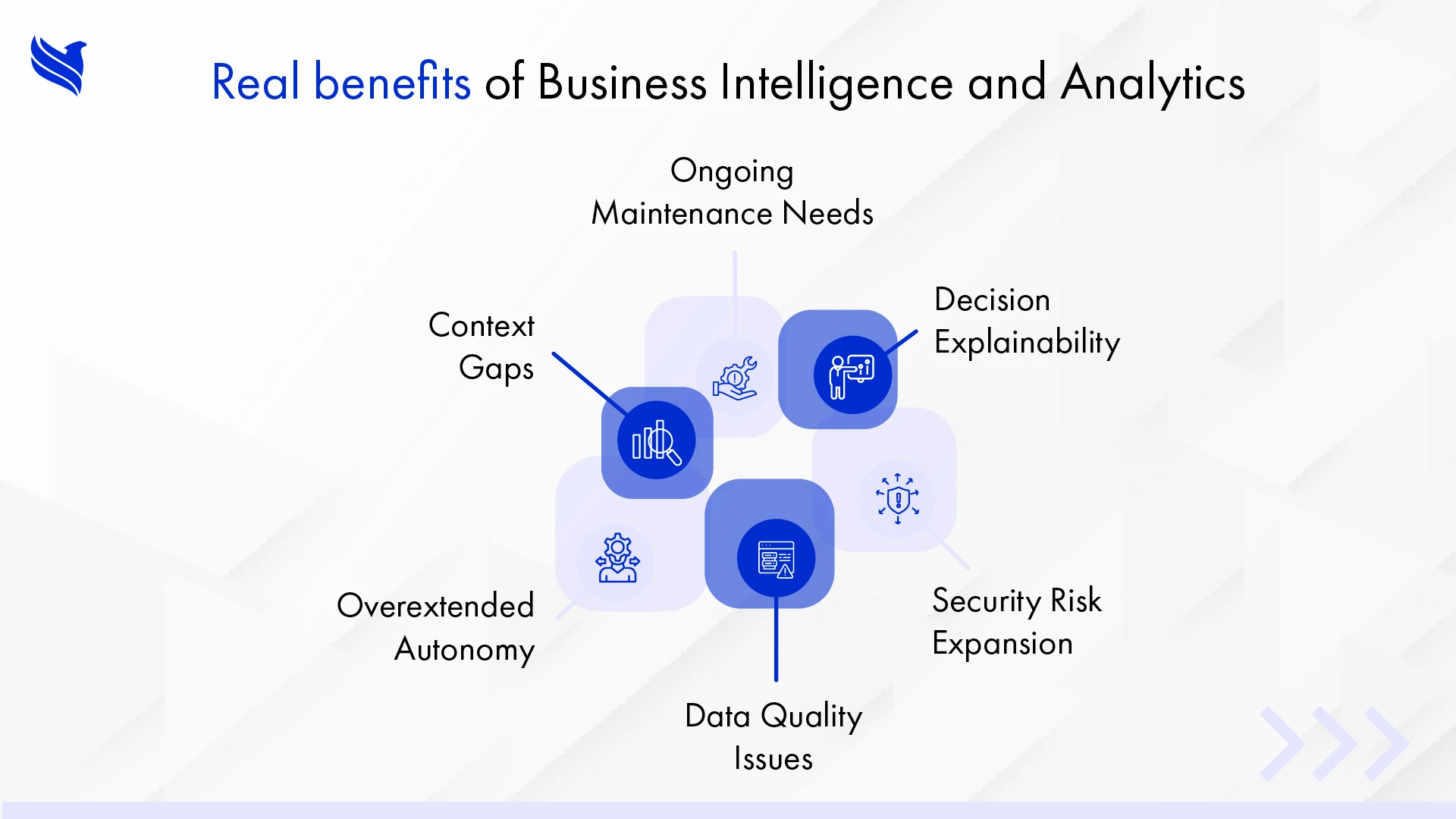
- Clear alignment on performance
Different teams often measure success differently. Sales may focus on growth, finance on margins, operations on efficiency. Business intelligence brings these views into a shared frame. Numbers still vary by function, but definitions stay consistent. Conversations shift from whose data is correct to what should happen next. - Faster responses to change
When insight arrives close to real time, action follows sooner. Issues are spotted earlier. Trends are addressed before they harden into results. This speed does not come from more reports, but from fewer, better ones, built around questions that matter. - Better decisions at every level
Business intelligence is no longer limited to executive dashboards. When designed properly, it supports managers and frontline leaders as well. Decisions stop bottlenecking at the top. Accountability spreads, backed by data people understand and trust. - Reduced dependence on instinct alone
Experience remains valuable, but it no longer works in isolation. Business intelligence and analytics add context to judgment. Patterns emerge that instinct alone might miss. Assumptions are tested, not just repeated. Over time, this balance improves consistency in decision-making. - More confidence in numbers
Trust grows when reports stay consistent, definitions are clear, and data sources are known. When people believe the numbers, they use them. When they use them, BI becomes part of daily work instead of an occasional reference. - Stronger foundation for growth
As organizations scale, informal knowledge breaks down. What once lived in conversations needs structure. Business intelligence provides that structure, allowing growth without losing control or clarity.
The benefits of business intelligence and analytics rarely announce themselves loudly. They show up as smoother meetings, fewer surprises, and decisions that age better over time. When intelligence becomes reliable, work becomes steadier.
This is also where many teams recognize the value of external support. Business Intelligence Services and outsourcing models help maintain this discipline when internal capacity is limited. The benefit is not outsourcing itself—it is consistency, focus, and sustained value from data.
Why business intelligence is indispensable right now?
Decisions today are made under pressure. Markets move quickly. Costs rise without warning. Customer behavior changes before teams notice the shift. In this environment, relying on delayed reports or gut feeling is no longer enough. Business intelligence and analytics have moved from “nice to have” to necessary because timing now shapes outcomes.
Many organizations already collect large volumes of data, yet clarity remains scarce. Leaders are expected to act with confidence while signals arrive late, incomplete, or inconsistent. Business intelligence brings order to that confusion. It does not promise perfect answers. It offers something more practical: reliable visibility into what is actually happening across the business, right now.
There is also a growing gap between operational activity and leadership awareness. Frontline teams see problems early. Executives often see them weeks later. Business intelligence closes that gap by turning daily activity into shared, accessible information. When numbers are current and trusted, conversations change. Less time is spent validating data. More time is spent deciding next steps.
External pressure adds another layer. Investors ask sharper questions. Regulators expect accuracy. Customers notice delays and errors faster than before. Without structured intelligence, responses become reactive. With it, organizations gain the ability to explain performance, defend decisions, and adjust course without panic.
Perhaps most importantly, business intelligence creates consistency in uncertain times. When everyone works from the same facts, alignment improves. Priorities become clearer. Trade-offs are made with awareness, not assumption. In a business climate defined by speed and scrutiny, that consistency is no longer optional.
Strategies for effective business intelligence
Building an effective business intelligence framework is not just about installing tools or creating dashboards. The real challenge lies in connecting data to action. Organizations that succeed don’t chase the latest platforms—they define clear goals, understand what matters most, and make intelligence part of daily work.
- Start with questions, not reports
The best strategies begin by asking what decisions need support. Too often, BI teams generate charts simply because they can. Instead, the focus should be on identifying critical questions: What drives sales this quarter? Which customers are at risk? Which operations are slowing growth? Defining purpose before tools ensures every report adds value. - Centralize and standardize data
A scattered data landscape is a common stumbling block. Teams often pull numbers from different systems, creating conflicting views of performance. A strategy that unifies sources, standardizes definitions, and maintains a single “version of truth” reduces confusion. It also makes audits and regulatory checks easier. - Integrate analytics into workflows
BI should not exist in isolation. Insights only have value when they influence day-to-day decisions. Successful organizations embed intelligence directly into operations; alerts for anomalies, dashboards within CRM systems, and predictive signals that trigger actions automatically. This bridges the gap between insight and impact. - Balance speed and accuracy
Real-time insights are powerful, but they lose value if reliability suffers. A good strategy prioritizes both timely delivery and data quality. This may mean automating certain reports, validating key metrics before distribution, and clearly communicating any assumptions or limitations. - Empower users across levels
Top-level executives aren’t the only beneficiaries of intelligence. When managers and frontline teams can access relevant insights, decisions become faster and more aligned. Training, intuitive tools, and well-designed dashboards make self-service a reality without overloading IT teams. - Monitor, iterate, and refine
Business intelligence is never “done.” Markets change, processes evolve, and new data streams appear. A sustainable strategy includes regular reviews of metrics, feedback loops from users, and continuous refinement. Organizations that treat BI as static risk irrelevance; those that adapt maintain relevance.
Ultimately, the most effective strategies transform intelligence from a set of tools into a decision-making partner. They are practical, flexible, and rooted in real-world needs, not just technological possibilities.
Best practices for business intelligence implementation
Even with the right strategy, execution determines whether BI delivers value or creates noise. Best practices are the subtle habits that separate dashboards people glance at from dashboards people rely on.
- Define clear metrics
Metrics must be meaningful, measurable, and linked to business goals. Avoid vanity numbers; focus on KPIs that drive decisions. Clarity in definitions prevents debates over numbers and fosters trust across teams. - Ensure data quality at the source
Garbage in, garbage out is a familiar phrase for a reason. Validating data where it originates, automating error checks, and keeping sources up to date prevents unnecessary firefighting downstream. - Foster data literacy
Even the most elegant dashboards fail if users cannot interpret them. Training programs, workshops, and bite-sized guides improve understanding. Teams gain the confidence to ask questions, challenge assumptions, and act on insights without hesitation. - Prioritize accessibility over complexity
Complexity may impress, but it rarely helps. Dashboards should communicate rather than overwhelm. Visualizations need to highlight trends and anomalies quickly. Accessibility means non-technical users can engage without constant support. - Promote accountability and ownership
Every report, every metric, every data source should have an accountable owner. Assigning responsibility prevents finger-pointing and ensures issues are resolved promptly. This practice builds a culture of reliability and trust. - Integrate feedback loops
Users are the ultimate test of BI effectiveness. Collect regular feedback to understand whether dashboards answer the right questions, workflows are supported, and insights are actionable. Iterative improvements keep the system relevant. - Leverage automation wisely
Automation saves time, but it must be purposeful. Automated alerts, data updates, and report generation reduce manual work, but they should not replace thoughtful analysis. Automation should free teams to focus on interpretation, not routine tasks. - Document assumptions and processes
Transparency reduces confusion. Documenting how metrics are calculated, where data comes from, and any known limitations prevents misinterpretation. Over time, this documentation becomes invaluable for onboarding and audits.
Adopting these practices turns BI from a toolset into a system people trust. When dashboards are reliable, accessible, and well-structured, teams stop debating numbers and start making informed decisions.
Trends and market developments in business intelligence
Business intelligence is evolving rapidly, shaped by technology, business needs, and cultural shifts. Companies that notice these developments early gain a competitive edge.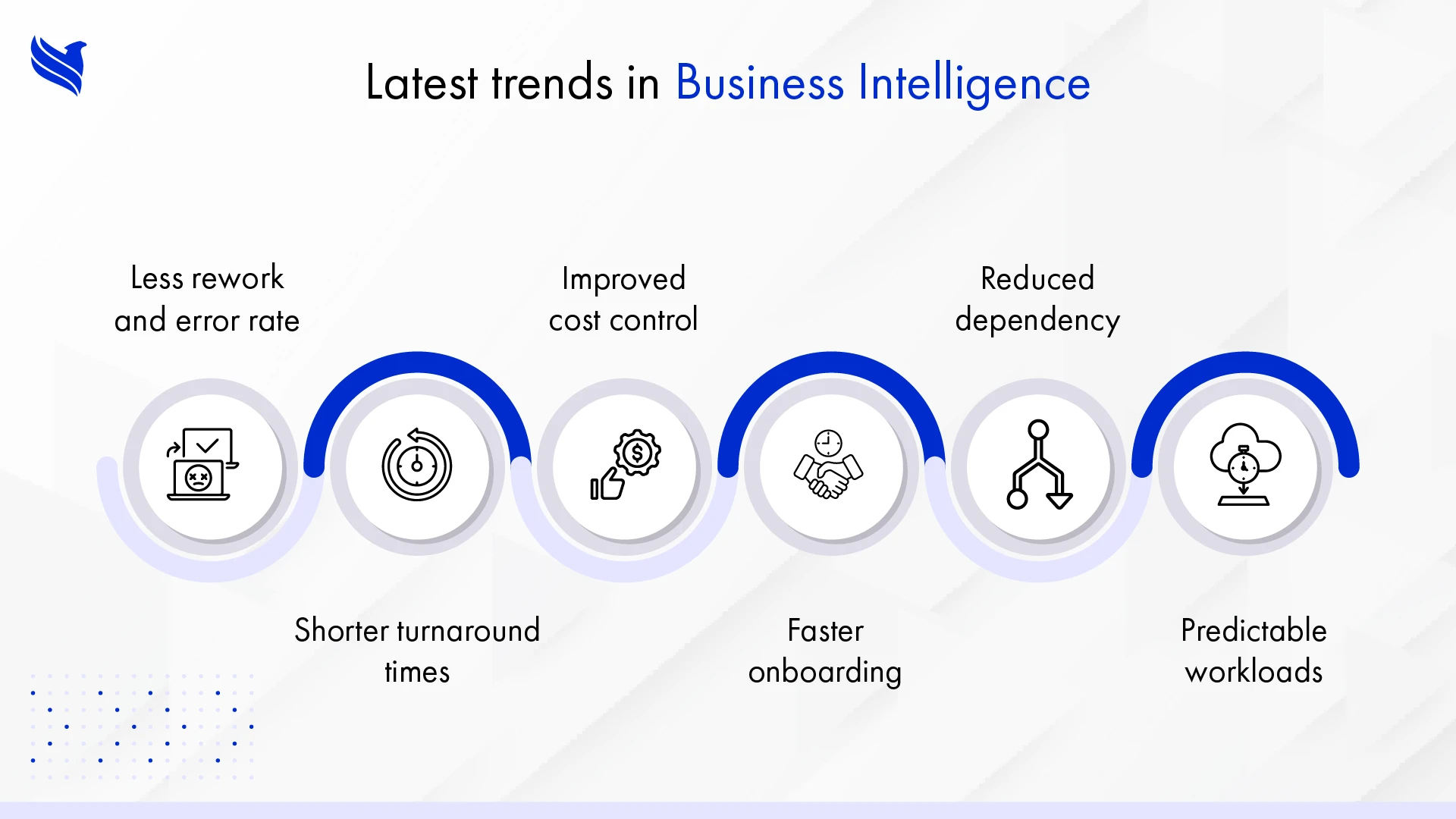
1. Cloud adoption
More organizations are moving BI platforms to the cloud. Hosting analytics in the cloud reduces infrastructure burdens, speeds deployment, and scales easily as data volumes grow. Teams can focus on insight rather than maintenance.
2. Real-time data availability
Traditional reporting cycles are giving way to continuous updates. Real-time data allows businesses to react immediately to changes; whether spotting supply chain disruptions, monitoring sales trends, or identifying customer issues as they emerge.
3. Self-service analytics
Empowering non-technical users is becoming a priority. Tools that allow employees to generate their own reports increase adoption and reduce bottlenecks. The focus is on usability, not technical sophistication.
4. Data literacy focus
Tools alone are insufficient. Organizations now invest in training employees to understand metrics, recognize data limitations, and apply insights effectively. Data literacy is the bridge between raw information and actionable intelligence.
5. Outsourcing BI functions
External experts increasingly handle dashboards, reporting, and data integration. This approach allows internal teams to focus on decision-making and strategy rather than managing infrastructure. Outsourcing also introduces fresh perspectives and specialized skills.
6. AI-assisted analytics
While not a replacement for human judgment, AI tools support pattern recognition, predictive insights, and anomaly detection. The key is using AI to augment, not replace, human decision-making.
The current BI landscape is defined by speed, accessibility, and practicality. Organizations that adopt cloud-first solutions, empower users, and maintain high data literacy will extract more value from their data. Business intelligence is no longer a back-office function; it is a core enabler of agile, informed decision-making.
Where to begin with business intelligence
Starting a Business Intelligence initiative can feel overwhelming. Data exists in multiple systems, teams have differing priorities, and the temptation to dive straight into tools is strong. The best approach begins with clarity on purpose. Ask what decisions need support, which processes generate the most friction, and which outcomes matter most to the organization.
Next, take stock of existing data. Identify sources, assess quality, and understand who owns what. This step uncovers gaps, redundancies, and potential quick wins. It also ensures that future BI efforts don’t start from scratch.
From there, prioritize high-impact areas. Focus on a few critical questions rather than trying to answer everything at once. Early wins, faster reporting, clearer insights, or reduced manual work, build trust and demonstrate the value of BI.
Finally, consider the team and skills required. Assign accountability, empower key users, and establish governance from the outset. Starting small, but with purpose, ensures that BI evolves as a reliable partner in decision-making rather than a collection of unused dashboards.
Choosing the right BI and analytics software
Selecting the right Business Intelligence software is about more than features; it’s about alignment with your organization’s goals, workflows, and culture. Start by defining the problems you want to solve. Are you seeking faster reporting, predictive analytics, better visualization, or self-service capabilities for teams? Clear objectives help narrow options before evaluating technical specifications.
Next, assess integration capabilities. Your BI platform should connect seamlessly with existing data sources; CRMs, ERPs, and operational systems; without requiring extensive manual preparation. Platforms that support a “single source of truth” reduce reconciliation efforts and ensure consistent reporting across teams.
Ease of use is equally critical. A tool that is technically powerful but inaccessible to non-technical staff limits adoption. Look for intuitive dashboards, drag-and-drop functionality, pre-built templates, and self-service analytics. Training resources, user communities, and vendor support play a role in accelerating adoption.
Scalability and performance matter as well. Consider data volume, query speed, and the ability to add users or integrate new data streams over time. Cloud-based solutions often offer flexible scaling with lower infrastructure overhead.
Security, governance, and compliance cannot be overlooked. Ensure the platform provides role-based access, audit trails, encryption, and support for regulatory requirements relevant to your business.
Finally, evaluate vendor reliability and cost. Compare licensing models, total cost of ownership, and long-term support options. Request demos, pilot trials, or proof-of-concept implementations to see how the software performs with your data. The best BI software balances power, accessibility, and governance while supporting decision-making across the organization.
How outsourcing business intelligence can drive value
Outsourcing Business Intelligence functions provides a practical path to consistent, high-quality insights without overloading internal teams. External BI partners bring specialized expertise, established processes, and tools that accelerate deployment. They help organizations standardize metrics, unify data sources, and maintain reporting accuracy, tasks that often strain internal resources.
Outsourcing also offers scalability. Teams can expand analytics capabilities quickly to accommodate growth, seasonal spikes, or complex projects without hiring new full-time staff. This flexibility allows internal teams to focus on strategy and decision-making rather than infrastructure maintenance or troubleshooting.
Beyond efficiency, outsourcing introduces an external perspective. Experienced BI providers can identify opportunities for optimization, suggest best practices, and implement frameworks that internal teams might overlook. Over time, this ensures BI delivers sustained value, improves confidence in numbers, and reinforces data-driven decision-making across the organization.
From insight to impact: Making data work for you
In today’s fast-paced business environment, data alone is not enough. Organizations face challenges like scattered reports, delayed insights, and low confidence in numbers. Business Intelligence and Analytics bridge this gap, transforming raw data into actionable insights, supporting faster, better, and more aligned decision-making across all levels. From defining clear metrics and standardizing data to embedding analytics into daily workflows, effective BI strategies foster trust, reduce reliance on instinct, and create a stronger foundation for growth.
Emerging trends such as cloud adoption, AI-assisted analytics, and self-service platforms are accelerating this transformation, while outsourcing can provide expertise, scalability, and consistent value. Starting with purpose, choosing the right software, and following best practices ensures BI evolves from a back-office function into a strategic partner.
Take the first step toward smarter, data-driven decisions with FBSPL, your partner in Business Intelligence and Analytics.


Bhavishya Bharadwaj
Bhavishya Bharadwaj is the Digital Marketing Manager at FBSPL, bringing over a decade of experience across insurance, outsourcing, accounting, and digital transformation.
Frequently Asked Questions
BI explains current performance; Analytics uncovers reasons and predicts future outcomes.

.png&w=3840&q=75)