



How to leverage insurance back-office outsourcing for growth?
13 MIN READ/Feb 19, 2026

Summary: Growing agencies often struggle with operational strain, compliance complexity, and staffing shortages. This guide explains how insurance back-office outsourcing transforms insurance back-office operations into scalable growth engines through digitization, process optimization, technology enablement, and strategic operational modernization.
A comprehensive guide to transforming insurance back-office operations into scalable, technology-enabled growth engines through strategic outsourcing partnerships.
Is your agency growing, or is it just getting busier?
Many insurance agencies increase revenue year after year, yet internally they feel stretched. Rising policy volumes, renewal workload pressure, and expanding documentation requirements create operational strain. Compliance risks intensify as regulations evolve, while talent shortages make it harder to hire experienced staff quickly.
Growth should create momentum, not bottlenecks.
As producers bring in new business, insurance back-office operations must process endorsements, prepare renewals, issue certificates, and maintain documentation accuracy. When insurance back-office support cannot scale at the same pace as revenue, delays and errors begin to surface.
This is why insurance back-office outsourcing must be viewed as a structured growth lever, not merely a cost-control tactic. By modernizing core operations and strengthening capacity, agencies create sustainable scalability.
In this blog, we explore how insurance back-office outsourcing services drive scalable, profitable growth.
What is insurance back-office outsourcing?
Insurance back-office outsourcing refers to delegating structured operational tasks within insurance back-office functions to specialized external teams. These tasks support the core operations of an agency while allowing internal staff to focus on client relationships and revenue generation.
Typical insurance back-office services include policy checking, endorsement processing, renewal documentation preparation, data entry, compliance tracking, quoting assistance, reporting, and accounting reconciliation. Each back-office insurance process directly affects turnaround times, accuracy, and compliance confidence.
Unlike generic outsourcing, insurance back-office management services require domain expertise, system knowledge, and regulatory familiarity. The objective is not simply task delegation; it is operational modernization.
Through insurance agency back-office outsourcing and Digitized Insurance Back-office Solutions, agencies Digitize Your Back-office, increase consistency, and build scalable insurance back-office operations that support long-term growth without proportional headcount expansion.
Challenges in insurance back-office operations
As agencies grow, insurance back-office operations become increasingly complex. What once worked for a smaller book of business often begins to strain under higher policy volumes and tighter renewal cycles. Without structured systems, operational pressure builds quietly; and growth starts to stall.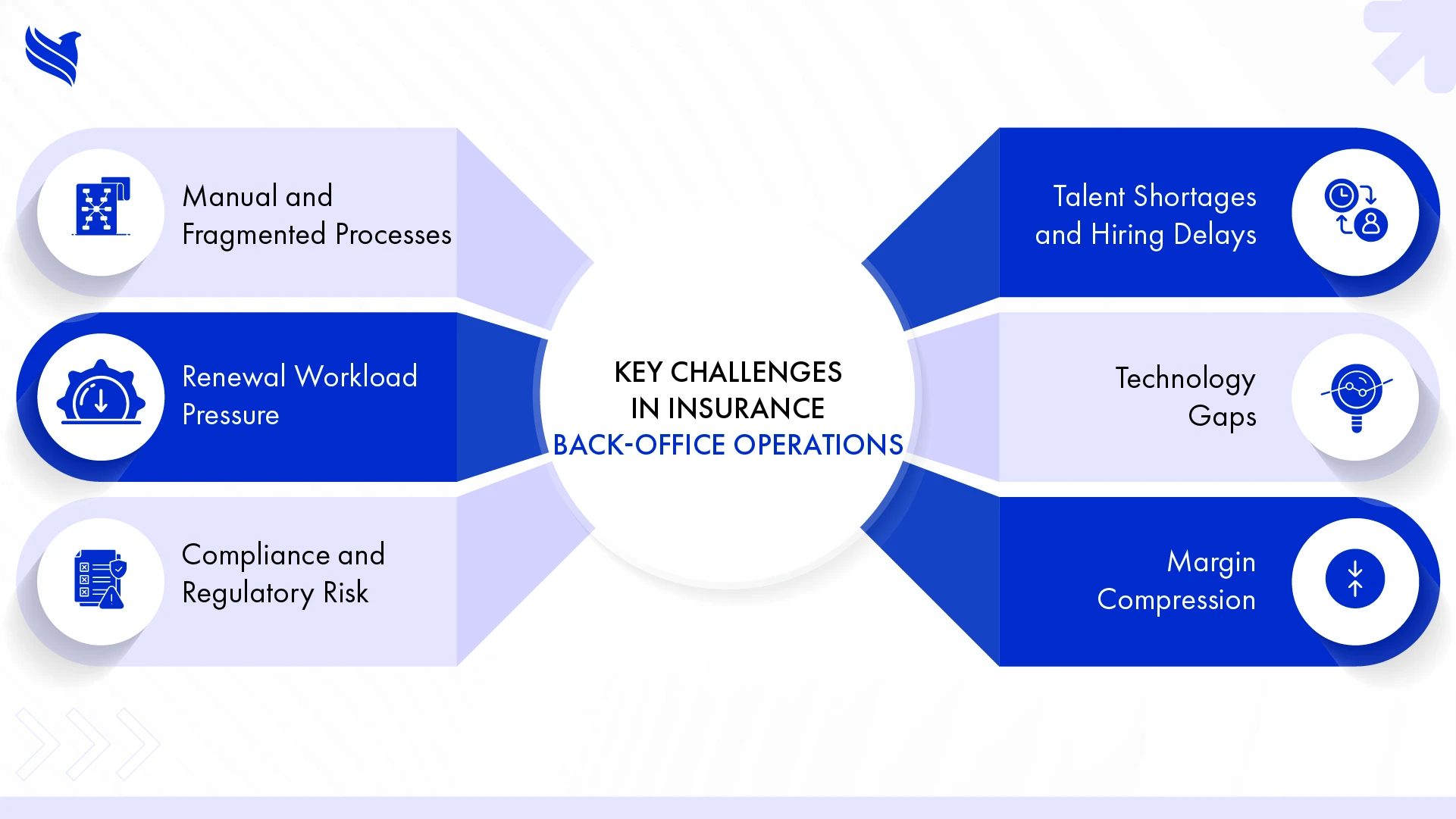
1. Manual and fragmented processes
Many agencies still rely on spreadsheets, emails, and manual document review for core back-office insurance process activities. Policy checking, endorsements, and renewal comparisons consume hours of repetitive work. Manual workflows increase the risk of oversight, slow turnaround times, and create inconsistencies in documentation standards.
2. Renewal workload pressure
Renewal seasons can overwhelm internal teams. As policy counts grow, account managers and support staff must prepare documentation, verify changes, coordinate with carriers, and ensure compliance; often simultaneously. Without scalable insurance back-office support, service quality may decline during peak cycles.
3. Compliance and regulatory risk
Insurance is highly regulated. Missing documentation, incorrect policy details, or delayed updates can expose agencies to E&O claims and audit findings. As operations expand across states or product lines, compliance complexity multiplies. Managing this internally without structured insurance back-office management services increases exposure.
4. Talent shortages and hiring delays
Experienced processing staff with insurance system knowledge are difficult to recruit. Hiring cycles are slow, onboarding takes time, and training costs add up. Insurance agency back-office outsourcing becomes attractive when internal hiring cannot keep pace with growth demands.
5. Technology gaps
Agencies often invest in front-end sales tools but neglect back-end infrastructure. Without Digitized Insurance Back-office Solutions, documentation remains siloed, workflows remain reactive, and performance metrics lack visibility. Failing to modernize back-office functions limits scalability.
6. Margin compression
As operational costs increase; salaries, benefits, system upgrades; profit margins shrink. Without efficiency improvements, revenue growth does not translate into proportional profitability.
These challenges do not signal poor management. They are natural consequences of growth without operational modernization. However, ignoring them prevents agencies from fully leveraging their potential.
Insurance Outsourcing Services address these structural challenges by introducing standardized workflows, scalable staffing models, quality control checkpoints, and digital process integration; transforming insurance back-office operations from a bottleneck into a strategic asset.
Benefits of insurance back-office outsourcing
When implemented strategically, insurance back-office outsourcing delivers measurable operational and financial advantages.
- Operational scalability
Insurance back-office outsourcing enables agencies to handle rising policy volumes without proportionally increasing internal headcount. Structured workflows and trained teams ensure consistent output even during peak renewal seasons. - Improved accuracy and compliance
Dedicated insurance back-office management services incorporate quality assurance checks and documentation controls. This reduces compliance risks and strengthens audit readiness across core operations. - Cost optimization and margin growth
Insurance agency back-office outsourcing converts fixed staffing costs into flexible operational models. Agencies pay for capacity as needed, improving margin stability while maintaining service quality. - Faster turnaround times
With standardized processes and specialized insurance back-office support teams, endorsements, renewals, and policy reviews move faster. Producers and account managers gain more time for revenue-generating activities. Operational modernization
By adopting Digitized Insurance Back-office Solutions, agencies Digitize Your Back-office and align workflows with modern performance standards. Data visibility improves, reporting becomes more structured, and process efficiency increases.
Ultimately, insurance back-office services become a growth enabler rather than an administrative burden. When combined with strategic planning, outsourcing transforms operational complexity into competitive advantage; supporting long-term, sustainable expansion.
Signs your agency is ready for insurance back-office outsourcing
Not every agency needs outsourcing immediately. However, certain operational signals clearly indicate readiness for insurance back-office outsourcing.
Use the checklist below to assess whether your agency has outgrown its current operational model.
- Renewals falling behind
If renewal preparation consistently runs late, documentation reviews are rushed, or carrier follow-ups are delayed, your insurance back-office operations may be operating beyond sustainable capacity. Delayed renewals directly impact client retention and revenue continuity. - Increasing E&O exposure
Frequent documentation errors, missed endorsements, or compliance gaps signal structural weaknesses in back-office insurance process management. Rising E&O concerns indicate that quality control frameworks need strengthening; often through specialized insurance back-office management services. - Frequent rework
If files are repeatedly corrected, data is re-entered multiple times, or policy discrepancies are discovered after issuance, inefficiencies exist in workflow design. High rework rates reduce productivity and inflate operational costs. - High overtime costs
Consistent overtime during peak seasons reflects staffing imbalance. Instead of scaling internal teams reactively, insurance agency back-office outsourcing provides elastic capacity. This reduces burnout and stabilizes labor expenses. - Growth plateau despite strong sales
If producers continue generating business but operational bottlenecks slow onboarding or renewal processing, revenue growth may plateau. Insurance back-office support should enable growth; not restrict it.
Additional indicators may include:
- Difficulty implementing Digitized Insurance Back-office Solutions internally
- Limited reporting visibility into operational performance
- Rising administrative costs without proportional revenue increase
- Compliance audits requiring extensive manual preparation
Recognizing these signs early allows agencies to proactively Digitize Your Back-office and modernize back-office functions before operational strain impacts client relationships.
Insurance Outsourcing Services are most effective when adopted strategically; not reactively. When implemented at the right stage, they transform insurance back-office operations into scalable infrastructure capable of supporting long-term expansion and margin growth.
Core areas you can outsource
Insurance back-office outsourcing is most effective when applied to structured, repeatable insurance back-office operations that directly impact accuracy, compliance, and turnaround time. Below are the core areas where agencies typically gain the highest operational value.
a) Policy lifecycle management
Policy lifecycle management is one of the most critical back-office insurance process segments.
- New business processing
Outsourced insurance back-office support teams handle data entry, documentation verification, carrier coordination, and system updates. This ensures smooth onboarding while reducing internal administrative strain. - Endorsements
Processing endorsements accurately and promptly is essential for compliance and client satisfaction. Insurance back-office services streamline endorsement validation, documentation updates, and carrier communication. - Cancellations
Managing cancellations requires proper documentation, system updates, and financial reconciliation. Structured insurance back-office management services ensure cancellations are processed accurately and tracked correctly. - Policy checking
Policy comparison and verification protect agencies from E&O exposure. Outsourced teams apply standardized quality control frameworks to validate limits, deductibles, endorsements, and exclusions. Combined with Digitized Insurance Back-office Solutions, this reduces manual errors and improves consistency.
b) Insurance accounting & reconciliation
Financial accuracy within insurance back-office operations is critical for profitability and compliance.
- Direct bill reconciliation
Outsourced specialists reconcile carrier statements against agency records, reducing discrepancies and improving financial clarity. - Agency bill processing
Processing agency-billed accounts requires accurate invoicing, payment tracking, and reporting. Insurance Outsourcing Services ensure billing cycles remain structured and transparent. - Commission tracking
Monitoring commission statements and reconciling them accurately protects revenue integrity. Dedicated insurance back-office support teams create structured tracking systems to reduce leakage.
c) Claims administration support
Claims activity directly influences client trust and retention.
- FNOL documentation
First notice of loss documentation must be accurate and complete. Outsourcing ensures claims are logged systematically and transmitted promptly. - Claims tracking
Insurance agency back-office outsourcing provides structured follow-up systems to monitor claim progress. - Status follow-ups
Consistent follow-ups with carriers reduce delays and improve client communication timelines.
d) Data & reporting support
Data accuracy strengthens operational modernization.
- CRM updates
Maintaining clean data within agency management systems improves reporting and renewal planning. - MIS reporting
Structured reporting enhances leadership visibility into core operations. - Compliance tracking
Tracking documentation, licensing, and regulatory requirements reduces compliance risk.
By outsourcing these core functions, agencies modernize back-office functions while preserving strategic control over growth direction.
Strategic goals that outsourcing can accelerate
Insurance back-office outsourcing should align with broader strategic objectives; not operate in isolation. When implemented correctly, it accelerates multiple agency growth goals.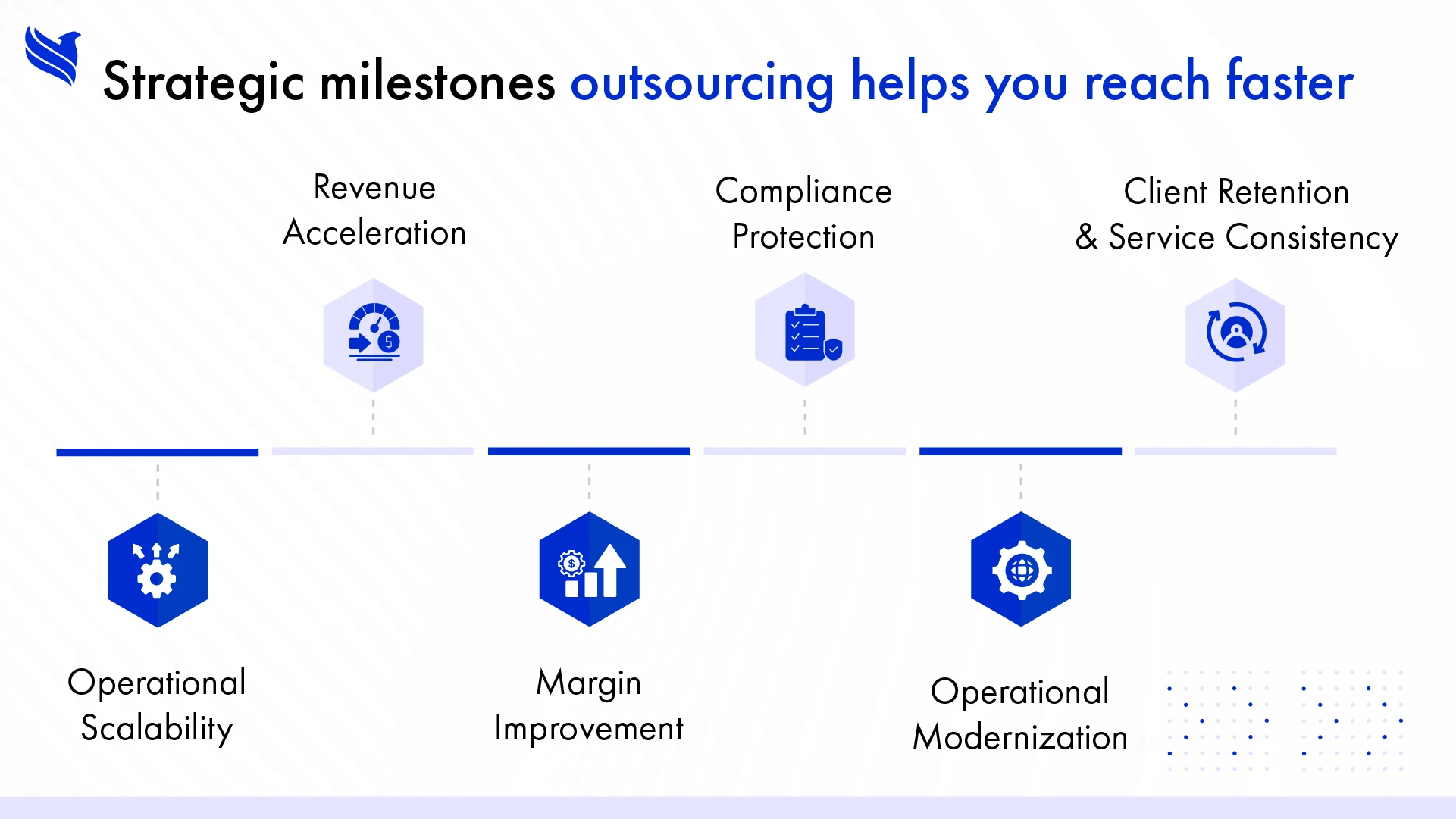
1. Operational scalability
As policy volumes increase, insurance back-office operations must expand efficiently. Outsourcing introduces elastic capacity, allowing agencies to scale without proportional hiring. This supports expansion into new markets or product lines.
2. Revenue acceleration
When producers and licensed staff are freed from administrative overload, they can focus on advisory work and new business development. Insurance back-office support becomes a revenue enabler rather than a cost center.
3. Margin improvement
Insurance outsourcing services convert fixed payroll expenses into flexible operational models. Process efficiency reduces rework and improves cost predictability, strengthening profit margins.
4. Compliance protection
Standardized insurance back-office management services introduce documented workflows, audit trails, and quality checkpoints. This reduces E&O exposure and improves regulatory readiness.
5. Operational modernization
Digitized insurance back-office solutions integrate automation, structured documentation workflows, and performance dashboards. Agencies that Digitize Your Back-office gain better visibility into turnaround times, productivity metrics, and compliance indicators.
6. Client retention & service consistency
Faster endorsements, accurate renewals, and structured claims follow-ups improve client satisfaction. Reliable insurance back-office services support long-term retention and referral growth.
Outsourcing is not merely about delegating tasks. It is about strengthening core operations to align with strategic ambition. Agencies that modernize back-office functions through structured insurance agency back-office outsourcing position themselves for scalable, profitable growth in increasingly competitive markets.
How insurance back-office solutions improve client experience
Client experience in insurance is deeply influenced by operational efficiency. While producers build relationships and offer advisory guidance, insurance back-office operations determine how smoothly services are delivered. Strong insurance back-office support creates consistency, speed, and reliability; the foundations of client trust.
- Faster endorsements
Clients often request mid-term policy changes that require immediate action. When endorsements are delayed due to manual processing or staff overload, dissatisfaction grows. Insurance back-office outsourcing introduces structured workflows and quality checkpoints, ensuring endorsements are processed promptly and accurately. - Reduced turnaround time
Long turnaround times during new business processing or renewals weaken competitive positioning. By modernizing back-office functions and implementing Digitized Insurance Back-office Solutions, agencies accelerate documentation review, data entry, and policy validation. Reduced turnaround time directly enhances perceived professionalism. - Proactive communication support
Insurance back-office services can include structured follow-up systems for renewals, documentation reminders, and carrier coordination. This enables agencies to anticipate client needs instead of reacting to issues. Proactive communication strengthens long-term retention. - Improved SLA adherence
Meeting Service Level Agreements consistently is critical in today’s competitive environment. Insurance back-office management services ensure tasks are tracked against measurable benchmarks. Clear SLAs, defined timelines, and quality standards create predictable service delivery.
Ultimately, when agencies invest in insurance agency back-office outsourcing, they are not only improving internal efficiency; they are enhancing client satisfaction, retention, and referral growth. Operational modernization directly translates into better client experiences.
Modern AI tools transforming insurance back-office operations
Operational modernization in insurance is no longer optional. To truly modernize back-office functions, agencies must combine structured insurance back-office outsourcing with intelligent automation. FBSPL strengthens insurance back-office operations through three AI-powered tools designed specifically for real-world insurance workflows.
1. Policy Checking and Comparison Tool (PolicyOne)
Policy review is one of the most time-consuming tasks within insurance back-office services. PolicyOne is built specifically for personal lines and automates policy checking and comparison with precision.
The tool automatically extracts and structures key policy data; including endorsements, premiums, and coverage limits; in seconds. It enables agents to instantly compare renewal offers against existing policies and automatically flags discrepancies across quotes, providers, or policy versions.
Key Benefits of PolicyOne:
- Extracts policy data in seconds
- Compares across versions or providers
- Highlights mismatches and missing endorsements
- Reduces review time by up to 70%
- Supports multiple formats and carriers
By embedding automation into the back-office insurance process, PolicyOne enhances compliance confidence while producing client-ready outputs. It replaces manual review cycles that once took hours with intelligent validation that takes minutes; without compromising accuracy.
2. Smart Intake Chatbot (PhoenixQ)
PhoenixQ reimagines client onboarding within insurance back-office support frameworks. This AI-powered Smart Intake Chatbot replaces traditional intake forms with a conversational, step-by-step interface.
The tool gathers essential data through contextual prompts and real-time validation. It minimizes incorrect submissions by incorporating intelligent input assistance and automated error detection.
Key Benefits of PhoenixQ:
- Contextual prompts guiding users in real time
- Automated error detection and validation
- Fully customizable, no-code interface
- Seamless integration with AMS or quote engines
By improving intake accuracy, PhoenixQ strengthens data integrity across insurance back-office management services and accelerates quote preparation workflows.
3. AI Proposal Generator (ProposalOne)
ProposalOne eliminates delays in preparing multi-carrier insurance proposals. Built on an AI-first approach, it reads, extracts, compares, and formats quote data from multiple documents automatically.
Within seconds, it generates a polished, branded, client-ready proposal.
Key Benefits of ProposalOne:
- Extracts quote data from multiple formats
- Highlights premium, coverage, and term differences
- Enables side-by-side comparisons
- Generates editable branded drafts
- Delivers final proposal PDF in under 30 seconds
Together, PolicyOne, PhoenixQ, and ProposalOne represent Digitized Insurance Back-office Solutions that allow agencies to Digitize Your Back-office strategically. By combining AI tools with insurance back-office outsourcing, agencies build scalable, efficient, and future-ready core operations.
Transforming insurance back-office operations into a scalable growth engine
Insurance growth should not be limited by operational strain. When insurance back-office operations remain manual, fragmented, or understaffed, scalability becomes unpredictable. Compliance complexity increases, turnaround times slow, and profitability suffers.
Insurance back-office outsourcing offers a structured solution. By strengthening core operations, modernizing back-office functions, and integrating Digitized Insurance Back-office Solutions, agencies build operational resilience. They gain scalability without excessive hiring, improve compliance control, and enhance client satisfaction.
Technology platforms like PolicyOne, ProposalOne, and PhoenixQ further elevate this transformation by embedding automation and intelligence into daily workflows.
If your agency is ready to shift from reactive workload management to strategic operational modernization, partnering with FBSPL for insurance back-office outsourcing and comprehensive Insurance Outsourcing Services can help you build a scalable, compliant, and growth-ready future.


Bhavishya Bharadwaj
Bhavishya Bharadwaj is the Digital Marketing Manager at FBSPL, bringing over a decade of experience across insurance, outsourcing, accounting, and digital transformation.
Frequently Asked Questions
Look for insurance expertise, strong SLAs, data security standards, technology integration, and scalable insurance back-office management services.

.png&w=3840&q=75)