9 MIN READ·May 12, 2026·Written by Bhavishya Bharadwaj
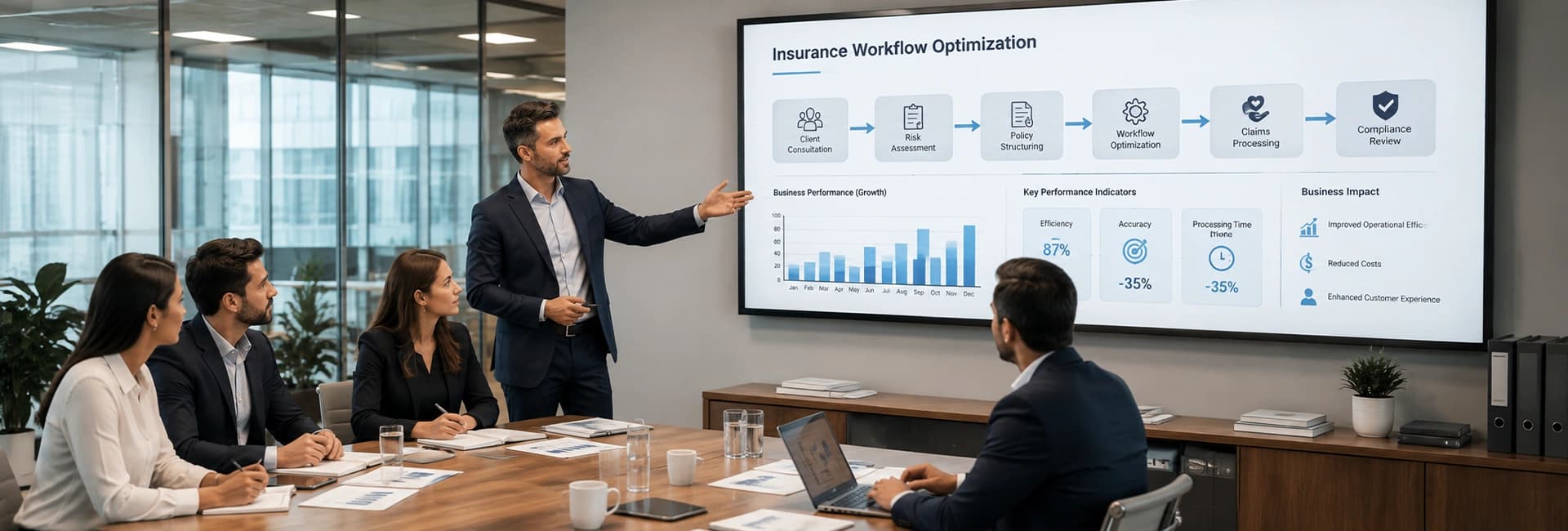
Summary: Insurance consultation goes beyond coverage; it maps, redesigns, and optimizes the workflows that drive operational performance. From claims processing to AI adoption, strategic consulting helps businesses eliminate inefficiencies, reduce costs, and build scalable operations that grow without breaking.
You've invested in software. You've hired good people. Yet your operations still feel like a traffic jam at rush hour. If that resonates, you're not alone; and the root cause might not be what you think.For many businesses navigating complex commercial operations, the answer isn't more tools. It's the strategic clarity to understand which processes are broken, why they're broken, and how to fix them in a way that scales. That's precisely where insurance consultation, paired with workflow optimization, becomes a competitive differentiator rather than an administrative checkbox.
This blog breaks down the real role expert insurance consulting services play in transforming operational efficiency, why workflow mapping is no longer optional, and what it takes to build an operation that runs with both speed and precision.
Before discussing solutions, it's worth examining the scale of the problem.
According to McKinsey & Company's Insurance Productivity 2030 report, insurance carriers have an opportunity to improve productivity and reduce operational expenses by up to 40% over the next decade; but only through comprehensive, structural transformation of their operating models, not piecemeal attempts at improvement. That opportunity is sitting largely uncaptured across most organizations today.
But inefficiency isn't just a time problem; it compounds. Manual processes introduce human error, errors create compliance risk, compliance risk requires rework, and rework delays client delivery. Every inefficient handoff between departments is a compounding tax on your organization's capacity to grow.
This is where a commercial insurance consultant shifts the conversation from "we need better software" to "we need to redesign how work flows across our entire operation."
Insurance consulting is often mischaracterized as a coverage or compliance exercise. In practice, the most valuable insurance consulting services extend far deeper; into operational architecture, process design, and technology alignment.
A competent insurance consulting company doesn't just audit your policies. It maps your current-state workflows, identifies where value leaks, and builds a future-state operating model that aligns people, process, and technology in a coherent system.
Here's what that looks like in practice across core operational areas:
Manual claims handling is one of the most resource-intensive operations in any insurance-reliant business. According to McKinsey & Company, automation can reduce claims processing time by up to 50%; and McKinsey further predicts a potential reduction of 25–30% in loss adjustment expenses through intelligent claims automation. But reaching that level of performance requires more than deploying software. It requires a consultant who understands the underlying decision logic, compliance requirements, and the organizational change management needed to make the transition durable.
A skilled consulting partner will assess your current claims intake, triage, and routing processes; then redesign them with smart escalation rules, SLA enforcement, and audit trails built in from day one.
Underwriting is where risk decisions get made; and where delays are most costly. PwC reports that automated underwriting can reduce underwriting costs by up to 30%, while McKinsey projects that by 2030, more than 90% of pricing and underwriting tasks for individual and small business policies will be fully automated. Reaching that level of efficiency, however, requires deliberate workflow mapping before a single line of automation logic is written.
Insurance consulting firms bring the process expertise to define decision trees, data capture standards, and exception-handling protocols that make automation work reliably; not just in controlled demos, but in production environments with real complexity.
Regulatory complexity continues to escalate. Every workflow that touches policy issuance, renewals, or compliance documentation must be designed with auditability in mind. Insurance consulting services help organizations establish standardized, defensible workflows that not only pass audits but proactively reduce exposure. According to Deloitte's 2025 Global Insurance Outlook, claims automation alone could reduce operational costs by up to 30%, with advanced technology capabilities forming the foundation for improving underwriting accuracy, bolstering claims management, and streamlining operations.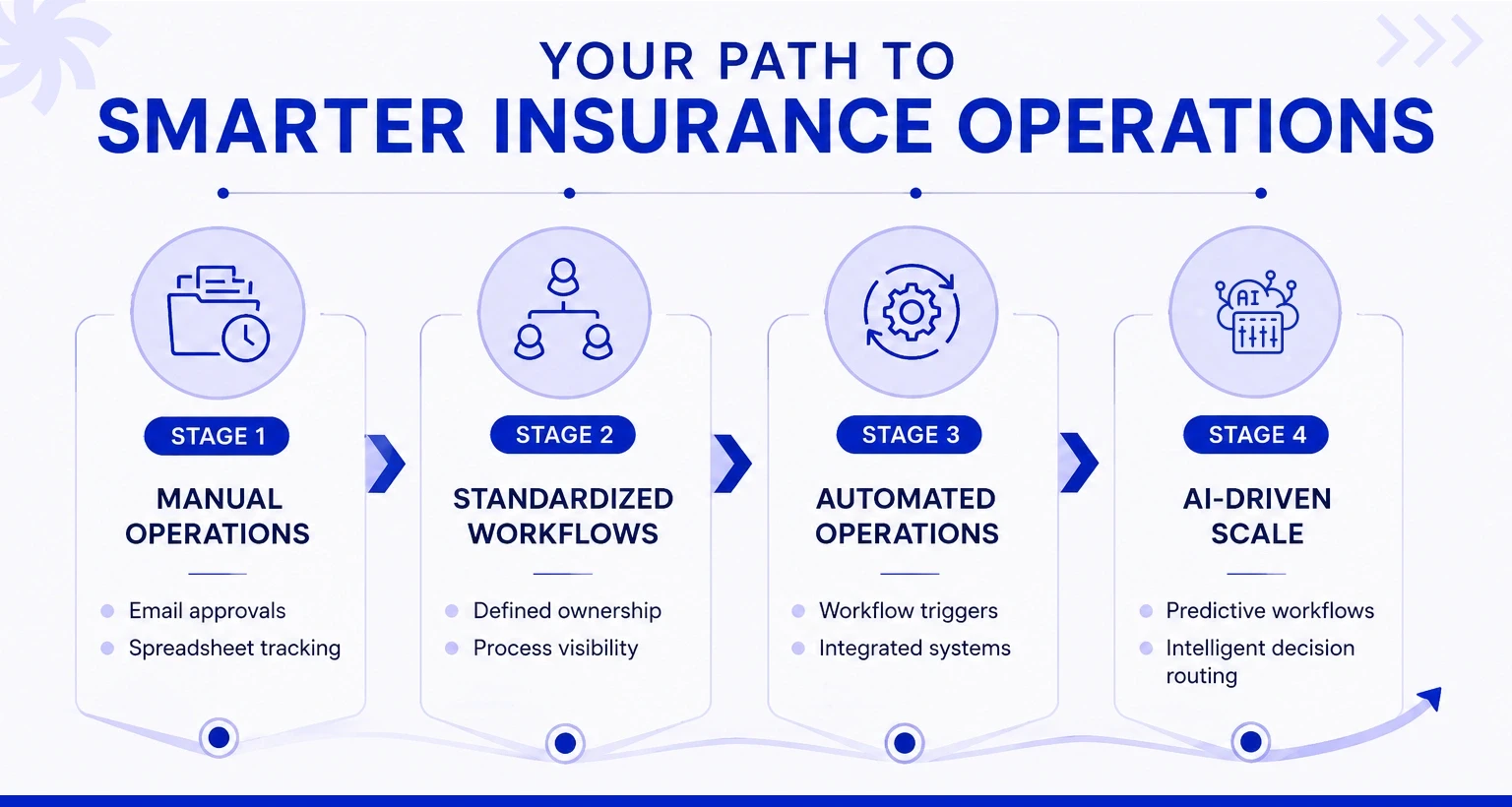
One of the most common mistakes organizations make is investing in automation before completing workflow mapping. The result is a faster version of a broken process.
Workflow mapping; the deliberate documentation and analysis of how work currently moves through an organization; is the diagnostic prerequisite for any meaningful optimization effort. Process mapping allows organizations to visualize workflows, identify bottlenecks, and assess redundancies. By analyzing these processes, businesses can pinpoint areas for improvement and implement more efficient workflows.
Consider a policy renewal workflow that bounces between account management, underwriting, and client service without a defined handoff protocol. Automating that workflow without mapping it first simply automates the confusion. Workflow mapping reveals the specific failure points; the missing data, the redundant approval steps, the informal workarounds; that automation can then systematically eliminate.
Experienced insurance consulting companies use workflow mapping as the foundation for transformation, not an afterthought. This is what separates a strategic consulting partner from a software vendor: the ability to diagnose before prescribing.
Key areas workflow mapping should cover
The data on AI adoption in insurance signals a widening performance gap between those who invest strategically and those who delay. According to Deloitte's 2025 Global Insurance Outlook, 76% of US insurance executives reported that their organization has already implemented generative AI capabilities in one or more business functions; a figure that has accelerated dramatically over the prior 12 months.
But implementation and transformation are not the same thing. McKinsey's latest research on AI in insurance makes this distinction clearly: the impact of isolated AI use cases is too limited to affect profitability. Transforming an entire operational domain, however, can lift the bottom line by double digits. The gap between the two outcomes is strategic consulting; the capability to redesign entire workflows rather than automate individual tasks in silos.
That gap is exactly where investing in AI and automation consulting pays its highest return. The challenge isn't access to technology. The challenge is building the operational architecture, data governance, and change management framework that allows AI to perform reliably at scale.
An experienced insurance consulting partner brings three capabilities that technology alone cannot provide:
Modern AI tools are also reshaping how businesses handle policy comparison and policy checking; instantly scanning multiple coverage documents, flagging gaps, and surfacing discrepancies that manual review routinely misses. What once took hours of analyst time now completes in minutes, with greater accuracy and a fully auditable output trail.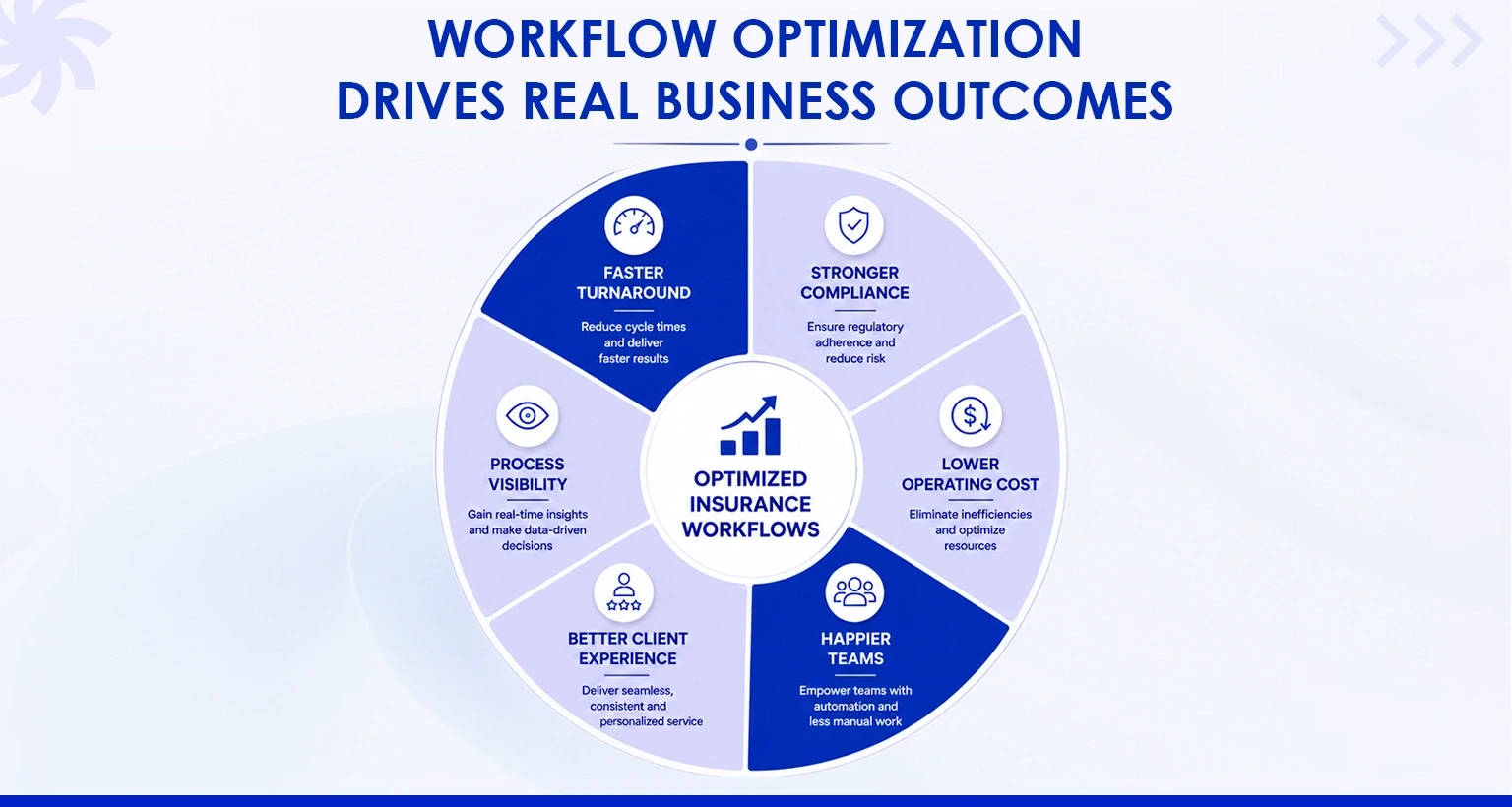
The most effective insurance agency workflow optimization engagements follow a structured methodology that moves from insight to implementation in measurable phases.
Phase 1 — Current-state assessment: Document all critical workflows, identify failure patterns, and quantify the operational cost of inefficiency. This creates the baseline against which all future improvements are measured.
Phase 2 — Future-state design: Redesign workflows around desired outcomes; faster cycle times, fewer errors, stronger compliance, higher client retention; with automation opportunities mapped to specific process steps.
Phase 3 — Technology alignment: Match the workflow design to the right tools. Whether that's an AMS upgrade, RPA deployment, AI-assisted document processing, or CRM integration, the technology selection flows from the workflow; not the other way around.
Phase 4 — Implementation and change management: Execute the transition with clear ownership, training protocols, and escalation paths. This is where most technology projects fail without a consulting partner guiding the process.
Phase 5 — Performance monitoring and optimization: Establish KPIs; cycle time, error rates, client satisfaction, cost per transaction; and build feedback loops that drive continuous improvement.
Studies show that automation-driven workflow optimization can reduce operational costs by up to 30% within five years. But that return is only achievable when the process architecture is sound and the implementation is disciplined.
The insurance operations landscape is undergoing structural change. According to projections from the U.S. Bureau of Labor Statistics, the insurance industry is facing growing workforce pressure driven by retirements, changing skill requirements, and long-term labor market shifts; increasing the need for workflow automation and operational efficiency. The businesses that thrive in that environment will be those that build scalable, technology-enabled operating models now; while the window to do so proactively is still open.
Waiting until inefficiency becomes a crisis is not a strategy. By then, the cost of transformation is higher, the competitive gap is wider, and the organizational appetite for change is lower.
The decision to invest in expert insurance consulting services and workflow optimization isn't a cost; it's an infrastructure decision with compounding returns.
Operational inefficiency doesn't announce itself dramatically. It accumulates quietly; in the hours spent on manual data entry, in the approval loops that slow client delivery, in the compliance gaps that create audit exposure, and in the talented people doing work that should have been automated years ago.
Insurance consultation, done well, addresses all of it. Not by selling software or implementing tools in isolation, but by rebuilding the operational foundation that everything else runs on.
FBSPL partners with organizations as a strategic operational transformation partner; bringing deep expertise in insurance agency workflow optimization, process redesign, AI and automation consulting, and scalable delivery models. Whether you're navigating inefficiencies in your current processes or designing the operating model for your next stage of growth, the conversation starts with a clear-eyed look at how work actually flows through your organization today.
Get the latest insights on insurance operations, policy management, and industry best practices.