



How financial services are investing in technology to transform operations
7 MIN READ/May 04, 2026

Summary: Financial services are rapidly evolving through strategic investments in AI, automation, and integrated technologies. These advancements streamline operations, reduce manual inefficiencies, and improve decision-making. Organizations adopting financial technologies gain scalability, real-time insights, and stronger operational resilience in a competitive landscape.
See how strategic technology investments are transforming financial services into intelligent, scalable, and data-driven operating models.
Financial services are undergoing a structural shift that is no longer incremental; it is foundational. What was once an industry defined by manual workflows, fragmented systems, and compliance-heavy operations is now being reshaped by digital ecosystems, automation, and data intelligence.
Yet, despite significant progress, many organizations still face a persistent gap between technology adoption and operational transformation. Processes remain siloed, reporting cycles are slow, and scaling operations often introduces more complexity instead of efficiency.
This is where strategic investment in technology in financial services becomes critical; not as a cost center, but as a transformation lever.
Modern financial operations are increasingly defined by how effectively organizations deploy financial technologies, integrate automation, and leverage intelligence systems to reduce inefficiencies and improve decision-making speed.
The question is no longer whether to invest in technology, but how strategically it is being deployed to solve real operational constraints.
The shift: From legacy systems to intelligent financial ecosystems
For decades, financial operations relied heavily on legacy infrastructure built for stability rather than agility. While these systems ensured compliance and accuracy, they struggled to keep up with modern demands; real-time reporting, rapid scaling, and cross-functional visibility.
Today, emerging technologies in the financial services industry are redefining that baseline.
These include:
- AI-driven process automation
- Cloud-native financial platforms
- Predictive analytics engines
- Intelligent document processing systems
- API-based ecosystem integrations
This shift is not just technical; it is operational. Financial processes are becoming interconnected, adaptive, and increasingly autonomous.
A Deloitte analysis highlights that financial institutions are accelerating digital transformation initiatives, with a strong focus on operational efficiency, data modernization, and scalable technology adoption as key priorities shaping investment decisions.
This reflects a clear industry direction: modernization is no longer optional—it is structural.
Why finance teams struggle without strategic technology adoption
Despite rapid digital investment, many organizations continue to experience operational friction. The challenge is not access to technology—it is the absence of structured implementation.
Common operational constraints include:
1. Fragmented systems and data silos
Multiple tools across accounting, reporting, and compliance functions often do not communicate effectively, leading to inconsistent data.
2. Manual process dependency
Repetitive workflows such as reconciliation, reporting, and document validation still rely heavily on human intervention.
3. Slow decision cycles
Without real-time data integration, financial decisions are often reactive rather than proactive.
4. Scaling inefficiencies
As operations grow, complexity increases disproportionately, creating bottlenecks in execution.
According to McKinsey, employees in financial operations spend nearly 60% of their time on repetitive tasks that could be automated with current technologies
This inefficiency directly impacts scalability and cost structure.
Understanding why finance teams struggle is essential to designing better systems; not just adding more tools.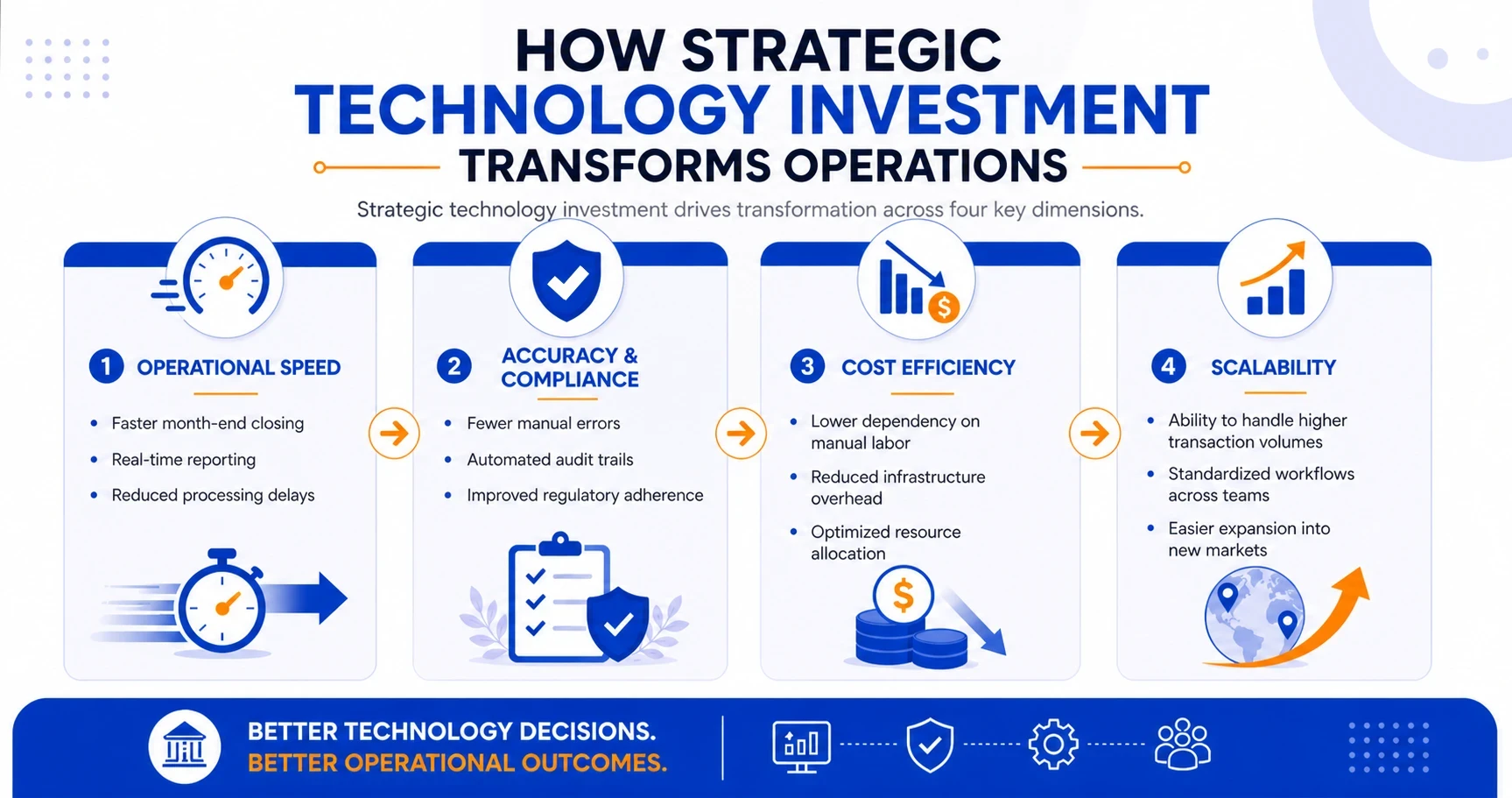
Strategic fintech investments are reshaping operational models
Modern fintech investments are no longer limited to product innovation; they are increasingly focused on infrastructure transformation.
Financial institutions and enterprises are investing in:
- Cloud-based accounting ecosystems
- AI-powered reconciliation systems
- Intelligent workflow automation
- Real-time reporting dashboards
- Integrated compliance monitoring systems
The objective is not just digitization, but optimization of entire operational layers.
A report from CB Insights shows that global fintech investment reached $51.2 billion in 2024, with a significant share directed toward AI, automation, and infrastructure technologies.
This signals a clear pivot toward scalable, intelligence-driven financial systems rather than isolated digital tools.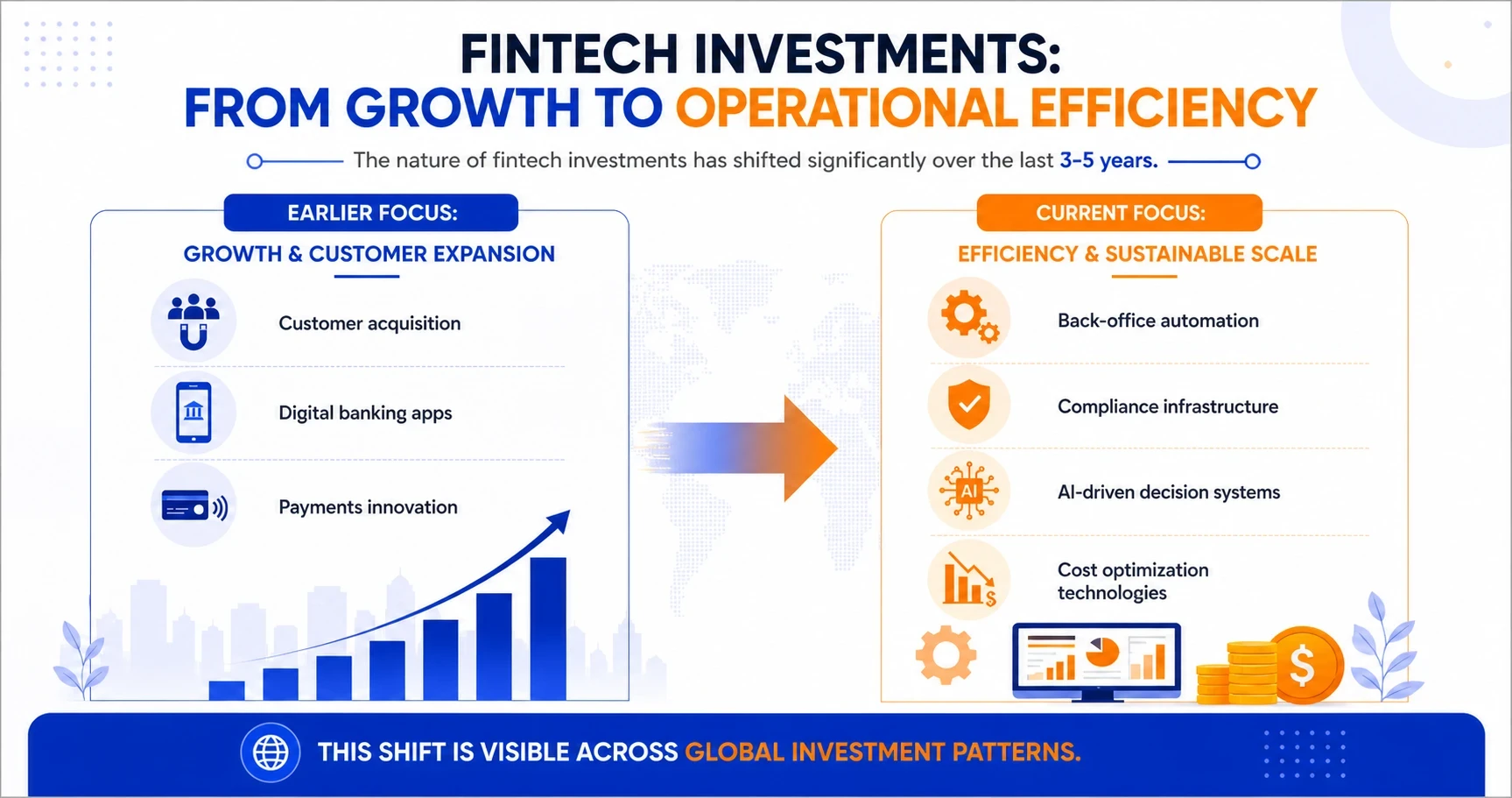
The rise of AI in financial services: From automation to intelligence
The most transformative force in modern financial operations is AI in financial services.
Unlike traditional automation, AI introduces contextual intelligence; systems that not only execute tasks but also learn, predict, and optimize outcomes.
Key Applications of AI in Financial Operations:
1. Intelligent reconciliation
AI systems automatically match transactions, flag anomalies, and reduce reconciliation time significantly.
2. Predictive financial forecasting
Machine learning models analyze historical and real-time data to forecast cash flow trends and financial risks.
3. Automated compliance monitoring
AI continuously tracks regulatory changes and ensures alignment across financial processes.
4. Document intelligence
OCR and NLP-based systems extract and validate financial data from invoices, contracts, and statements.
This shift represents a fundamental redefinition of operational efficiency.
Emerging technologies in financial services industry: What’s driving change
The adoption of emerging technologies in financial services industry is being driven by three key forces:
1. Complexity of financial data
Modern financial ecosystems generate vast volumes of structured and unstructured data requiring advanced processing capabilities.
2. Demand for real-time insights
Decision-makers increasingly require real-time visibility into financial performance, risk exposure, and operational health.
3. Pressure to scale efficiently
Organizations must scale without proportionally increasing operational overhead.
Key technologies enabling this transformation include:
- Cloud-native financial architecture
- API-first integration models
- Robotic process automation (RPA)
- Machine learning-based analytics
- Blockchain-based transaction validation
These technologies are not standalone solutions; they function as interconnected layers of a modern financial operating system.
Financial services technology consulting: Why strategic implementation matters
Adopting technology is only one part of the equation. The real challenge lies in aligning it with operational workflows, compliance requirements, and scalability goals.
This is where financial services technology consulting plays a critical role.
Rather than implementing tools in isolation, strategic consulting focuses on:
- Mapping existing operational workflows
- Identifying automation opportunities
- Eliminating redundant processes
- Integrating systems into a unified architecture
- Ensuring compliance and governance alignment
The difference between partial digitization and full transformation lies in structured execution.
Without this alignment, organizations often face “tool overload”; multiple systems that increase complexity rather than reducing it.
Technology in financial services: From efficiency to competitive advantage
The role of technology in financial services has evolved significantly. It is no longer just about operational efficiency; it is now a competitive differentiator.
Organizations leveraging integrated financial technologies experience:
- Faster reporting cycles
- Improved accuracy in financial data
- Reduced operational overhead
- Enhanced compliance readiness
- Greater scalability with lower marginal cost
The most successful financial systems today are not the most complex—they are the most integrated.
IMF working papers highlight that fintech competition is driving financial institutions to adopt digital technologies that improve operational efficiency and reduce costs through structured digital transformation initiatives.
This demonstrates that technology adoption directly impacts financial performance and operational resilience.
Things small businesses should know about financial technology adoption
While large enterprises often lead transformation initiatives, smaller organizations face unique advantages and challenges.
Key considerations include:
1. Start with process, not tools
Technology should be mapped to existing workflows before implementation.
2. Prioritize integration over expansion
Multiple disconnected tools create inefficiency rather than solving it.
3. Focus on automation of repetitive workflows
High-impact areas include invoicing, reconciliation, reporting, and compliance tracking.
4. Build for scalability early
Systems should be designed to grow without structural redesign.
5. Data quality determines technology success
Even the most advanced systems fail without clean, structured data inputs.
These principles ensure that financial technologies deliver measurable operational value rather than becoming fragmented investments.
The future: Intelligent, connected, and autonomous financial operations
The next phase of transformation in financial services will be defined by convergence.
Systems will no longer operate independently; they will function as interconnected ecosystems powered by AI, automation, and real-time data exchange.
Key trends shaping the future include:
- Autonomous financial reporting systems
- AI-driven decision support platforms
- Fully integrated compliance ecosystems
- Predictive operational analytics
- Continuous financial optimization loops
The emphasis will shift from managing processes to orchestrating intelligent systems.
Building financial operations that scale intelligently
Strategic investment in technology is no longer a modernization initiative; it is a structural necessity for sustainable financial operations.
Organizations that align financial technologies, automation, and intelligent systems with their core workflows are better positioned to reduce inefficiencies, improve decision-making, and scale without friction.
The transformation is not about adopting more tools; it is about building systems that think, adapt, and evolve with operational needs.
At FBSPL, we work as a strategic consulting partner to help organizations redesign financial operations through structured technology adoption, automation frameworks, and data-driven transformation models.


Bhavishya Bharadwaj
Bhavishya Bharadwaj is the Digital Marketing Manager at FBSPL, bringing over a decade of experience across insurance, outsourcing, accounting, and digital transformation.
Frequently Asked Questions
Financial services are investing in technology to modernize legacy systems, eliminate manual inefficiencies, improve real-time decision-making, and build scalable, data-driven operations that can adapt to increasing complexity and regulatory demands.