


5 business areas where AI is already delivering real results in 2026
7 MIN READ/Apr 27, 2026

Summary: Discover 5 high-impact AI use cases already delivering measurable business results in 2026. From finance automation to insurance operations and workflow optimization, learn where AI drives ROI, why adoption fails, and how outsourcing accelerates successful digital transformation.
Let’s be honest, most business leaders in 2026 are no longer asking what AI is. They’re asking something far more urgent:
“Where exactly is AI delivering results for businesses like mine, and am I already behind?”
That concern is valid. Competitors are investing in AI in Business. Boards are pushing for digital transformation. Meanwhile, internal teams are still buried under manual processes, fragmented data, and delayed decision-making.
The real problem isn’t lack of access to AI; it’s knowing which AI use cases for business actually deliver ROI. Many organizations invest in tools before fixing workflows, leading to stalled projects and unclear outcomes.
Here’s the reality: AI is not failing businesses, poor prioritization is.
In this blog, we go beyond theory and explore real-world AI use cases that are already delivering measurable impact in 2026. You’ll also understand the common execution gaps, the real benefits AI brings when applied correctly, and when to invest in AI for maximum return.
Why AI adoption feels harder than it should
Despite the momentum around AI in Business, execution remains the biggest barrier. The issue isn’t awareness, it’s alignment between data, processes, and decision-making.
- Data is fragmented: AI depends on clean, structured, and unified data. However, most organizations operate across disconnected systems—CRMs, policy platforms, spreadsheets, and legacy tools. This fragmentation leads to inconsistent outputs and unreliable insights. Without a strong data foundation, even promising AI use cases fail to scale.
- Processes aren’t standardized: AI performs best in structured environments. But in reality, workflows vary across teams and regions. For example, two teams may handle the same process differently, making automation inconsistent. This is one of the biggest reasons use cases for AI break during implementation.
- Talent constraints: AI requires more than technology; it needs domain expertise, process understanding, and data capabilities. These skill sets are expensive and difficult to build in-house, slowing down execution of AI use cases for business.
- Unclear ROI timelines: Leaders often hesitate because they don’t know when to invest in AI or which problems solved by AI will generate immediate value. Without clear benchmarks, initiatives get delayed.
According to a 2025 McKinsey report, only 27% of companies report significant bottom-line impact from AI, despite over 70% adopting it.
Key insight: Most failed AI projects don’t fail because of technology; they fail because businesses automate broken processes instead of fixing them first.
When AI works: from efficiency gains to business leverage
When applied correctly, AI doesn’t just improve efficiency; it changes how work gets done at a fundamental level.
Instead of abstract benefits, let’s look at operational outcomes:
- Month-end financial close cycles shrink from 8–10 days to 2–3 days
- Customer query resolution drops from hours to minutes
- Claims processing and underwriting decisions accelerate significantly
- Reporting cycles move from static monthly reports to real-time dashboards
AI reduces decision latency across functions, enabling faster, more confident business actions.
According to PwC, AI is expected to contribute up to $15.7 trillion to the global economy by 2030, largely driven by productivity improvements.
But here’s the real shift: The biggest ROI in AI is not in customer-facing tools; it’s in back-office operations where inefficiencies are highest.
These artificial intelligence examples in business are already proving that value is created where processes are repetitive, data-heavy, and time-sensitive.
5 high-impact AI use cases for businesses
Let’s move beyond theory and explore real-world AI use cases that are actively driving results.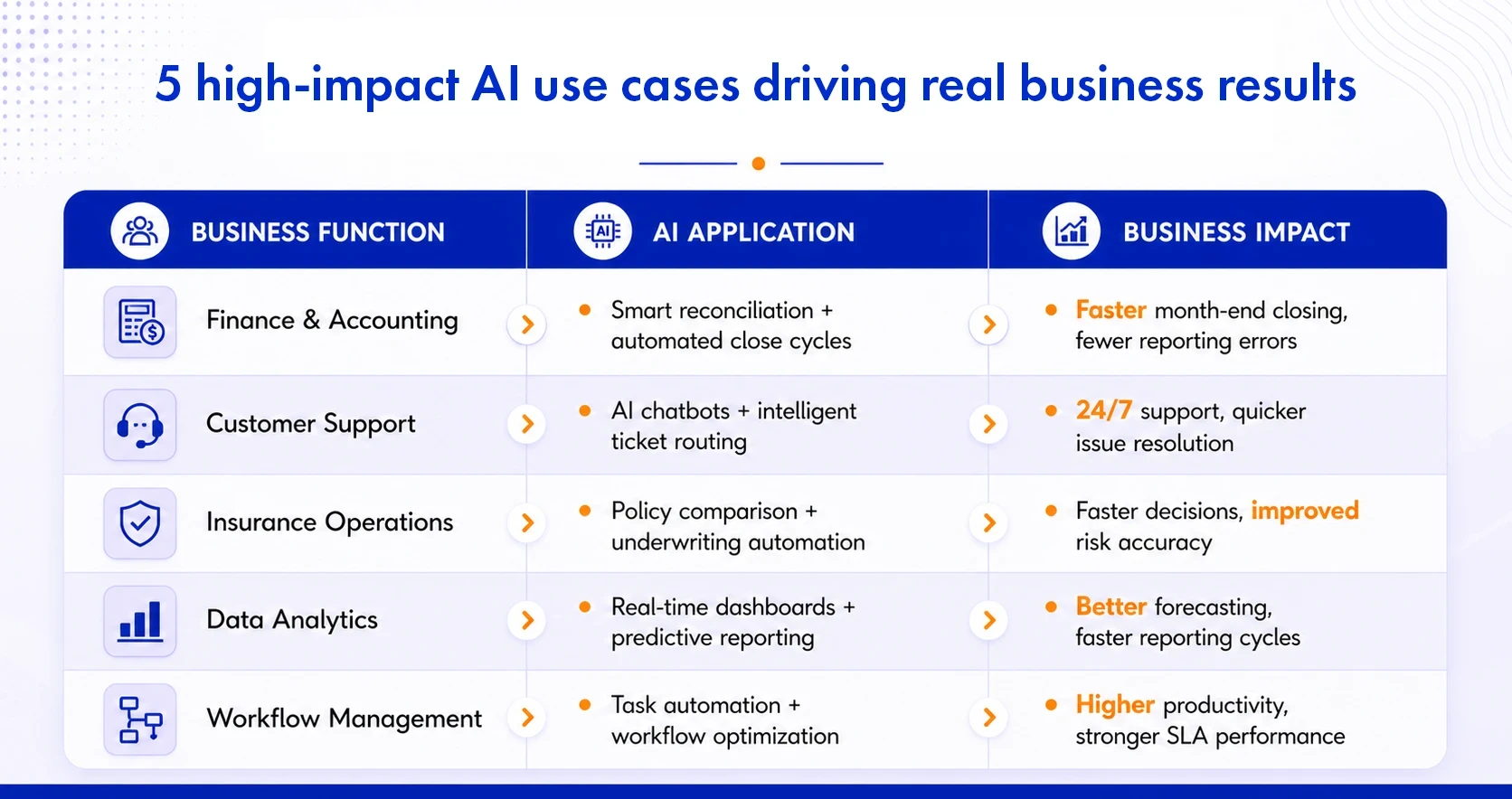
1. Finance & Accounting Automation
Finance is one of the most mature areas for AI use cases for business.
Problems solved by AI:
Manual reconciliations, delayed closings, reporting errors
How it actually works:
AI systems match transactions across bank feeds, invoices, and ledgers in real time. Instead of reconciling at month-end, discrepancies are flagged instantly, allowing teams to resolve issues continuously.
Impact:
- 60–70% reduction in manual effort
- Faster financial close cycles
- Improved audit readiness
2. Customer Support & Engagement
Customer expectations demand speed, accuracy, and personalization.
Use cases for AI in customer support:
Chatbots, sentiment analysis, automated ticket routing
How it actually works:
AI handles first-level queries instantly, classifies tickets based on urgency and intent, and routes them to the right agents. Sentiment analysis helps prioritize frustrated customers before escalation.
Impact:
- 24/7 support availability
- Faster response and resolution times
- Consistent customer experience
AI enhances, not replaces, human agents by removing repetitive workload.
3. Insurance Operations & Underwriting
AI use cases in insurance are among the most advanced and impactful.
Problems solved by AI:
Manual policy comparison, underwriting delays, claims inefficiencies
How it actually works:
AI extracts data from policy documents, compares coverage terms, identifies discrepancies, and evaluates risk using historical datasets. Claims are validated automatically based on predefined rules.
Impact:
- Faster underwriting cycles
- Improved risk accuracy
- Reduced claims leakage
This is where Agentic AI becomes a lifeline that doesn’t just assist but independently trigger workflows, validate decisions, and escalate exceptions.
4. Data Analytics & Business Intelligence
Data is only valuable when it drives decisions.
Use cases for AI in analytics:
Automated reporting, predictive insights, real-time dashboards
How it actually works:
AI pulls data from multiple systems, cleans and consolidates it, and generates dashboards automatically. Instead of waiting for reports, decision-makers get real-time insights.
Impact:
- 90–95% faster reporting cycles
- Reduced manual data handling
- Better forecasting and planning
5. Operations & Workflow Automation
Operational inefficiencies are often hidden but expensive.
AI in Business operations:
Workflow automation, task routing, process optimization
How it actually works:
AI tracks workflows across departments, identifies bottlenecks, and automatically assigns tasks based on priority, workload, and deadlines.
Impact:
- Faster turnaround times
- Improved SLA performance
- Scalable operations without additional hiring
Key insight: The most valuable AI use cases are often invisible; they operate behind the scenes but drive the biggest efficiency gains.
Accelerating AI outcomes through outsourcing
One of the biggest misconceptions in AI in Business is that success depends on choosing the right tools. In reality, success depends on fixing processes before automating them.
This is where outsourcing becomes a strategic advantage, not just a support function.
How outsourcing accelerates AI adoption:
- Standardizes workflows before automation
- Brings domain + AI expertise together
- Reduces implementation time and risk
- Enables faster scaling of real-world AI use cases
Most AI failures happen because organizations try to automate inefficient processes. Outsourcing solves this by aligning workflows, data, and execution strategy before deploying AI.
Instead of asking “when to invest in AI,” businesses can start with focused AI use cases for business and expand based on measurable outcomes.
The results are real, execution is the differentiator
AI is no longer a future investment; it is a present-day performance driver. Across finance, customer experience, insurance, analytics, and operations, real-world AI use cases are already delivering measurable impact.
The shift in 2026 is clear: success is no longer defined by adoption, but by application. Businesses that focus on practical AI use cases, aligned with real workflows, are achieving faster ROI and sustainable efficiency gains.
However, the real risk today is not investing in AI; it’s investing in the wrong use cases or applying it without fixing foundational gaps. This is where many digital transformation efforts fall short.
Organizations that take a structured, execution-first approach to AI in Business will lead to the next phase of growth.
FBSPL enables this transition by combining domain expertise with scalable AI-driven solutions; helping businesses turn artificial intelligence examples in business into consistent, measurable outcomes.


Bhavishya Bharadwaj
Bhavishya Bharadwaj is the Digital Marketing Manager at FBSPL, bringing over a decade of experience across insurance, outsourcing, accounting, and digital transformation.
Frequently Asked Questions
The most valuable AI use cases for businesses include finance automation, customer support, insurance operations, data analytics, and workflow automation. These areas deliver faster decisions, reduced manual effort, and stronger operational efficiency.