
6 MIN READ·Apr 24, 2026·Written by Bhavishya Bharadwaj

Summary: Generative AI in financial services brings speed and efficiency, but also introduces risks around data accuracy, compliance, and control. This blog explores key challenges, benefits, and practical approaches to manage risks while enabling reliable, AI-driven financial operations.
Speed has quietly become the biggest pressure point across financial operations. Reporting cycles are shrinking, compliance expectations are tightening, and decision-making windows are narrower than ever. At the same time, data volumes are growing faster than teams can validate them. This imbalance creates a familiar risk: faster outputs, but weaker control.
Generative AI is often positioned as the fix. It promises automation, rapid insights, and scalable intelligence across workflows;
In this blog, the focus is on understanding the risks of generative AI, how they show up in financial services, and what practical steps can help manage them without slowing innovation.
Adoption of generative AI in financial services is accelerating, but the risks are not always obvious at the implementation stage. They tend to surface laterk; during audits, compliance reviews, or operational scaling.
Generative AI models are designed to predict outputs, not verify truth. In financial workflows, even small inaccuracies can cascade into material reporting errors. A model generating financial summaries or reconciliations without proper validation layers can introduce inconsistencies that are difficult to trace.
A recent report by Deloitte highlights that organizations deploying generative AI are increasingly concerned about data integrity, model accuracy, and trust, especially as AI systems scale.
Financial services operate within tightly regulated environments. Generative AI introduces opacity; often referred to as the “black box” problem. When outputs cannot be easily explained, regulatory scrutiny increases.
This becomes critical in areas like financial reporting, underwriting, and risk assessment, where audit trails and explainability are non-negotiable.
Generative AI systems often rely on large datasets, including sensitive financial information. Without strict governance, there is a risk of data leakage—especially when models interact with external APIs or shared environments.
AI models trained on historical data can replicate or amplify existing biases. In financial contexts, this can affect credit decisions, fraud detection, or risk scoring.
Over time, models drift; where outputs become less accurate as data patterns evolve; can further degrade reliability if not continuously monitored.
There is a growing tendency to treat AI-generated outputs as final rather than assistive. This over-reliance reduces human oversight, increasing the probability of undetected errors.
For CFOs and finance leaders, this creates a governance challenge: balancing automation with accountability.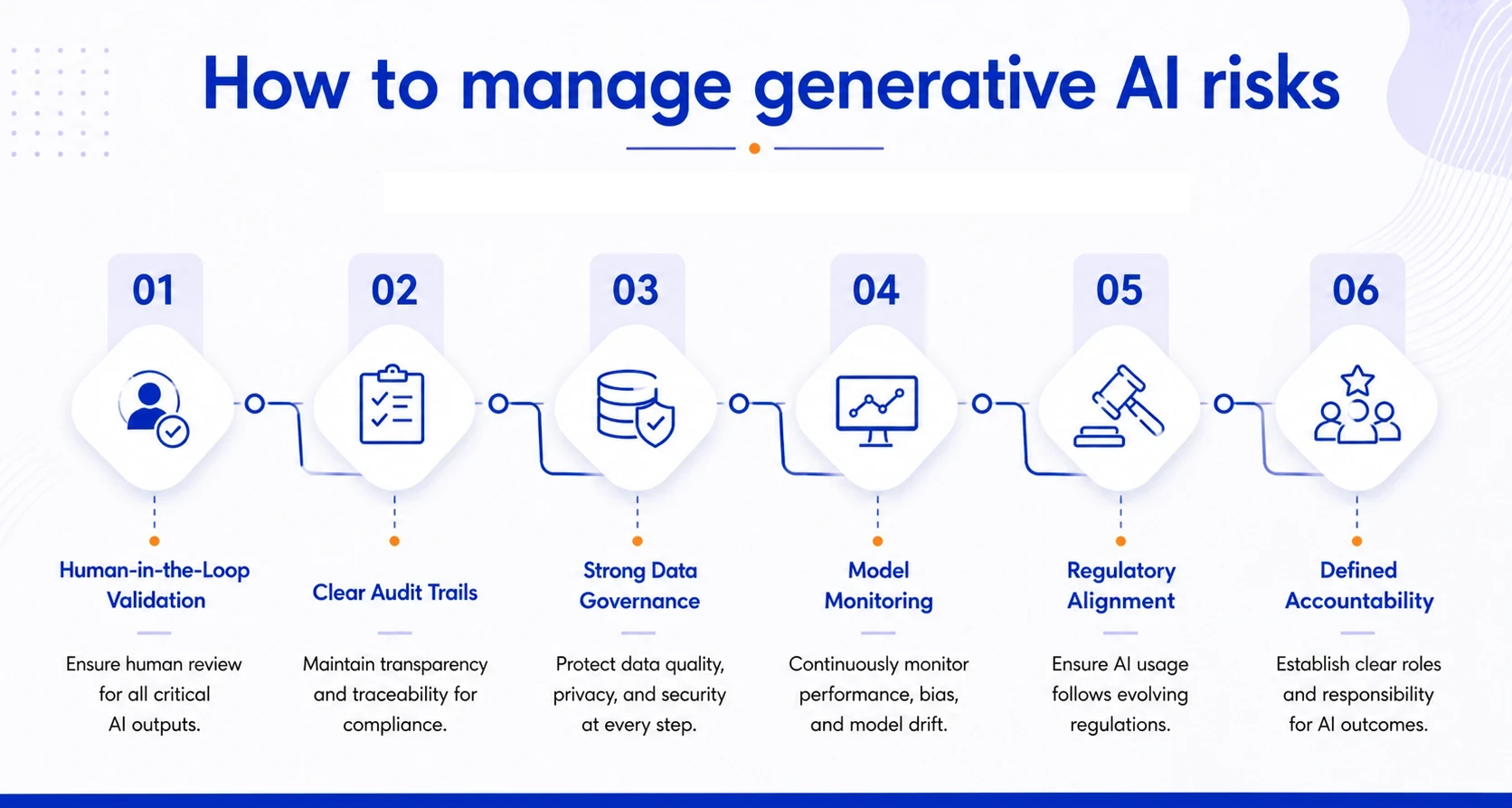
Despite the risks, generative AI brings measurable advantages when implemented with the right controls.
Tasks such as financial reporting, reconciliations, and document analysis can be completed significantly faster. This shortens month-end cycles and improves responsiveness.
Automation reduces manual effort across repetitive processes. This leads to lower operational costs while maintaining output volume.
The McKinsey Global Institute estimates that among industries globally, gen AI could add the equivalent of $2.6 trillion to $4.4 trillion annually in value across all its use cases.
Generative AI can process unstructured data; emails, contracts, financial notes; and convert it into actionable insights. This expands the scope of analysis beyond traditional structured datasets.
From personalized financial insights to automated query resolution, generative AI improves engagement without increasing headcount.
With structured validation layers, AI can reduce manual errors in high-volume processes such as data entry, reconciliation, and reporting. The key lies in combining AI outputs with verification workflows.
Generative AI refers to models that can create new content; text, data summaries, forecasts, or recommendations; based on patterns learned from existing data.
In financial services, this translates into systems that can:
Unlike traditional automation, which follows predefined rules, generative AI adapts based on context. This flexibility is what makes it powerful; but also what introduces risk.
Instead of static dashboards, finance teams now interact with dynamic systems that interpret and generate insights in real time. This changes how decisions are made; and how they need to be validated.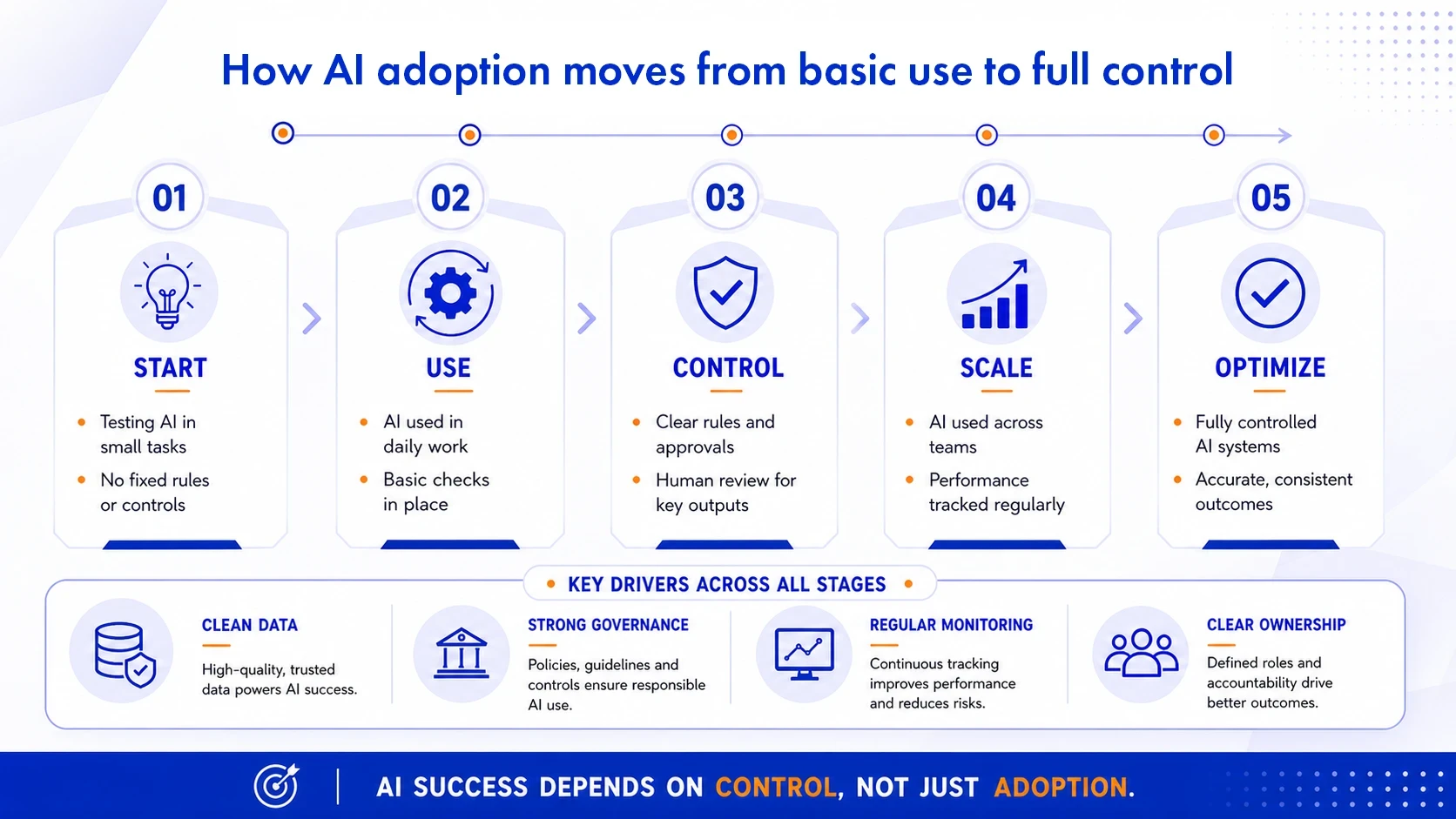
Generative AI is already being embedded across multiple financial workflows. The most effective use cases tend to combine automation with human oversight.
Understanding risks is only useful if it leads to better control. Effective risk management for generative AI in financial services typically includes:
The objective is not to limit AI adoption, but to ensure that speed does not come at the cost of accuracy or control.
Generative AI is reshaping financial services in ways that go beyond efficiency. It is changing how data is interpreted, how decisions are made, and how operations scale. But the same capabilities that drive value also introduce new forms of risk; data inaccuracies, compliance exposure, and reduced transparency.
The path forward is not about choosing between automation and control. It is about designing systems where both coexist. Financial institutions that invest in governance, validation, and structured implementation are more likely to see sustainable benefits.
The conversation around AI in financial services is shifting; from adoption to accountability. And that shift will define how successfully organizations balance innovation with trust.
FBSPL works with financial institutions to implement AI-driven workflows that combine speed with accuracy, ensuring operational efficiency without compromising control.
The primary risks include data inaccuracies, lack of transparency, regulatory non-compliance, data privacy concerns, and over-reliance on automated outputs without sufficient human validation.
Get the latest insights on insurance operations, policy management, and industry best practices.