
7 MIN READ·Jan 15, 2026·Written by Bhavishya Bharadwaj

Summary: Operational inefficiencies continue to challenge insurance teams despite years of digitization. This blog examines why everyday insurance process operations break down, where delays begin, how connected workflows improve operational efficiency, and how outsourcing supports scale without disrupting internal teams.
Take a look at the practical ways insurance teams tackle daily bottlenecks, improve workflows, and handle rising workloads efficiently without major disruptions.
Did you know that up to 30% of an insurer’s costs are buried in daily operations that no one questions?
Operational pressure in insurance organizations rarely hits suddenly. It builds gradually; through longer review cycles, heavier workloads, and small manual steps that multiply unnoticed. Policy volumes grow. Customer expectations rise. Compliance requirements tighten. Yet, daily work often moves through the same processes.
This creates a familiar situation across carriers, MGAs, and agencies: skilled teams working hard but struggling to keep pace. The challenge is not talent or effort; it’s how operations are designed.
Leaders often ask: What is one of the main operational inefficiencies faced by the company, and why does it keep coming back despite investments in systems and people?
The answer usually lies in everyday insurance process operations; policy review, intake, and proposal creation; where manual effort, fragmented systems, and late-stage corrections quietly consume time and margin. Some organizations tackle this internally; others combine internal improvements with outsourcing. Most do so quietly, without large-scale changes.
In this blog, we explore how insurance teams are addressing operational inefficiencies, why earlier attempts often fall short, and how workflow design and flexible support are improving workflows.
Insurance operational challenges keep coming back because inefficiencies are built into how everyday work is designed, not because teams fail to execute. When manual checks, fragmented systems, and late-stage corrections become part of normal operations, they quietly repeat themselves across every policy, intake, and proposal; regardless of how experienced the team or how modern the systems appear.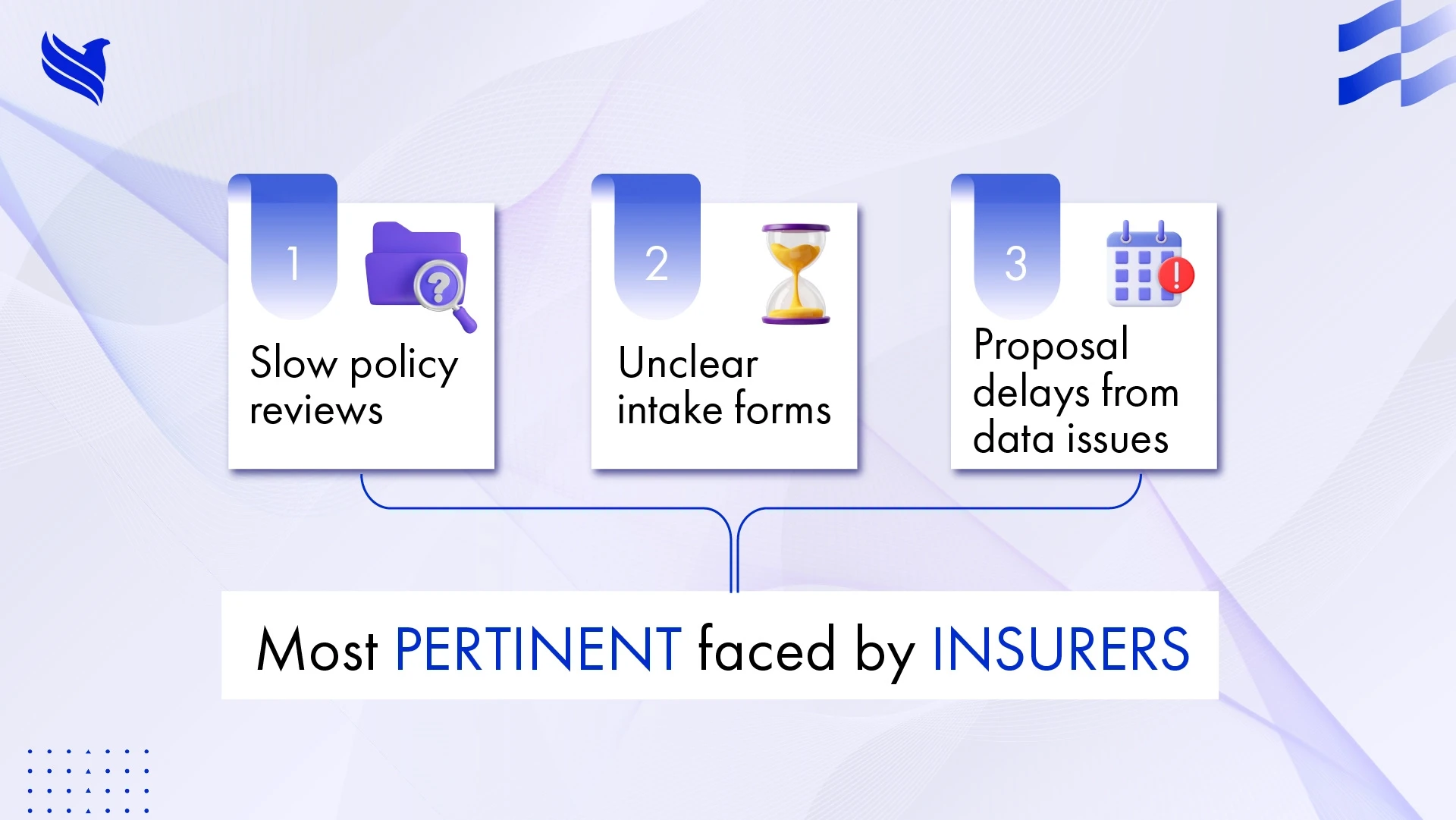
These challenges rarely surface as dramatic breakdowns. Instead, they show up as familiar patterns:
Each issue may seem manageable on its own. Over time, they compound.
Industry data supports this: McKinsey reports that 25–30% of an insurer’s total cost base is tied to operations, with workflow inefficiencies being a major contributor. Deloitte notes that over 60% of insurance executives see legacy processes as a direct growth barrier; even in digitally mature firms.
When inefficiency becomes routine, it often stops being questioned. Manual steps are seen as safeguards. Rework is treated as quality control. This mindset makes improvement difficult because the problem no longer looks like a problem.
Digitization failed to fully solve insurance operational inefficiencies because it changed where information lives, not how work actually happens. While documents became digital and processes moved online, the underlying workflows like manual review, rekeying, late validation, and fragmented handoffs largely remained unchanged.
Over the past decade, insurers have invested heavily in digitization. Paper files became PDFs. Forms moved online. Communication shifted to email and portals. Access improved, but the way work was performed largely stayed the same.
Data still had to be read, checked, interpreted, and re-entered. Documents arrived in different formats. Errors were often discovered late. In some cases, digitization even increased volume without reducing effort.
Digitization addressed where information lived, not how it was handled. This shows why smarter approaches are needed; ones that change workflows, validate inputs early, and ensure consistent data across insurance process operations. Without this, digital systems only move inefficiencies faster.
Rather than large-scale transformations, many insurance teams focus on specific pressure points. Three areas consistently deliver results: policy review, intake, and proposal creation.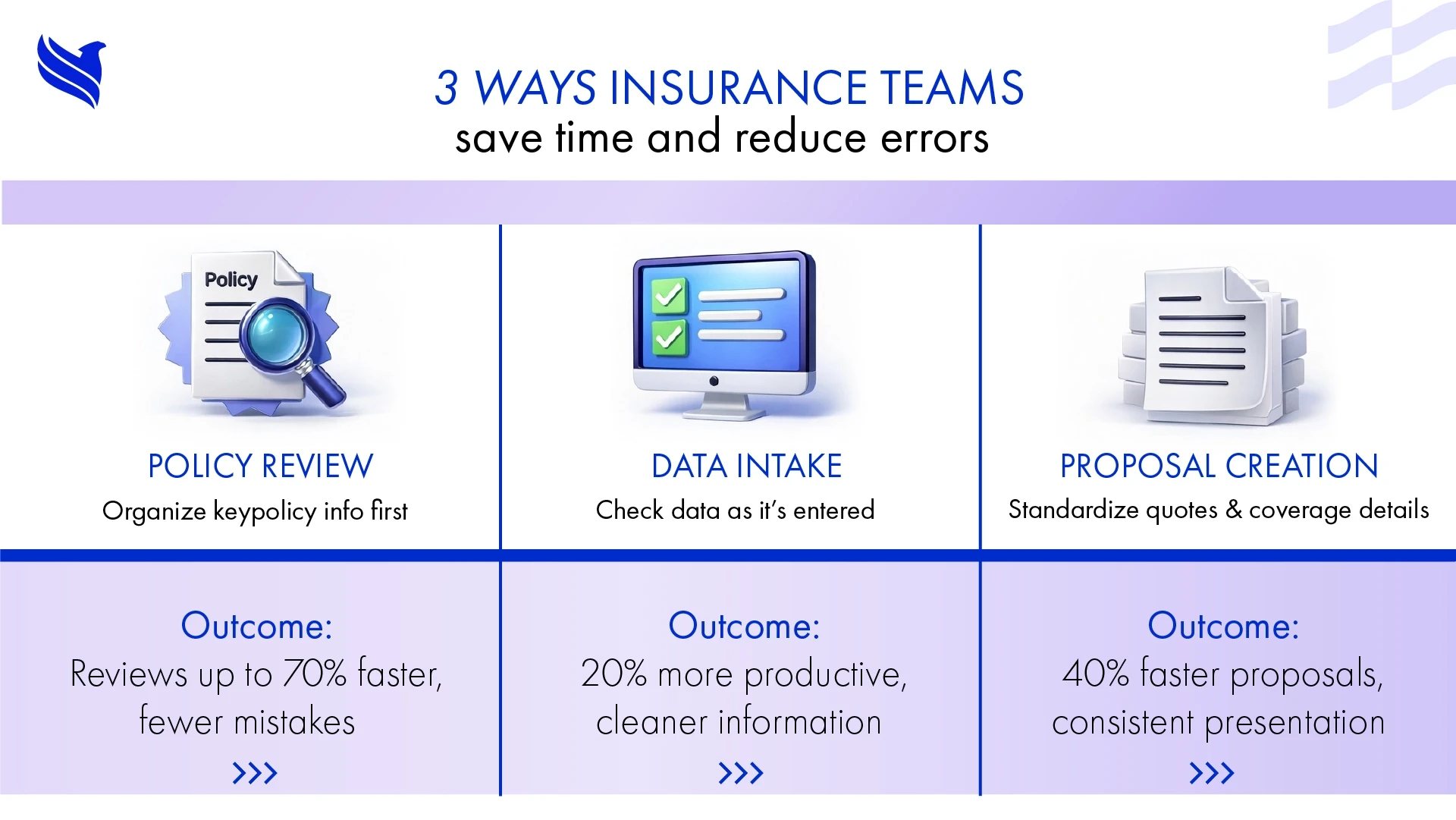
Policy review is one of the most demanding tasks. Modern policies include layered endorsements, carrier-specific rules, and frequent mid-term changes. Manual review puts heavy cognitive load on staff.
Common challenges:
Some organizations now prepare key policy data upfront; limits, premiums, endorsements, and coverage details; so, reviewers focus on evaluation, not data hunting.
Reported results:
Example: One regional MGA implemented structured pre-review data sheets and reduced policy review time from 5 hours to under 2 hours per file, while improving accuracy.
This is not removing oversight; it is letting experts focus on the work that truly requires judgment.
Poor intake creates ripple effects across underwriting, quoting, and servicing. Accenture estimates that bad intake data can reduce operational productivity by up to 20%.
Traditional intake collects data first and validates later, creating delays. Teams focused on efficiency now reverse this: validation happens as data is entered.
Key steps in intake redesign:
Cleaner intake improves all downstream insurance process operations, from underwriting to policy issuance.
Proposal preparation is often manual and repetitive, yet it directly affects client experience. Challenges include:
Teams now standardize how quote information is extracted and structured. Key elements are prepared consistently before assembling proposals.
Results:
In competitive markets, responsiveness can be as critical as price or coverage. Reducing delays at this stage improves outcomes.
Improvements deliver the most value when workflows are connected. Intake data flows directly into policy review, and policy insights carry into proposals.
Disconnected fixes reduce effort in one area but leave friction elsewhere. Connected insurance process operations minimize repeated inefficiencies.
PwC reports that insurers investing in connected, intelligent operations see up to 30% improvement in operational efficiency, along with better audit readiness and data consistency.
The benefit is predictability. Teams know what to expect, and leaders gain clearer visibility into capacity and risk.
Even well-designed operations face limits. Renewal seasons, growth spurts, and market volatility place pressure on internal teams.
Modern outsourcing provides:
When paired with clear processes and accountability, outsourcing extends operational capacity rather than replacing it. Many organizations rely on it to maintain efficiency in real-world conditions.
Successful teams share common practices:
This incremental, practical approach optimizes business operations without sweeping changes, focusing on how work actually happens.
This blog examined why operational inefficiencies persist, especially in policy review, intake, and proposal creation. It highlighted how small but structured changes, connected workflows, and outsourcing help improve efficiency without destabilizing teams.
FBSPL works with insurance organizations to reduce friction across core insurance process operations, including policy review, intake, and proposal support. By combining deep insurance domain expertise, well-defined operating models, and scalable delivery teams, we help carriers, MGAs, and agencies improve turnaround times, strengthen accuracy, and manage capacity with greater predictability.
Our approach supports day-to-day execution without disrupting existing systems or workflows, enabling sustainable efficiency through trusted insurance outsourcing services.
Manual policy review, incomplete intake, and proposal preparation often slow operations and create errors. These issues increase turnaround times and place unnecessary strain on experienced teams.
Get the latest insights on insurance operations, policy management, and industry best practices.