



Insurance outsourcing guide for US agencies: Benefits, pricing, risks & key considerations
16 MIN READ/Mar 17, 2026

Summary: Insurance agencies face growing administrative demands that can slow operations and strain internal teams. This guide explores how outsourcing helps manage back-office tasks, improve efficiency, maintain compliance, and scale operations while outlining key considerations, pricing models, and risks agencies should evaluate.
US insurance agencies are operating in an environment defined by rising policy volumes, stricter compliance expectations, and increasing administrative workloads. As agencies expand their client base, routine back-office responsibilities such as policy servicing, documentation, and data management often consume valuable time that could otherwise be spent on growth-focused activities.
To address these operational pressures, many firms are exploring more efficient support models. One approach gaining momentum is insurance outsourcing for US agencies, which allows agencies to delegate time-intensive administrative functions to specialized teams while maintaining full operational oversight.
This insurance outsourcing guide explains how outsourcing works, the processes agencies commonly outsource, the benefits and risks involved, and the key factors agencies should evaluate before choosing an outsourcing partner.
Understanding insurance outsourcing in modern agency operations
Insurance outsourcing refers to the practice of delegating specific operational tasks to external specialists who support agency workflows remotely. Instead of handling every administrative function internally, agencies partner with providers that deliver structured insurance outsourcing services for processes such as policy servicing, documentation management, data entry, and renewal preparation. This allows agencies to maintain operational continuity while reducing internal workload.
It is important to distinguish outsourcing from other commonly used operational strategies. Outsourcing focuses on transferring defined processes to an external partner that manages them according to agreed service standards. Offshoring, on the other hand, simply refers to performing work in another country, which may or may not involve a specialized outsourcing provider. Automation relies on technology to execute repetitive tasks through software tools or workflows, often complementing human expertise rather than replacing it entirely.
In many modern agency environments, outsourcing and automation work together. External teams manage administrative workflows while agencies use digital systems to streamline documentation and communication.
Professional insurance outsourcing companies play a crucial role in this model. They bring trained insurance professionals, structured processes, and performance monitoring systems that help agencies manage operational workloads efficiently while maintaining accuracy and consistency across back-office activities.
Key drivers behind the shift toward outsourcing
The operational landscape for insurance agencies has evolved significantly over the past decade. Agencies are managing higher client expectations, larger policy volumes, and more complex regulatory requirements than ever before. As these pressures continue to grow, many firms are adopting US insurance agency outsourcing as a strategic approach to strengthen operational capacity while maintaining service quality.
Several key industry factors are driving this shift.
- Workforce shortages in insurance operations – The insurance industry is experiencing a growing talent gap as experienced professionals retire and fewer new workers enter operational roles. Agencies often struggle to hire and retain skilled staff for administrative functions such as policy processing, endorsements, and documentation management. Outsourcing provides access to trained professionals who can support these workflows without the long recruitment cycles associated with in-house hiring.
- Increasing compliance complexity – Regulatory requirements in the insurance sector continue to expand, making compliance management more demanding for agencies. Accurate documentation, policy verification, and record maintenance are essential to avoid compliance issues. Many agencies rely on insurance outsourcing services to ensure that administrative processes follow structured workflows and maintain proper documentation standards.
- Need for faster turnaround times – Clients today expect quick responses when requesting policy updates, certificates of insurance, or endorsements. Delays in administrative processing can affect client satisfaction and agency reputation. By extending operational capacity through outsourcing support, agencies can process requests more efficiently while maintaining service quality.
Pressure to control operational costs – Maintaining a fully staffed back-office team can significantly increase operational expenses. Recruitment, training, salaries, and technology investments all contribute to rising costs. Outsourcing allows agencies to manage workloads more efficiently by aligning operational support with actual transaction volumes. - Growing policy volumes – As agencies expand their client base and product offerings, the number of policies, endorsements, and documentation requests naturally increases. Without scalable operational support, internal teams can quickly become overwhelmed by administrative tasks.
These industry pressures have encouraged agencies to explore more flexible operating models. By integrating structured outsourcing support into their workflows, agencies can improve operational efficiency while allowing internal teams to focus on client engagement, advisory services, and long-term growth.
Common insurance operations agencies choose to outsource
Insurance agencies handle a wide range of administrative workflows that support policy management and client service. While these tasks are essential for maintaining accurate records and meeting client requests, they often require significant time and operational resources. As a result, many agencies rely on structured insurance agency outsourcing to manage routine back-office functions more efficiently.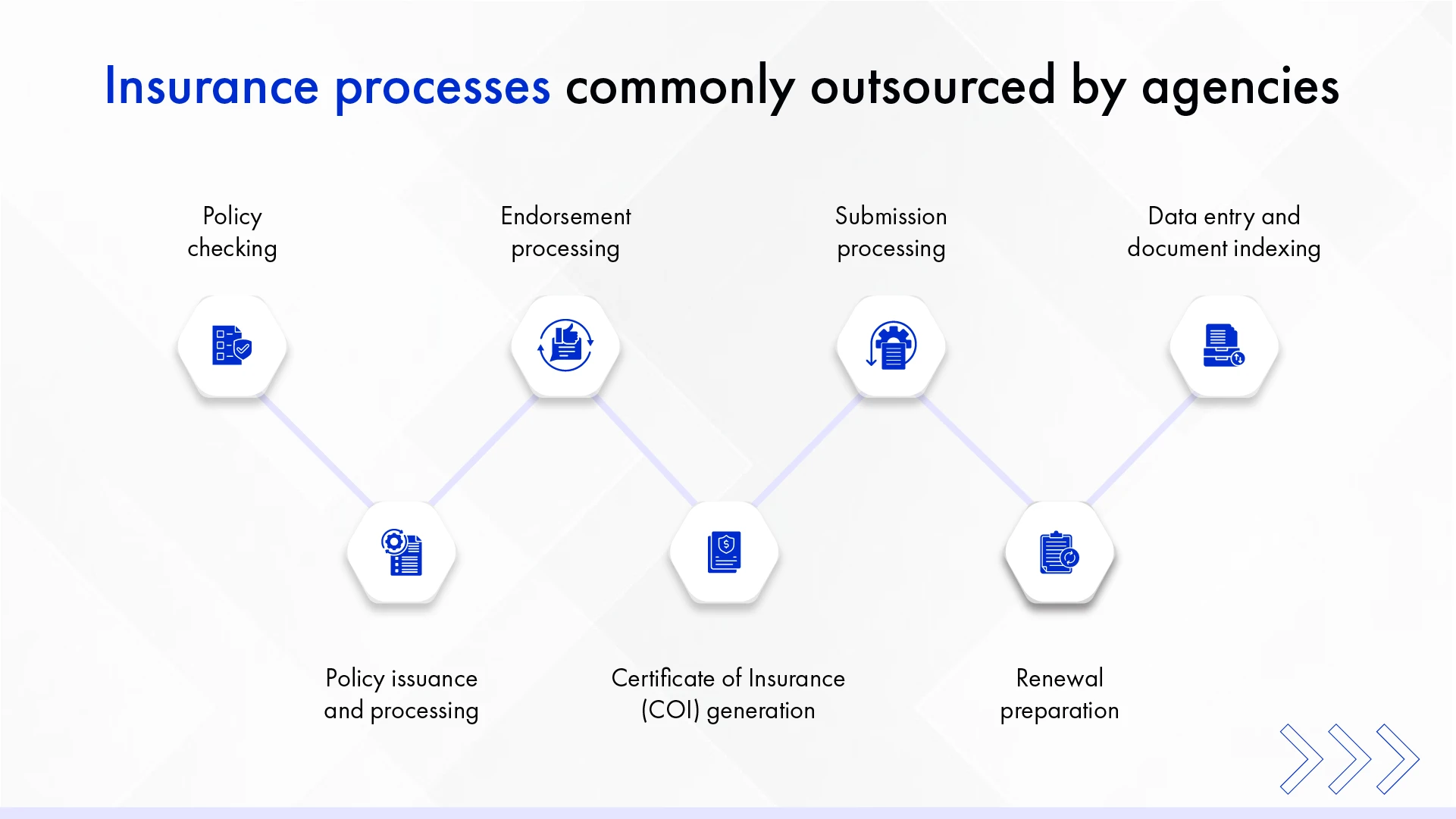
Below are some of the most common insurance processes that agencies choose to outsource.
- Policy checking – Policy checking involves reviewing issued policies to ensure that coverage details, endorsements, limits, and insured information match the original submission and carrier documentation. Even small discrepancies can lead to coverage disputes or compliance issues later. Outsourcing this process allows trained professionals to systematically review policy documents and identify errors before they affect clients.
- Policy issuance and processing – Once a policy is approved, agencies must generate documentation, verify details, and record information within agency systems. This process includes preparing policy documents, updating policy records, and organizing related files. Outsourcing policy processing helps ensure that documentation is handled consistently and that all policy records are maintained accurately.
- Endorsement processing – Policy changes occur frequently throughout the policy lifecycle. Clients may request updates such as adding additional insured parties, modifying coverage limits, or correcting policyholder details. Endorsement processing involves updating policy documentation, coordinating with carriers, and maintaining accurate records within internal systems. External support teams often assist with this workflow to maintain quick turnaround times.
- Certificate of Insurance (COI) generation – Businesses frequently require proof of insurance before entering contracts or partnerships. Agencies must generate Certificates of Insurance that accurately reflect policy coverage and limits. Because these requests often require fast response times, many agencies outsource COI generation to ensure that client requests are processed quickly while maintaining documentation accuracy.
- Submission processing – Before a policy is issued, agencies must prepare and organize submission materials for carriers. This includes collecting application details, reviewing supporting documents, and ensuring all required information is complete. Outsourcing submission processing helps agencies maintain organized documentation while improving the speed at which submissions move through the underwriting process.
- Renewal preparation – Policy renewals require careful preparation to ensure clients receive updated coverage options before their existing policies expire. Administrative teams must review policy history, update documentation, and prepare renewal summaries. By outsourcing renewal preparation, agencies can streamline this process and ensure that renewal discussions with clients happen on time.
- Data entry and document indexing – Insurance agencies manage large volumes of documents including policy files, endorsements, client communications, and claims records. Accurate data entry and document indexing help maintain organized systems that allow staff to locate information quickly. Outsourcing these administrative tasks improves record accuracy while reducing the workload placed on internal teams.
Because these workflows involve repetitive documentation and detailed record management, many agencies extend their operational capacity through specialized insurance BPO services. External teams follow structured processes to manage administrative workloads efficiently while allowing agency staff to focus more on client relationships and business development activities.
Strategic advantages of outsourcing insurance operations
As insurance agencies expand their client base and service offerings, administrative workloads naturally increase. Managing these operational demands entirely in-house can be challenging, especially when agencies must balance efficiency, compliance, and cost control. This is why many agencies today are exploring the benefits of insurance outsourcing as a way to strengthen operational performance while maintaining service quality.
Several strategic advantages make outsourcing an attractive option for modern insurance agencies.
- Reduced operational costs – Maintaining a full in-house back-office team requires significant investment in recruitment, training, salaries, infrastructure, and technology. Outsourcing allows agencies to manage administrative workloads without continuously expanding internal teams. By aligning operational support with actual workflow volumes, agencies can control costs more effectively while maintaining operational efficiency.
- Faster processing and turnaround times – Administrative requests such as policy updates, endorsements, and certificates of insurance often require quick responses. Delays in these processes can affect client satisfaction and slow down overall agency operations. With dedicated support teams managing routine workflows, agencies can process requests faster and maintain consistent turnaround times.
- Access to trained insurance professionals – Specialized insurance outsourcing companies provide teams that are familiar with common insurance workflows and documentation standards. These professionals are trained to manage tasks such as policy verification, documentation review, and system updates with accuracy and consistency. This expertise allows agencies to maintain high-quality operational support without the time and resources required for internal training.
- Scalability during peak workloads – Insurance operations often experience workload fluctuations, particularly during renewal seasons or periods of rapid growth. Outsourcing provides agencies with flexible operational capacity that can scale according to demand. Instead of overloading internal teams, agencies can rely on external support to handle higher transaction volumes efficiently.
- Improved accuracy and process standardization – Administrative workflows in insurance require careful documentation and attention to detail. Structured outsourcing processes help introduce standardized procedures for handling policy documentation, data entry, and transaction management. This consistency reduces errors and improves the overall reliability of back-office operations.
When implemented thoughtfully, these insurance outsourcing benefits allow agencies to operate more efficiently while enabling internal teams to focus on higher-value activities such as client advisory services, relationship management, and business development.
How outsourcing improves operational efficiency in insurance agencies
Operational efficiency is a critical factor in the long-term success of insurance agencies. When administrative workloads increase, internal teams often spend a significant portion of their time handling documentation, data updates, and routine policy tasks. Over time, this can limit the time agents and producers have available for client engagement and business development. This is where insurance outsourcing for US agencies can significantly improve workflow efficiency.
One of the most immediate improvements comes from reducing the administrative workload for agents. Producers and account managers frequently manage tasks such as document updates, policy record changes, and routine data entry. When these responsibilities are handled by dedicated operational teams, internal staff can concentrate more on advising clients, strengthening relationships, and generating new business opportunities.
Another important advantage is the introduction of standardized operational processes. Outsourcing providers typically follow structured workflows designed to ensure consistency across policy servicing, documentation management, and transaction processing. These standardized procedures help reduce variations in how tasks are handled, improving overall reliability and reducing the likelihood of administrative errors.
Efficiency is further supported through Service Level Agreement (SLA)–driven performance management. Outsourcing partnerships are usually governed by clearly defined performance metrics that track factors such as turnaround times, accuracy levels, and task completion rates. These measurable benchmarks create accountability and allow agencies to monitor operational performance more effectively.
Modern outsourcing workflows also incorporate automation and digital tools that help streamline repetitive tasks. Document indexing, data verification, and transaction tracking can often be integrated with agency management systems, allowing external teams to manage tasks more efficiently. When automation is combined with experienced operational support, agencies benefit from faster processing and more organized workflow management.
For many agencies, these operational improvements are delivered through specialized insurance outsourcing services that focus on optimizing back-office functions. By improving workflow structure, reducing manual workload, and maintaining consistent performance standards, outsourcing helps agencies operate more efficiently while supporting long-term business growth.
Understanding insurance outsourcing pricing models and benchmarks
For insurance agencies evaluating outsourcing options, understanding how pricing structures work is an important step in the decision-making process. Outsourcing providers typically offer flexible pricing models designed to align with an agency’s operational needs, transaction volumes, and level of support required. Instead of a one-size-fits-all approach, pricing structures are often customized based on workflow complexity and the type of administrative services involved.
Below are some of the most common pricing models used in insurance BPO services.
| Pricing model | How it works | Best for |
| Full-time equivalent (FTE) model | Agencies work with a dedicated professional or team that supports their processes on an ongoing basis for a fixed monthly engagement. | Agencies with consistent daily workloads and continuous operational needs. |
| Per-transaction pricing | Agencies are charged based on the number of tasks completed, such as policy reviews, endorsements, or certificate requests. | Agencies that experience fluctuating workflow volumes. |
| Hybrid pricing structure | A combination of dedicated support and transaction-based pricing, allowing agencies to maintain steady support while scaling during peak periods. | Agencies seeking both stability and operational flexibility. |
| Volume-based pricing | Pricing is structured according to the total number of transactions handled over a specific period, often allowing greater efficiency at higher volumes. | Agencies handling large volumes of policy-related tasks. |
Many insurance outsourcing companies structure their service agreements around these models to ensure agencies receive the right level of operational support without unnecessary costs. The final pricing structure generally depends on several factors, including the complexity of processes, technology integration requirements, turnaround expectations, and reporting needs.
When evaluating insurance outsourcing services, agencies should focus not only on pricing but also on the value delivered through accuracy, operational consistency, and scalable workflow support. A well-designed pricing model should support long-term efficiency while allowing agencies to adapt to changing business demands.
Key risks agencies should consider in outsourcing
While outsourcing offers clear operational advantages, agencies should also evaluate potential risks before adopting this approach. A balanced assessment helps organizations build effective safeguards and ensure outsourcing partnerships deliver consistent results. Understanding insurance outsourcing risks allows agencies to make informed decisions and implement proper oversight mechanisms.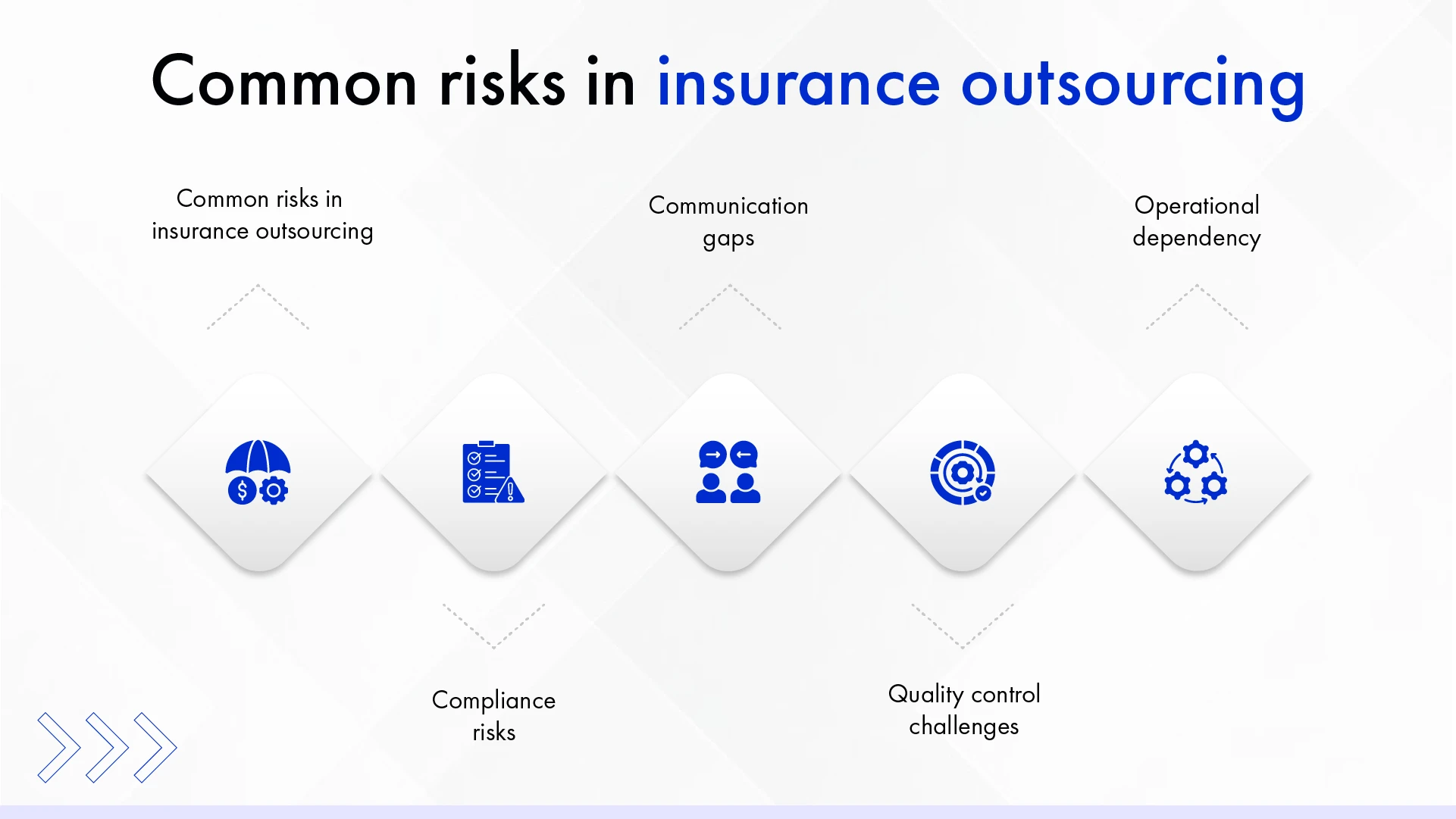
Some common concerns agencies evaluate include:
- Data security concerns – Insurance agencies manage sensitive client information, including policy details and personal data. Sharing system access with external teams requires strong data protection measures, secure access protocols, and clear confidentiality agreements to protect client information.
- Compliance risks – Insurance operations must follow strict regulatory and documentation standards. If processes are not handled carefully, errors in record management or documentation could create compliance issues. Working with experienced outsourcing partners that follow structured workflows can help reduce this risk.
- Communication gaps – Differences in time zones, process understanding, or workflow expectations can sometimes lead to communication challenges. Clear documentation, regular reporting, and defined communication channels help maintain alignment between agency teams and outsourcing partners.
- Quality control challenges – Agencies must ensure that outsourced tasks maintain the same accuracy and service standards as internal operations. Performance monitoring, review processes, and defined service metrics are essential to maintain consistent quality.
- Operational dependency – Relying heavily on external teams may create operational dependence over time. Agencies can manage this risk by maintaining clear process documentation and retaining oversight of critical workflows.
Data security and compliance in insurance outsourcing
Data security is one of the most important considerations when agencies evaluate insurance outsourcing for US agencies. Insurance operations involve handling sensitive policyholder information, financial records, and confidential documentation. As a result, outsourcing partners must follow strict security practices to ensure that client data remains protected at all times.
A key responsibility of outsourcing providers is the secure handling of policyholder information. This includes maintaining strict confidentiality protocols, controlling how data is accessed, and ensuring that all client records are processed in accordance with agency guidelines. Proper documentation procedures help prevent unauthorized use or accidental exposure of sensitive information.
Reputable providers also operate within established compliance frameworks that align with industry regulations and internal agency policies. These frameworks help ensure that administrative workflows; such as policy documentation, endorsements, and record management; are handled in a consistent and compliant manner.
Another critical safeguard is the use of secure data access controls. Outsourcing teams typically work within restricted system environments where access permissions are carefully managed. Multi-layer authentication, role-based access, and monitored system activity help maintain security across all operational tasks.
Finally, agencies often expect outsourcing partners to maintain audit readiness. Structured documentation, transaction tracking, and performance reporting allow agencies to review processes easily and demonstrate compliance whenever required.
Best practices for building successful outsourcing partnerships
For agencies exploring insurance agency outsourcing, success depends not only on choosing the right partner but also on implementing a structured approach to collaboration. A well-managed outsourcing relationship helps agencies improve efficiency while maintaining operational control and service quality. Following a few proven practices can help agencies avoid common challenges and build long-term, productive partnerships.
- Start with high-volume processes – Agencies often benefit from outsourcing tasks that involve repetitive administrative work and predictable workflows. Processes such as policy checking, certificate generation, and data entry are typically good starting points. Beginning with high-volume tasks allows agencies to test the outsourcing model while quickly reducing internal workload.
- Establish clear workflows and documentation – Clearly defined procedures are essential for smooth collaboration. Agencies should provide detailed workflow documentation, processing guidelines, and system access instructions. When expectations and responsibilities are well documented, outsourcing teams can perform tasks consistently and accurately.
- Maintain regular performance reviews – Continuous monitoring helps ensure that operational standards are maintained. Agencies should establish performance metrics such as turnaround times, accuracy levels, and service consistency. Regular review meetings allow both teams to discuss improvements, resolve issues quickly, and maintain alignment.
- Scale outsourcing gradually – Instead of transferring large volumes of work immediately, agencies often achieve better results by expanding outsourcing support step by step. Starting with a limited set of processes allows teams to refine workflows, build communication routines, and improve coordination before adding additional responsibilities.
By following these best practices, agencies can maximize the insurance outsourcing benefits while maintaining transparency and operational control. A structured partnership approach allows agencies to strengthen operational efficiency, support internal teams more effectively, and build a reliable long-term outsourcing model.
Is insurance outsourcing the right strategy for your agency?
Managing growing policy volumes, administrative workloads, and compliance requirements can place significant pressure on insurance agencies. As discussed throughout this insurance outsourcing guide, outsourcing provides a structured way to manage routine operational tasks while allowing internal teams to focus on higher-value activities such as client relationships and business growth.
By leveraging specialized insurance outsourcing services, agencies can improve operational efficiency, maintain consistent documentation standards, and create scalable support systems for handling increasing workloads. When implemented with the right processes and oversight, outsourcing can also help agencies control operational costs and maintain faster turnaround times.
However, every agency operates differently. Evaluating internal workflows, workload patterns, and operational goals is essential before making outsourcing decisions.
For agencies looking to strengthen operational support, FBSPL offers experienced insurance BPO services designed to streamline back-office processes, improve workflow efficiency, and support long-term agency growth.


Bhavishya Bharadwaj
Bhavishya Bharadwaj is the Digital Marketing Manager at FBSPL, bringing over a decade of experience across insurance, outsourcing, accounting, and digital transformation.
Frequently Asked Questions
Agencies commonly outsource administrative workflows such as policy checking, endorsement processing, COI generation, renewal preparation, submission processing, and data entry tasks.

.png&w=3840&q=75)