
7 MIN READ·Feb 03, 2026·Written by Bhavishya Bharadwaj

Summary: Well-structured insurance back-office operations improve accuracy, reduce risk, control costs, and support scalable growth. By standardizing workflows and embedding compliance, insurers gain operational clarity, faster turnaround times, and the flexibility needed to meet evolving market and regulatory demands.
See why disciplined back-office structures quietly drive accuracy, compliance, scalability, and long-term operational confidence for insurance businesses.
What if the biggest barrier to fixing back-office operations in insurance isn’t technology, talent, or budget; but acceptance?
For many insurance business owners, back-office operations have quietly become the most persistent source of friction. Policy issuance delays, endorsement backlogs, reconciliation errors, compliance pressure, rising operational costs, and disconnected systems all compound over time. These challenges rarely appear dramatic on their own, but together they erode margins, customer trust, and growth potential.
The hard truth is this: insurance back-office operations cannot be “patched” indefinitely. Incremental fixes, short-term staffing decisions, or overburdening internal teams no longer work in an environment defined by Digital Transformation in Insurance, regulatory scrutiny, and rising customer expectations. The solution begins with accepting that back-office work must evolve structurally, not tactically.
Outsourcing has emerged as a strategic lever in that evolution, not as a cost-cutting shortcut, but as an operational reset. In this blog, the focus is on understanding what back-office work truly involves, why it struggles to scale internally, and how insurance business outsourcing can help rebuild operations for long-term resilience.
To understand why back-office operations break down, it is important to first answer a foundational question: What is back-office work in an insurance company?
Back-office work includes all non-customer-facing functions that ensure insurance businesses operate accurately, compliantly, and efficiently. These functions form the backbone of daily operations and directly impact speed, service quality, and profitability.
Typical insurance back-office operations include policy administration, endorsements and renewals, new business setup, premium accounting, reconciliation, claims processing support, compliance documentation, reporting, data management, and workflow coordination between underwriting, claims, and finance teams.
Unlike front-office activities, back-office operations often deal with high volumes, repetitive tasks, and strict regulatory requirements. Precision matters. Small errors can trigger compliance risks, rework, customer dissatisfaction, or financial leakage. As businesses grow, these operations become increasingly complex, especially when legacy systems, manual processes, and fragmented data remain in place.
For insurance business owners, the back-office is not just a support function; it is a performance engine. When it slows down, everything else follows.
Well-structured insurance back-office operations do far more than keep administrative tasks running smoothly. They create a stable operating foundation that directly influences service quality, compliance, profitability, and long-term scalability. When processes are clearly defined, consistently executed, and supported by the right tools and expertise, the back-office shifts from being a reactive function to a strategic enabler. For insurance business owners, this structure reduces operational noise and brings predictability to areas that often feel chaotic and resource-intensive.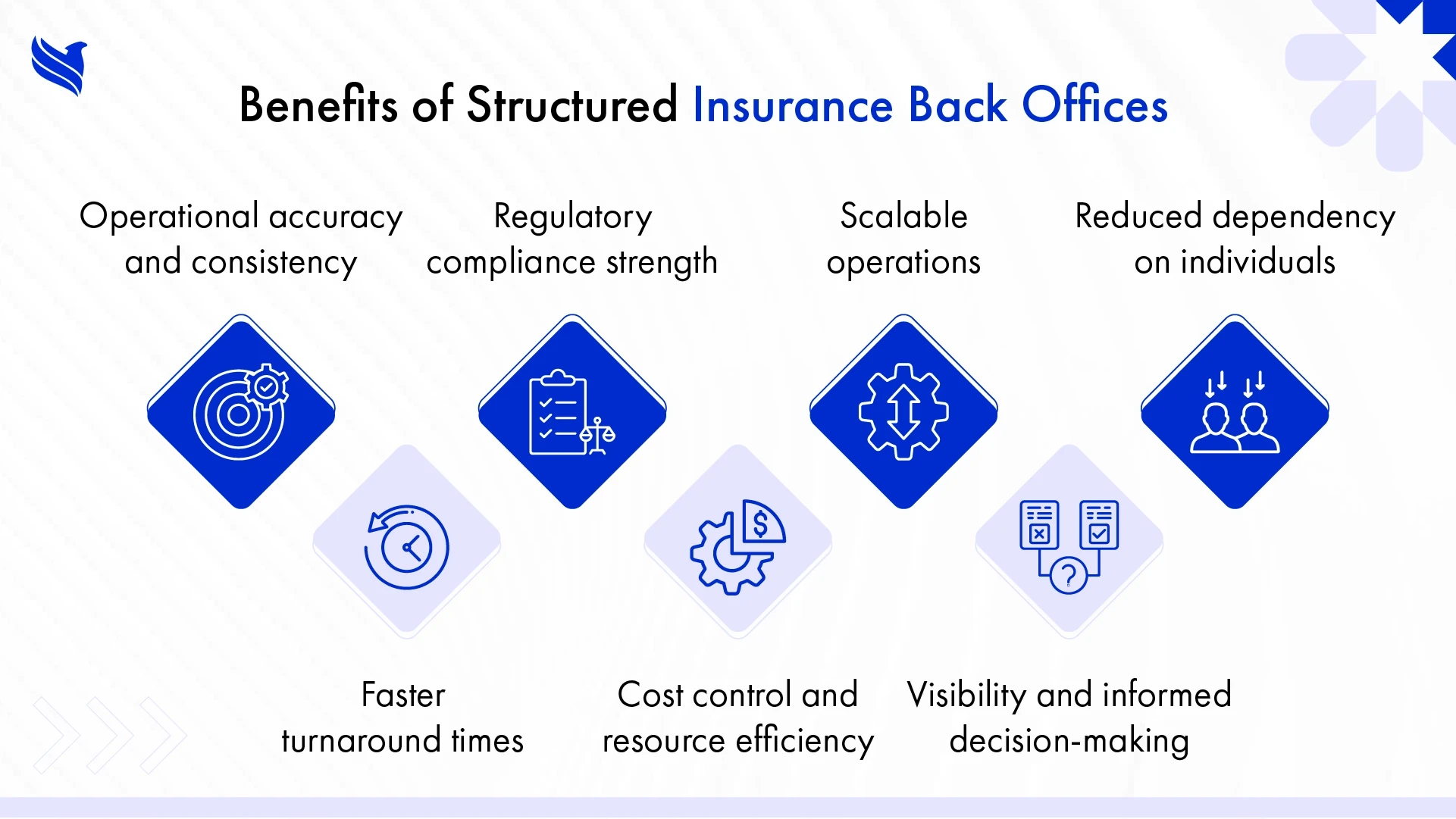
Key benefits of well-structured insurance back-office operations include:
In essence, well-structured insurance back-office operations create stability in an industry where complexity is unavoidable. They allow businesses to operate with confidence, respond faster to market demands, and support growth without constant operational stress. Over time, this structure becomes a competitive advantage, one that strengthens service delivery while freeing leadership to focus on strategic priorities rather than day-to-day operational challenges.
Despite their importance, challenges in back-office operations remain widespread across the insurance industry. The reasons are structural, not managerial.
Many insurance firms still rely on legacy systems that were never designed for today’s speed, data requirements, or integration needs. Manual processes persist where automation should exist, increasing error rates and turnaround times. Data often sits in silos, limiting visibility and decision-making.
Talent constraints add another layer of pressure. Skilled operational professionals are difficult to hire and retain, particularly for repetitive, high-volume work. Training new hires takes time, and knowledge loss from attrition disrupts continuity.
Regulatory demands continue to evolve, increasing documentation, audit readiness, and compliance monitoring workloads. Internal teams frequently struggle to keep pace while also managing daily operations.
Perhaps the most overlooked challenge is mindset. Many insurance business owners attempt to scale back-office operations the same way they scale sales teams, by adding people. This approach increases costs without solving underlying inefficiencies, leading to diminishing returns.
Back-office outsourcing is no longer about offloading tasks; it is about redesigning operations for consistency, control, and scalability. When executed strategically, insurance business outsourcing addresses the root causes of operational strain.
Specialized insurance back-office support providers bring process maturity, trained talent, and technology-enabled workflows that are difficult to replicate internally. They operate at scale, absorb volume fluctuations, and maintain service levels even during peak demand.
Insurance BPO models also reduce dependency on individual knowledge holders. Standard operating procedures, quality controls, and performance metrics ensure continuity and accuracy regardless of staffing changes.
Cost efficiency improves not just through labor arbitrage, but through reduced rework, faster cycle times, and better compliance adherence. Outsourcing partners invest continuously in training, automation, and process optimization, investments that are often impractical for mid-sized and growing insurers to make alone.
Most importantly, outsourcing allows insurance business owners to shift focus from managing processes to managing outcomes. This shift aligns directly with the goals of Digital Transformation in Insurance, leveraging external expertise to modernize operations without disrupting the business.
Accepting change is what fixes the back-office
The one thing insurance business owners must accept to fix their back-office operations is simple, yet transformative: the back-office cannot remain static while the business evolves. Growth, compliance demands, and customer expectations require operations that are flexible, scalable, and resilient.
This blog explores what back-office work in an insurance company truly involves, the benefits of structured operations, the common challenges that hinder performance, and how outsourcing redefines what is operationally possible. Insurance back-office operations are no longer just a cost center; they are a strategic differentiator.
Top back-office operations companies have demonstrated that the right outsourcing model delivers accuracy, speed, and scalability without sacrificing control. For insurance business owners, the choice is no longer whether change is needed, but how decisively it is embraced.
If strengthening insurance back-office support is a priority, partnering with a proven insurance BPO provider can accelerate that transformation. FBSPL works with insurance businesses globally to modernize back-office operations through specialized expertise, scalable delivery models, and a deep understanding of insurance workflows. The next phase of operational excellence begins with the right partner.
Get the latest insights on insurance operations, policy management, and industry best practices.