1 MIN READ·Oct 26, 2026·Written by Bhavishya Bhardwaj

Bordereaux (plural: bordereaux, abbreviated BDX) reporting is the recurring process through which an MGA or cover holder provides carriers, managing agents, or other capacity providers with structured information about the business written under delegated authority.
An insurance bordereau may contain policy, premium, claims, and exposure data, depending on the reporting requirement and the terms of the underlying agreement. Carriers use this information to monitor delegated business, reconcile financial activity, assess claims development, review exposure, and maintain an auditable record of the portfolio.
For MGAs, bordereaux reporting is a core part of delegated authority operations. It provides carriers and capacity providers with the premium, claims, and risk information needed to monitor performance, reconcile accounts, and maintain visibility across the business written under delegated arrangements.
As reporting volumes increase, however, the process becomes more demanding. Data may be drawn from multiple systems; carrier requirements can differ, and inconsistencies across policy references, financial values, claims records, or reporting periods can create reconciliation issues and additional review.
Effective MGA bordereaux reporting therefore depends on more than meeting submission deadlines. It requires disciplined data validation, consistent reconciliation, clear ownership of exceptions, and visibility across every stage of the reporting cycle.
Strengthening these controls can help MGAs improve bordereaux data accuracy, reduce avoidable reporting friction, and maintain greater confidence in the information shared with capacity providers.
Common types of Bordereaux reporting include:
| Bordereaux Type | Purpose |
| Premium Bordereaux | Reports written and earned premium across the reporting period |
| Claims Bordereaux | Reports claims activity, including payments, reserves, and claim status |
| Risk Bordereaux | Provides information on insured risks and underwriting exposures |
| Commission Bordereaux | Reports producer, broker, or intermediary commission information |
| Policy Bordereaux | Records policy-level transactions such as new business, renewals, endorsements, and cancellations |
| Exposure Bordereaux | Reports insured values, limits, locations, and other exposure-related information |
| Technical Account Bordereaux | Supports financial reconciliation and settlement between the MGA and capacity provider |
As MGAs' operations expand, bordereaux reporting becomes more complex. The challenge is not only higher reporting volume, but managing different data requirements, templates, reporting cycles, and reconciliation expectations across each arrangement.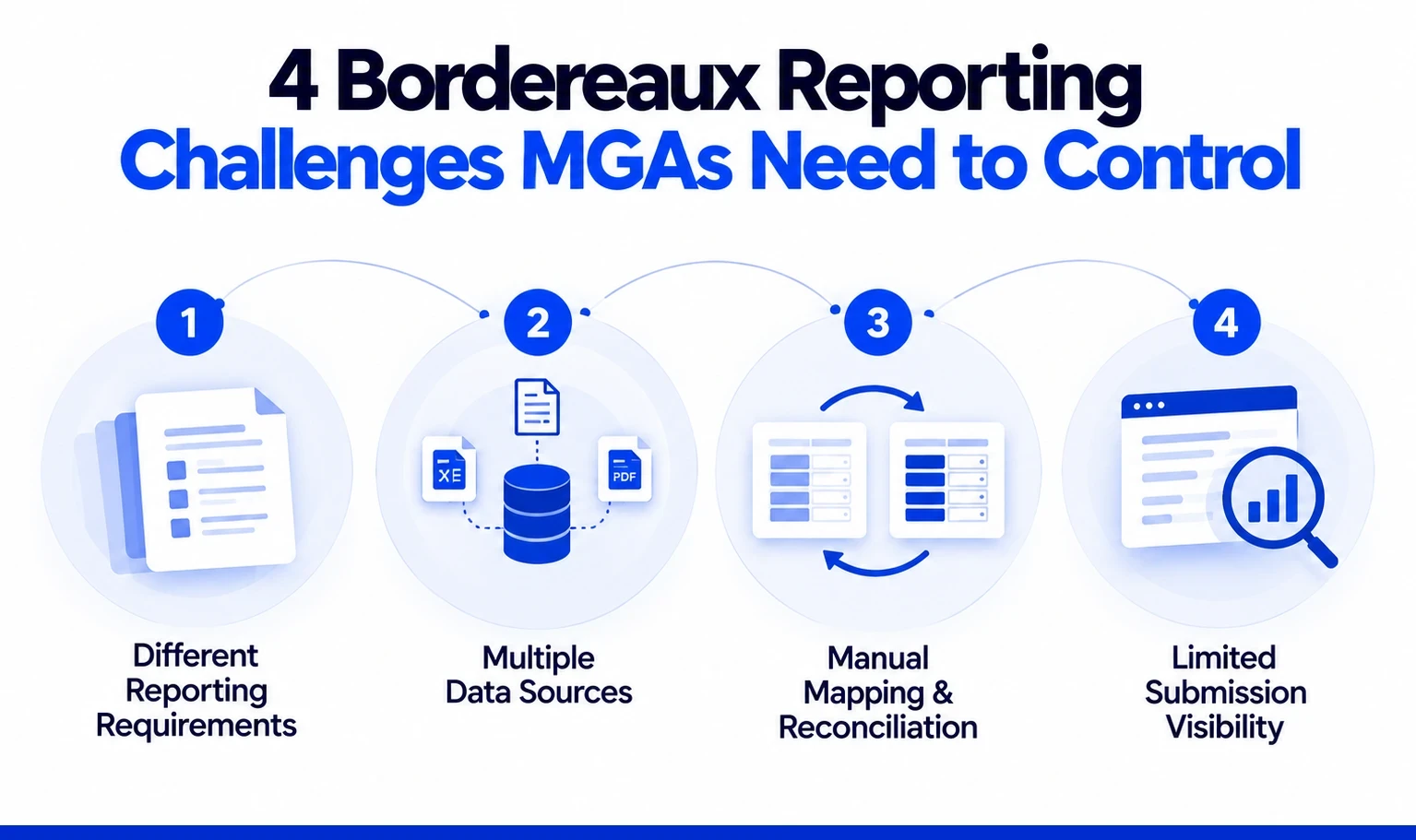
Carrier and managing agent requirements can vary by program. The same underlying policy, premium, claims, or exposure data may need to be mapped differently depending on the reporting structure.
Bordereaux data often comes from policy administration, underwriting, claims, and accounting records. Inconsistencies across those sources can create missing fields, duplicate records, or reconciliation gaps.
Repeated spreadsheet manipulation, rekeying, and carrier-specific formatting increase the risk of errors, especially when multiple bordereaux are prepared within the same reporting cycle.
MGAs also need to know what has been validated, submitted, queried, corrected, and accepted. Without clear status tracking, outstanding exceptions and reporting deadlines can become difficult to manage.
As operations scale, stronger bordereaux management depends on consistent data controls, reliable reconciliation, and clearer visibility across the reporting cycle.
Improving bordereaux data accuracy starts before the report is formatted for submission. MGAs need a controlled process for validating source information, reconciling key financial & policy records, and checking carrier-specific requirements before the bordereau leaves the business.
Policy, premium, claims, commission, and exposure data should follow consistent internal definitions before being mapped. A standardized source structure reduces the risk of the same field being interpreted differently.
Missing transactions, duplicate records, inconsistent policy references, incorrect dates, currency issues, and calculation errors are common causes of bordereaux reporting problems. Hence, careful validation is a must.
Premium, claims, policy, and accounting information should be checked for consistency before submission. Reliable bordereaux reconciliation helps identify mismatches early, eliminating delays.
Carrier-specific formatting will remain part of MGA bordereaux reporting, but the mapping process should be documented and repeatable. Defined field mappings and business rules can reduce unnecessary rework.
Accurate data is only one part of effective MGA bordereaux reporting. MGAs also need clear visibility into where each submission stands, particularly when several programs, carriers, and reporting deadlines are being managed at the same time.
A defined reporting workflow should show whether a bordereau is being prepared, validated, submitted, queried, corrected, resubmitted, or accepted. This gives operations teams a consistent view of progress across reporting cycles.
Carrier queries, missing information, and reconciliation issues should have a clear owner. Defined accountability helps prevent exceptions from remaining unresolved between reporting periods.
Different delegated authority agreements may follow different submission schedules. Centralized tracking helps teams manage due dates and identify reporting requirements that need immediate attention.
Effective bordereaux management should make it clear which file was submitted, what was subsequently changed, and which version represents the current position.
Before a bordereau is released to a carrier or capacity provider, the final review should confirm that both the data and the reporting structure are complete. A concise pre-submission check can help reduce avoidable exceptions and strengthen overall bordereaux data accuracy.
MGAs should confirm that:
A structured bordereaux reporting checklist adds an important control point before submission. It helps ensure that the bordereau is not only complete, but also consistent, reconciled, and ready for carrier review.
A more disciplined approach to bordereaux reporting gives MGAs greater control over both data quality and the wider reporting process. The value is not limited to fewer errors. It also improves how information is reviewed, reconciled, and communicated across delegated authority relationships.
Consistent validation and reconciliation improve bordereaux data accuracy and reduce the risk of incomplete, duplicated, or mismatched records reaching the capacity provider.
Clearer data controls make it easier to identify the source of discrepancies and resolve carrier queries without repeatedly tracing information across multiple files.
Structured bordereaux management provides a clearer view of reporting status, outstanding actions, current versions, and approaching deadlines.
Reliable reporting processes help MGAs maintain consistency as volumes grow, while supporting better oversight across premium, claims, policy, and exposure reporting.
Ultimately, stronger bordereaux processes create a more dependable reporting environment for both the MGA and its capacity partners.
Improving MGA bordereaux reporting is all about working on the framework that reflects the structure of each delegated authority arrangement and the way data moves across the business.
Managing bordereaux reporting requires consistent execution across data preparation, validation, reconciliation, and submission tracking. Through its insurance support services, FBSPL provides MGAs with the operational capacity needed to manage these recurring activities with greater structure and control.
FBSPL's Insurance Support includes:
FBSPL’s back-office support services can help MGAs maintain reporting consistency as transaction volumes, programs, and capacity relationships expand.
For an MGA, the quality of bordereaux reporting says a great deal about the quality of the operation behind it.
Capacity providers rely on this information to understand the business being written, monitor portfolio performance, and maintain confidence in delegated authority arrangements. When reporting is dependable, the conversation can move beyond correcting data and toward managing the portfolio more effectively.
That makes bordereaux report a strategic discipline, not simply a monthly obligation.
MGAs that treat reporting as part of their operating model are better positioned to support stronger carrier relationships, demonstrate greater control over delegated business, and manage growth without allowing reporting complexity to become a constraint. At FBSPL, we help MGAs with smooth bordereaux reporting, ensuring 100% data accuracy and submission visibility.
Feel free to drop your requirement to us and seek our insurance business consultancy support.
A bordereau in insurance is a structured report used by an MGA or coverholder to provide policy, premium, claims, risk, or other delegated authority data to a capacity provider. A bordereau report is generally submitted on an agreed reporting schedule and according to the requirements of the relevant delegated authority arrangement.
Get the latest insights on insurance operations, policy management, and industry best practices.