1 MIN READ·Oct 22, 2026·Written by Bhavishya Bhardwaj

Insurance operations are becoming increasingly complex, not because the work itself is unfamiliar, but because teams are expected to manage more of it with greater speed, accuracy, and control.
Across an agency, that can mean collecting client information, extracting quote data, comparing carrier options, preparing proposals, reviewing policies, analyzing loss runs, managing signatures, organizing documents, and keeping renewals on track. Much of this work is still manual, fragmented, or dependent on repetitive administrative effort.
FBSPL’s Insurance AI Ecosystem was built around those specific tasks. The platform brings together nine insurance AI tools, each designed to support a different part of the agency's workflow while fitting into a broader operational model. FBSPL recently showcased these purpose-built tools at Applied Net 2026, demonstrating how AI can support real insurance workflows.
This blog explores what each tool does, where it fits, and how FBSPL is applying AI to real insurance operations rather than treating AI as a standalone technology.
The value of AI in insurance does not come from adding another layer of technology. It comes from applying it to work that already consumes time, attention, and operational capacity.
Agencies need practical support across everyday tasks such as:
That is the motive behind FBSPL’s Insurance AI Ecosystem. Instead of solving one isolated problem, the platform supports multiple stages of insurance operations through a connected set of tools.
The tools are accessed through a single login and shared permission model, which makes the ecosystem easier to manage as part of the agency’s wider workflow.
For agency owners and operations leaders, the focus is not simply on adopting AI. It is on using AI where it can reduce friction without taking control away from the people making the decisions.
Built around real insurance tasks, these nine tools support different points in the workflow, from client intake and quote processing to policy review, loss-run analysis, document handling, and renewals. Together, they show how AI can be applied where insurance teams spend time every day.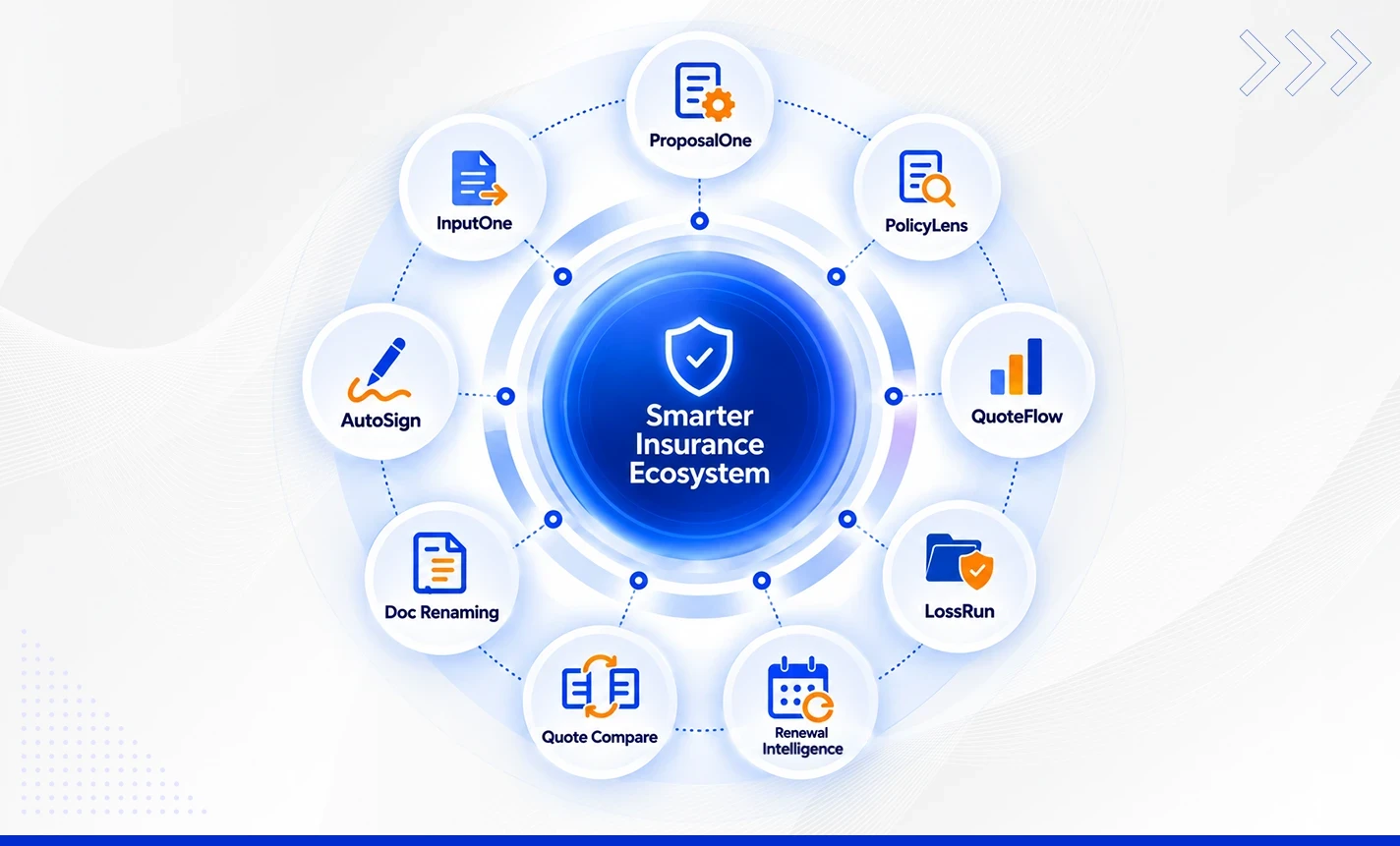
Getting complete information from a prospect can take more effort than expected. Replies arrive in pieces; forms come back incomplete, and producers often end up asking the same questions more than once.
InputOne gives agencies a structured way to collect that information through a guided questionnaire, while keeping the responses usable for the work that follows.
What InputOne Does:
Carrier quote documents rarely follow one standard format. That leaves agency teams opening PDFs, locating the right figures, and moving the information somewhere it can be used.
QuoteFlow turns those documents into structured quote data, giving teams a cleaner starting point for comparison, proposal creation, and other downstream activity.
What QuoteFlow Does:
Quote Compare helps agencies look beyond premium by bringing carrier quotes together and comparing coverage and price side by side. Its recommendation score is based on defined weights rather than an unexplained model output, and the final result still requires human review.
What Quote Compare Does:
Once the options are reviewed, the work is not finished. Someone still has to turn the carrier information into a proposal the client can understand.
ProposalOne reads carrier quote PDFs, pulls out the relevant figures, organizes them into a client-facing proposal, and adds an executive summary that can be reviewed before export.
What ProposalOne Does:
Signature preparation is a small task that becomes repetitive very quickly, especially across longer commercial applications.
AutoSign identifies where signatures and initials are required, places the fields, and sends the document through DocuSign. One important distinction is that it does not use a language model; the tool relies on OCR for this task.
What AutoSign Does:
A quote, binder, and issued policy should tell the same story. Finding out that they do not can otherwise mean comparing several documents line by line.
PolicyLens is built for that review. It extracts policy information, identifies field-level differences across the documents, and adds a plain-language narrative to help teams understand what changed and where attention may be needed.
What PolicyLens Does:
Loss runs carry important risk information, but they are rarely quick documents to work through.
LossRun gives teams a calculated starting point by reading the PDFs, computing loss ratios, and flagging defined patterns for review. The calculations are handled through deterministic rules, and a human reviewer must approve the output before it is treated as final.
What LossRun Does:
Not every useful insurance AI application needs to solve a highly complex problem.
Inconsistent filenames make documents harder to locate, file, and reuse. Doc Renaming reads batches of files, identifies what each document is, and applies the agency’s chosen naming convention across the batch.
What Doc Renaming Does:
Renewals involve much more than watching an expiration date. There are documents to collect, tasks to assign, clients to follow up with, policies to re-market, and progress to track across the book.
Renewal Intelligence brings that activity into a structured workflow, giving teams visibility into renewal status, ownership, outstanding work, and history. It also uses the ecosystem’s existing LossRun and Quote Compare capabilities when those functions are needed.
What Renewal Intelligence Does:
The value of insurance AI lies in how effectively it improves operational control across the business. For agency owners and operations leaders, that means reducing the administrative burden attached to document-heavy workflows while creating greater consistency across quoting, policy review, renewals, and related service activities.
The practical impact can be seen in areas such as:
FBSPL’s tools have been built around these operational priorities. Each tool addresses a specific task, while the wider platform brings greater structure to work that is often fragmented across documents, spreadsheets, systems, and manual follow-ups.
For insurance business owners, the opportunity is not simply to adopt more technology. It is to establish a more controlled and scalable operating model for the work their teams already manage.
Insurance AI will create the most value where it is applied with a clear understanding of the work, the workflow, and the decisions that still require human judgment.
FBSPL’s AI tools ecosystem reflects that approach. Each capability is built around a specific operational task, while the broader platform brings those capabilities together across intake, quoting, proposals, policy review, loss analysis, document management, signatures, and renewals. Besides that, we offer expert consulting services to check whether your workflow is AI-ready or not and help you choose the best-suitable tools for your business process and operations.
At Applied Net 2026, FBSPL showcased how these tools work in practice and how purpose-built AI can support different stages of modern insurance operations. Besides just showcasing AI tools, the experts helped insurance businesses suggest the right tools based on their business needs and requirements.
So, if you want to explore how these tools can fit into your insurance operations?
Connect with our experts to explore more.
Bhavishya Bhardwaj is the Digital Marketing Manager at FBSPL, bringing over a decade of experience across insurance, outsourcing, accounting, and digital transformation.
Get the latest insights on insurance operations, policy management, and industry best practices.