1 MIN READ·Oct 29, 2026·Written by Bhavishya Bhardwaj

AI and automation initiatives often begin with a major question: What can we automate? But, before that, we should always ask: Is the process ready to be automated? That distinction matters.
As per Boston Consulting Group, 74% of companies had yet to demonstrate tangible value from AI, while roughly 70% of AI implementation challenges were linked to people and process issues rather than technology or algorithms.
An SOP may look complete on paper and still conceal outdated steps, informal workarounds, unclear handoffs, or exceptions that depend on individual judgment. Automating that workflow does not remove those weaknesses. It can embed them more deeply into the operating model.
A structured SOP audit checklist helps businesses examine the process before technology is introduced. By comparing the documented procedure with how work happens, teams can identify process gaps, strengthen controls, clarify decision points, and determine what can be standardized, automated, or AI-assisted while keeping human insights.
That makes business process gap analysis an essential starting point for any serious AI or automation initiative.
An SOP audit checklist is a structured framework used to assess whether a standard operating procedure is current, complete, and aligned with how the process is performed.
The review should go beyond checking whether the document contains the expected sections. A standard operating procedure audit checklist examines three things together:
Effective SOPs are expected to define scope, purpose, responsibilities, execution sequence, controls, and review requirements, but their value depends on how accurately they reflect day-to-day operations.
For businesses preparing automation, the audit becomes an early form of business process gap analysis.
Automation works best when you have clear processes and standardized workflows. If your system lacks pre-defined ownership and data, technology can carry those weaknesses forward. That's where a well-defined SOP can help you identify those issues before implementation.
Duplicate approvals, repeated data entry, and unnecessary handoffs should be identified before automation. Otherwise, businesses risk automating activities that add little value to the process.
Many workflows depend on employees knowing what steps to take when something falls outside the standard path. If those exceptions are not documented properly, an automated process won’t work without human intervention.
AI and automation depend on clearly defined inputs, reliable data sources, and expected outputs. Missing fields, inconsistent formats, or unclear data ownership can reduce process reliability and create downstream errors.
Not every decision within an SOP should be automated. Businesses need to define where AI can support execution and where human judgment must remain part of the process.
A thorough SOP audit checklist helps determine whether the process is stable enough to automate and which gaps should be resolved before AI is introduced.
A useful SOP audit checklist should test whether the process is clear enough to automate or not. Here is a useful SOP audit checklist where reviewing 7 major key areas would help before automating anything.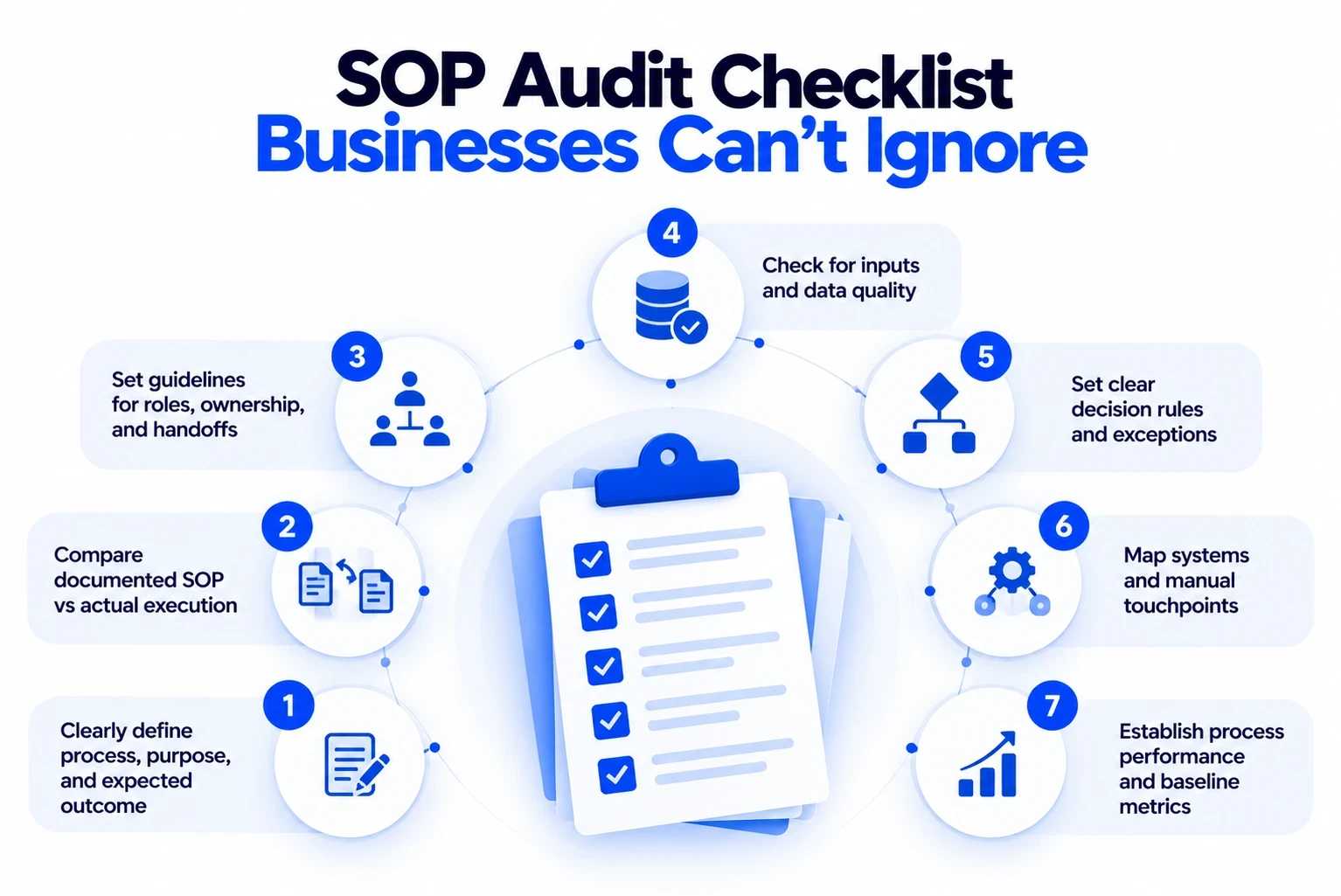
Start by confirming what the process is designed to achieve.
Check for the following details:
The written SOP should reflect how employees perform the work in practice.
Look for:
These differences are often the first indicators uncovered during a business process gap analysis.
A Maryland based insurance agency got it's errors reduced by 30%, improved task completion speed by 20% through workflow standardization, SOP improvements, and operational changes.Read the case study to explore the results.
Every task, approval, and escalation point should have clear ownership.
Review whether responsibilities are defined at each stage and whether handoffs between teams create delays, duplication, or uncertainty. Processes with unclear ownership are difficult to automate because the system needs to know who acts, when they act, and where work moves next.
Automation depends on consistent inputs.
Audit:
If inputs vary significantly from one case to another, those inconsistencies should be addressed before automation or AI is introduced.
A process is not fully documented if the SOP explains only the standard path. Identify where teams rely on judgment, special cases, or unwritten escalation rules. Exceptions should define what triggers them, who handles them, and when human intervention is required.
This becomes particularly important when preparing an AI-driven SOP, where decision boundaries need to be explicit.
Map where people interact with systems throughout the workflow.
Common gaps include:
These may represent automation opportunities, but only after the underlying workflow has been reviewed and standardized.
Before changing the process, establish how it performs today.
Useful measures may include:
| Metric | What it helps assess |
| Cycle time | How long the process takes from start to completion |
| Rework frequency | How often completed work requires correction |
| Exception volume | How frequently cases fall outside standard procedures |
| Number of handoffs | How often work moves between people or teams |
| Backlog | How much work remains incomplete |
| Completion rate | How consistently work reaches its intended outcome |
Without a baseline, it becomes difficult to determine whether automation has actually improved the process.
An SOP is ready for AI or automation when the process is stable enough to be translated into clear rules, inputs, decisions, and outcomes. Documentation alone is not sufficient. The procedure must explain how the workflow behaves under both normal and exception conditions.
Before moving toward an AI-driven SOP, businesses should confirm that the process clearly defines:
The relationship between Artificial Intelligence (AI) and Standard Operating Procedures (SOPs) works best when these elements are explicit. A well-defined SOP gives automation a reliable structure to follow while preserving human oversight where risk, ambiguity, or judgment still matters.
AI and automation can improve execution, but only when the underlying process is clear enough to support them. An outdated or inconsistent SOP does not become stronger simply because technology is added to it.
A structured SOP audit checklist helps businesses identify where workflows need to be clarified, standardized, or controlled before implementation begins. The goal is not to automate more, but to automate what is genuinely ready.
For organizations moving from process review to implementation, the right AI & automation consulting for businesses can help connect SOP findings with practical automation priorities. FBSPL’s AI Consulting and Automation Solutions support this transition by helping businesses assess workflows, identify process gaps, and determine where AI or automation can add meaningful value. Feel free to connect with our experts to learn more.
Get the latest insights on insurance operations, policy management, and industry best practices.