1 MIN READ·Sep 25, 2026·Written by Bhavishya Bharadwaj
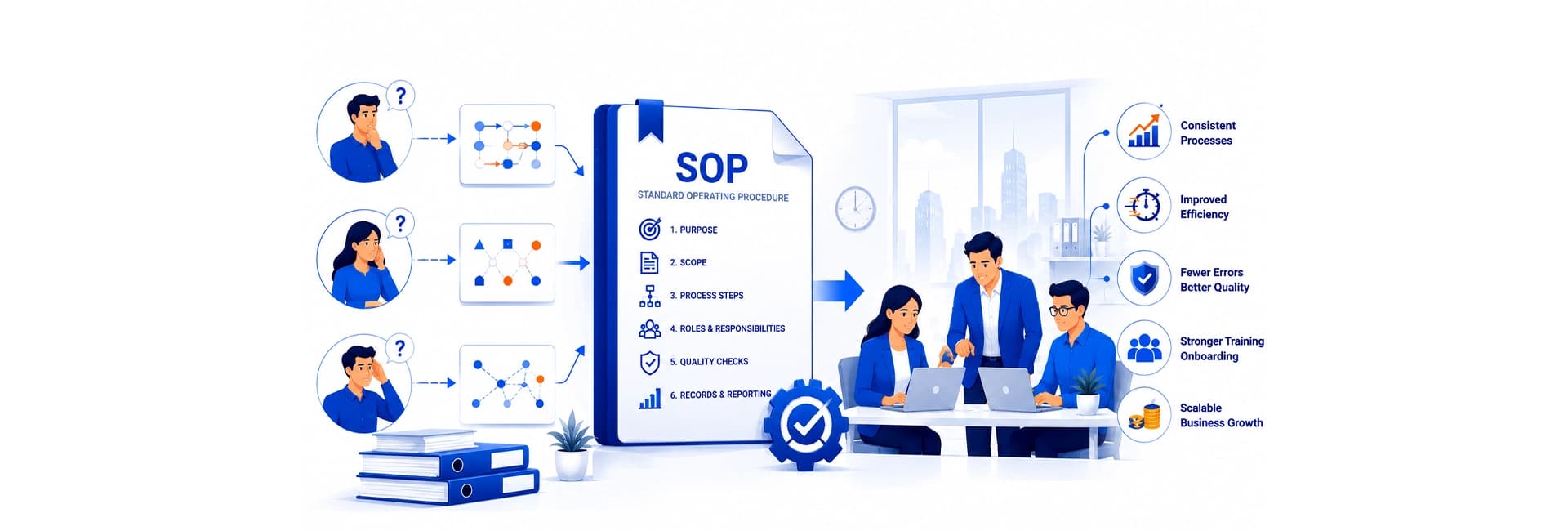
Summary: SOP development transforms undocumented business knowledge into standardized, scalable processes that improve consistency, onboarding, compliance, and operational efficiency. By creating clear procedures and continuously refining them, businesses build a strong foundation for sustainable growth, automation, AI adoption, and long-term organizational resilience.
Most businesses don't collapse because of a bad quarter. They collapse quietly, one undocumented decision at a time; when the one person who "just knows how things work" goes on leave, resigns, or retires, and takes the entire operating model out the door with them.
That's the real story behind SOP development. It isn't paperwork. It's the difference between a business that can scale and one that's permanently held hostage by tribal knowledge.
If you've ever asked "why does onboarding take six weeks," "why did that client complaint slip through," or "why does the same task get done three different ways by three different people"; you've already diagnosed the problem. The answer, in almost every case, is the absence of well-built Standard Operating Procedures.
SOP development is the structured process of identifying, documenting, standardizing, and continuously improving the step-by-step procedures that keep a business running; from how a lead gets qualified, to how an invoice gets approved, to how a new hire gets trained.
A true SOP isn't a vague policy statement or a dusty PDF nobody opens. A well-developed SOP defines:
Done properly, SOP development sits at the intersection of process consulting, operations strategy, and change management. It's not about creating rigid bureaucracy; it's about capturing what already works, removing what doesn't, and building a system that runs consistently whether your best performer is in the room or not.
Growing businesses tend to treat documentation as a "someday" project; until the cracks become too expensive to ignore. Some of the most common symptoms include: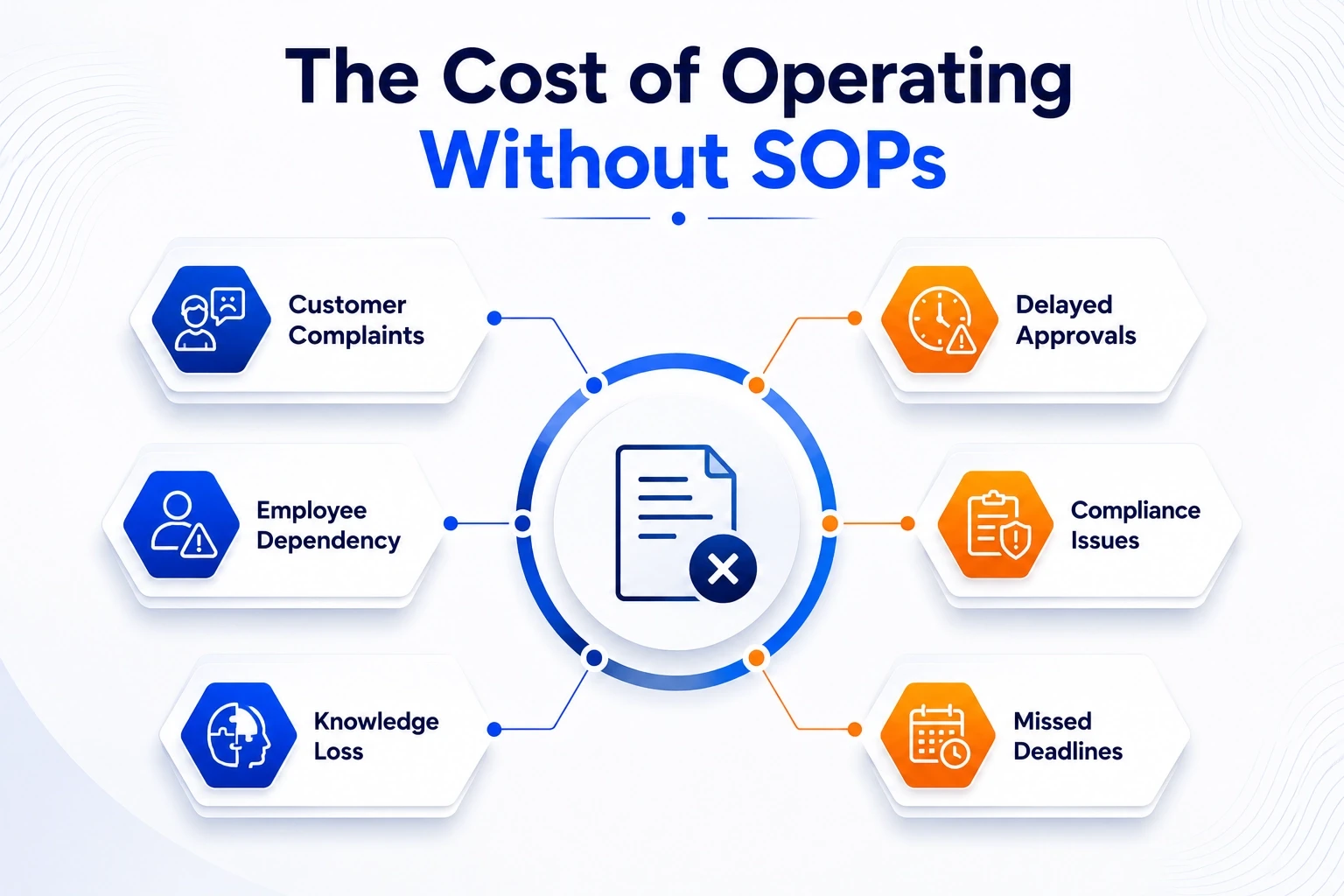
This isn't a niche concern anymore; it's a recognized market shift. Analysts tracking the standard operating procedures software category project the global market to grow from roughly $371 million in 2025 to about $541 million by 2032, a trajectory that reflects how many organizations are formally investing in process documentation rather than treating it as an afterthought. That kind of sustained investment doesn't happen unless business leaders are feeling real operational pain.
Here's the paradox: SOPs feel unnecessary when a business is small, because the founder or a tight core team can hold every process in their heads. But the moment a business starts growing; new hires, new locations, new clients, new product lines; that informal system breaks down almost overnight.
Growth multiplies:
Without documented procedures, growth doesn't scale the business; it scales the chaos. Every new hire becomes a new interpretation of "how we do things," every new market adds a new set of undocumented workarounds, and leadership spends more time firefighting than steering strategy.
This is precisely why SOP development is not a support function; it's a growth enabler. It's the operational backbone that lets a business add headcount, locations, or product lines without diluting quality or slowing down decision-making.
Effective SOP development is a discipline, not a document exercise. It typically follows a structured cycle:
Before anything gets written, the actual process; not the assumed process; needs to be mapped. This means interviewing the people who do the work, observing workflows, and identifying where the real bottlenecks and variations exist.
Once the current-state process is clear, the next step is designing the ideal version: removing redundant steps, closing gaps, and writing procedures in plain, unambiguous language that a new employee could follow without hand-holding.
SOPs are tested against real scenarios; including edge cases; before they're rolled out. A procedure that only works in the ideal scenario isn't a real SOP.
Documentation is worthless if teams don't use it. Strong SOP development includes a rollout plan: training sessions, accessible formats, and clear ownership for updates.
Processes aren't static. SOPs need scheduled reviews so they evolve alongside the business, new tools, and regulatory changes; instead of becoming outdated the moment they're published.
This is also exactly where organizations attempting to automate or apply AI on top of messy operations tend to stall. McKinsey's most recent global survey on AI adoption found that while a large majority of companies now use AI in at least one function, the organizations actually capturing enterprise-level financial impact are the ones that go further: roughly half of high-performing organizations are deliberately redesigning their workflows rather than layering new tools on top of old, undocumented processes. In other words, technology amplifies whatever process foundation already exists; good or bad. Without SOPs to standardize the "before," automation simply digitizes the dysfunction faster.
When SOP development is done as a strategic initiative rather than a compliance checkbox, the returns show up across the business:
Every conversation about automation, AI agents, or digital transformation today assumes there's a clear, documented process underneath the technology. That assumption often doesn't hold. Gartner's most recent research on enterprise AI readiness found that among senior business leaders surveyed at the close of 2025, only 27% reported having a comprehensive AI strategy, and just 20% believed their workforce was genuinely ready to work alongside it. The gap isn't a technology gap; it's an operational readiness gap. You cannot automate a process that has never been clearly defined.
This is the strategic argument for treating SOP development as infrastructure, not paperwork: it's the groundwork that makes every future initiative; automation, AI adoption, new market entry, franchising, or private equity due diligence; dramatically easier to execute.
The businesses that get the most value from SOP development don't just document what exists; they use the process as an opportunity to identify inefficiencies, remove unnecessary steps, and build a system that's genuinely easier to follow than the old, undocumented way of working. That requires an outside, structured perspective: someone who can map processes objectively, ask the uncomfortable "why do we do it this way" questions, and translate operational chaos into a system your whole team can rely on.
This is where a strategic operations partner; rather than a generic documentation vendor; makes the difference. At FBSPL, SOP development is approached as operational transformation: mapping how your business actually runs today, standardizing it into clear, scalable procedures, and building the foundation that supports your next stage of growth, whether that's automation, expansion, or simply running a tighter, more resilient operation.
Get the latest insights on insurance operations, policy management, and industry best practices.