AI in Financial Reporting: Use Cases, Benefits, Risks, and Best Practices
1 MIN READ·Nov 03, 2026·Written by Bhavishya Bhardwaj

What is AI in Financial Reporting?
Artificial intelligence (AI) in financial reporting refers to the use of AI technologies to support how financial data is collected, reviewed, analyzed, and communicated across the reporting process.
Its role can extend across account reconciliation, anomaly detection, variance & financial statement analysis, forecasting, and report preparation. This helps finance teams identify exceptions, detect patterns, and focus their manual review on transactions or figures that need closer attention.
To understand where AI fits into this process, it is useful to first understand financial reporting and why it is important for financial control, performance visibility, and business decision-making.
As finance teams manage growing data volumes, tight reporting deadlines, and evolving compliance requirements, maintaining accurate and timely financial reports can become increasingly challenging.
A KPMG study found that “72% of surveyed organizations were already piloting or using AI in financial reporting, with adoption expected to increase significantly.”
This indicates that AI's role in financial reporting extends beyond automating routine data entry. It can also support financial analysis, help identify potential reporting issues, and provide insights that inform business decisions.
The opportunity is significant, but so are the requirements behind it. The key is to understand where AI can create meaningful value and how to implement it while maintaining the accuracy, transparency, and accountability that financial reporting requires.
Source: “72% of surveyed organizations..." - KPMG
How is AI Used in Financial Reporting Process?
The use of AI in financial reporting becomes a savior where finance teams spend more time collecting data, reviewing transactions, and preparing reports.
1. Financial Data Collection
AI can help gather financial information from multiple systems and data sources, reducing the effort required to prepare reports. This is useful where finance teams rely on spreadsheets or manual data preparation.
2. Account Reconciliation and Transaction Matching
Reconciliations often involve reviewing large volumes of transactions to identify matches and exceptions. AI can assist by recognizing potential matches and directing unresolved items for further review, allowing teams to focus on core tasks.
How Automation Improved Commission Reconciliation: A specialty insurance provider in Arizona faced delays caused by manual commission reconciliation, disconnected agency management systems, and inconsistent reporting.
Following automation and system integration improvements, the provider reported a 50% reduction in commission reconciliation time, alongside reduced manual intervention in commission processing.
Read the complete insurance operations automation case study to understand the changes behind these results.
3. Anomaly and Error Detect
AI can examine financial data for unusual transactions, duplicate entries, unexpected movements, or inconsistencies. A flagged item should be treated as an exception for review, not automatically as an error or fraud indicator.
4. Financial Statement Analysis
AI can support financial statement analysis by examining trends, ratios, and relationships across financial data. This can help finance teams identify patterns that may be difficult to detect through manual analysis alone.
5. Variance Analysis
Significant differences between actual results, budgets, or forecasts require considerable investigation. AI can help surface material variances and support analysis across accounts, departments, locations, or reporting periods.
For a deeper explanation of these applications, explore FBSPL's guide to predictive analytics in finance.
What Are the Benefits of AI in Financial Reporting?
The benefit of AI in financial reporting is most visible when it reduces the number of manual efforts without weakening control or financial oversight. The benefit lies in shifting the finance team’s time toward review, interpretation, and decision support.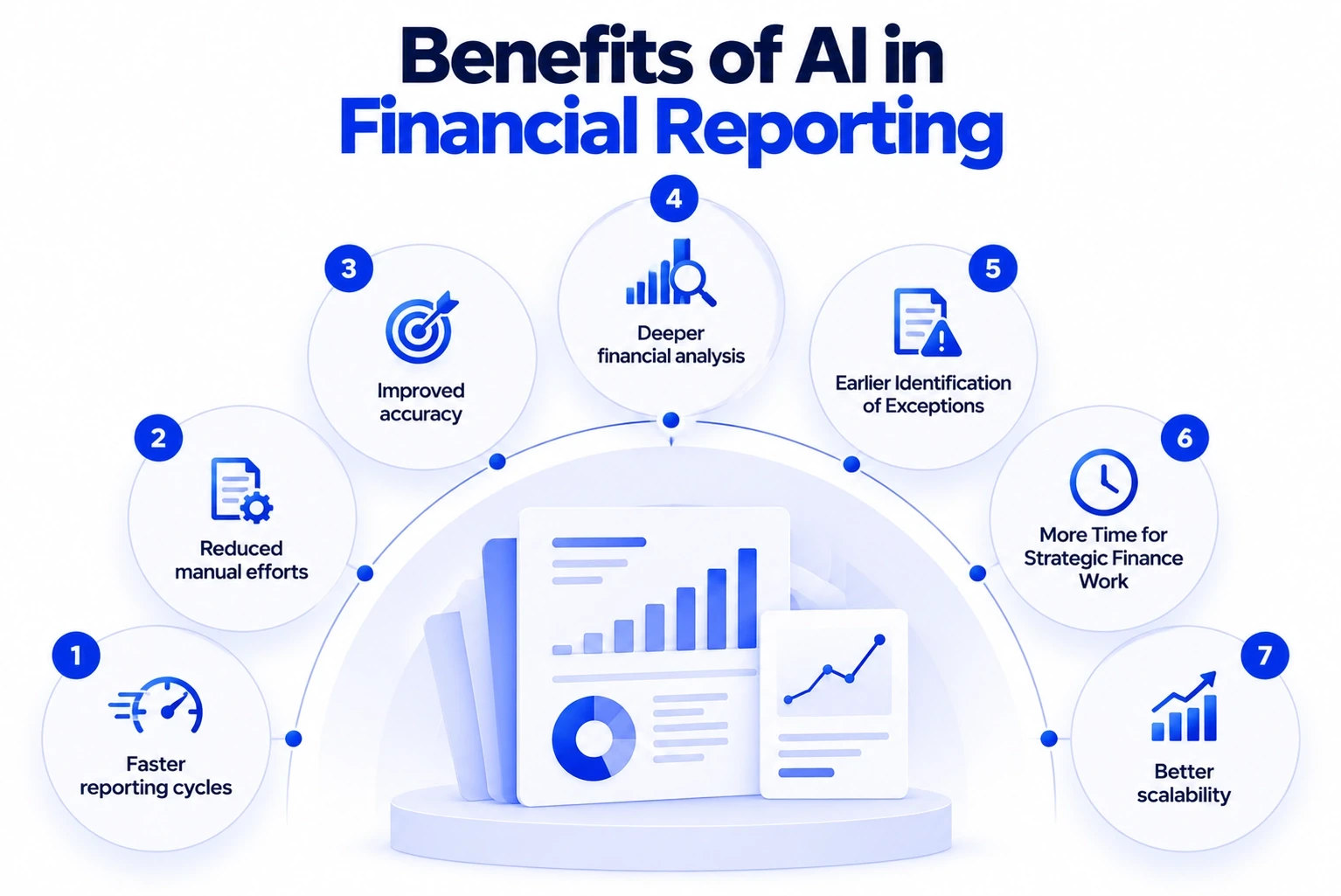
- Faster Reporting Cycles
When data preparation, transaction matching, and exception identification require less manual handling, parts of the reporting process can move more quickly. This can help finance teams spend less time gathering unwanted data. - Reduced Manual Effort
AI can take on repetitive activities such as organizing financial data, identifying potential matches, and highlighting unusual transactions. That reduces the amount of routine work that finance professionals need to perform manually. - Improved Accuracy and Consistency
AI-supported checks can help reduce duplicate entries, mismatches, unusual movements, or missing information. It should support accuracy, not be treated as a substitute for financial validation. - Deeper Financial Analysis
One of the stronger benefits is the ability to examine larger volumes of information and identify relationships across accounts, entities, or business units. This can strengthen financial statement analysis and give finance teams more context around performance. - Earlier Identification of Exceptions
Potential issues can be flagged earlier in the reporting cycle instead of being discovered only at final review. Earlier visibility gives teams more time to investigate discrepancies before reports are finalized. - More Time for Strategic Finance Work
As repetitive reporting tasks require less attention, finance professionals can redirect capacity toward forecasting, planning, business partnering, and management analysis. - Better Scalability
As transaction volumes grow, reporting requirements do not always need to create a proportional increase in manual effort. AI-supported workflows can help finance functions manage greater reporting complexity while maintaining more consistent processes.
What is the Impact of AI in Financial Reporting?
The impact of AI on financial reporting is not limited to speed. It changes where finance teams spend their effort and how the reporting cycle is managed from one stage to the next.
| Reporting Area | Traditional Approach | AI-Enabled Approach |
| Data preparation | Data gathered and consolidated manually from multiple sources | AI-assisted extraction, classification, and consolidation |
| Reconciliation | Large transaction populations reviewed line by line | Potential matches identified automatically; exceptions routed for review |
| Financial analysis | Period comparisons and trends assessed mainly through manual review | Patterns, relationships, and unusual movements surfaced more quickly |
| Variance review | Significant differences investigated after reports are assembled | Material variances identified earlier in the reporting cycle |
| Error detection | Periodic checks performed at defined review points | Anomalies and inconsistencies flagged as data is processed |
| Report preparation | Financial summaries and commentary drafted manually | First drafts of summaries and commentary generated for finance review |
| Forecasting | Heavily dependent on historical models and manual assumptions | Historical and current data used to support predictive analysis |
| Finance team focus | Significant time spent preparing and checking information | More time directed toward exceptions, interpretation, and business insight |
The larger shift is toward a more exception-driven reporting process. Instead of reviewing every transaction with the same effort, finance teams can focus more on tasks that require investigation or need professional judgment.
That can also change the role of the finance function itself. Teams will spend less time checking routine information while more attention moves toward business context, forecasting, and decision support.
However, this shift only creates value when the underlying reporting process is well controlled. AI may change how financial information is prepared and reviewed, but accountability for material financial decisions, interpretation, and final reporting still rests with finance professionals.
What Are the Risks and Challenges of AI in Financial Reporting?
Before integrating AI, business owners must be aware of ‘What are the risks and challenges of AI in financial reporting?’ Here are a few of them -
1. Poor Data Quality
AI is only as reliable as the information it works with. Incomplete records, inconsistent account structures, duplicate entries, or poorly standardized data can weaken outputs from the beginning.
Therefore, before making AI part of the reporting process, finance teams need to address the quality, ownership, and consistency of the financial data.
2. Data Privacy and Security
Financial information often includes sensitive business, employee, customer, and transaction data. Introducing AI means reviewing where that data is processed, who can access it, and how it is protected.
Access controls, secure environments, and defined data-handling rules should be established before implementation.
3. Limited Explainability
If an AI system flags an anomaly, recommends a classification, or generates an explanation, users should be able to trace the result back to the relevant financial information wherever possible. Outputs that cannot be explained are difficult to rely on in a controlled reporting environment.
4. Unsupported or Misleading Outputs
Generative AI can produce summaries, explanations, or reporting commentary quickly, but those outputs may occasionally contain incorrect assumptions or unsupported conclusions.
That is especially important in financial reporting, where a convincing narrative is not the same as a correct one. Material commentary and explanations should always be checked against the underlying numbers.
5. Integration with Existing Systems
Many finance functions still operate across multiple accounting platforms, ERPs, spreadsheets, and reporting tools. Introducing AI into that environment can be difficult if data structures are inconsistent or systems do not connect cleanly.
How to Implement AI in Financial Reporting: Key Steps and Best Practices
Implementing AI in financial reporting requires more than selecting a tool and connecting it to financial data. The quality of the outcome depends on how well the existing reporting process is understood, how reliable the underlying data is, and whether appropriate controls are built into the workflow from the beginning.
1. Assess the Existing Reporting Process
Identify bottlenecks, repetitive work, manual handoffs, recurring errors, and areas where finance teams spend disproportionate time.
Many of these issues are also among the common financial reporting challenges businesses need to address before introducing AI into the workflow.
2. Prioritize the Right AI Use Cases
Start with a defined reporting problem rather than adopting AI broadly. Reconciliation support, variance analysis, and anomaly detection can be more suitable starting points than trying to automate the whole reporting cycle.
3. Prepare and Standardize Financial Data
Review data quality, ownership, naming conventions, structures, duplicates, and system consistency before implementation.
4. Choose Technology Around the Use Case
Evaluate tools based on the reporting requirement, system environment, traceability, security, and integration needs rather than selecting technology first and finding a use for it later.
5. Build Governance and Human Review into the Workflow
Define:
- Access permissions
- Approval authority
- Data-handling rules
- Audit trails
- Review requirements
- Accountability
6. Start With a Controlled Pilot
Begin with a manageable use case and test it against real reporting conditions before expanding.
7. Measure Performance and Refine
Track indicators such as:
- Reporting turnaround time
- Manual effort
- Exception volume
- Rework
- Close-cycle duration
- Time available for analysis
Where Human Oversight Still Matters?
AI can take on more of the repetitive and data-intensive work around financial reporting, but that does not reduce the need for human expertise.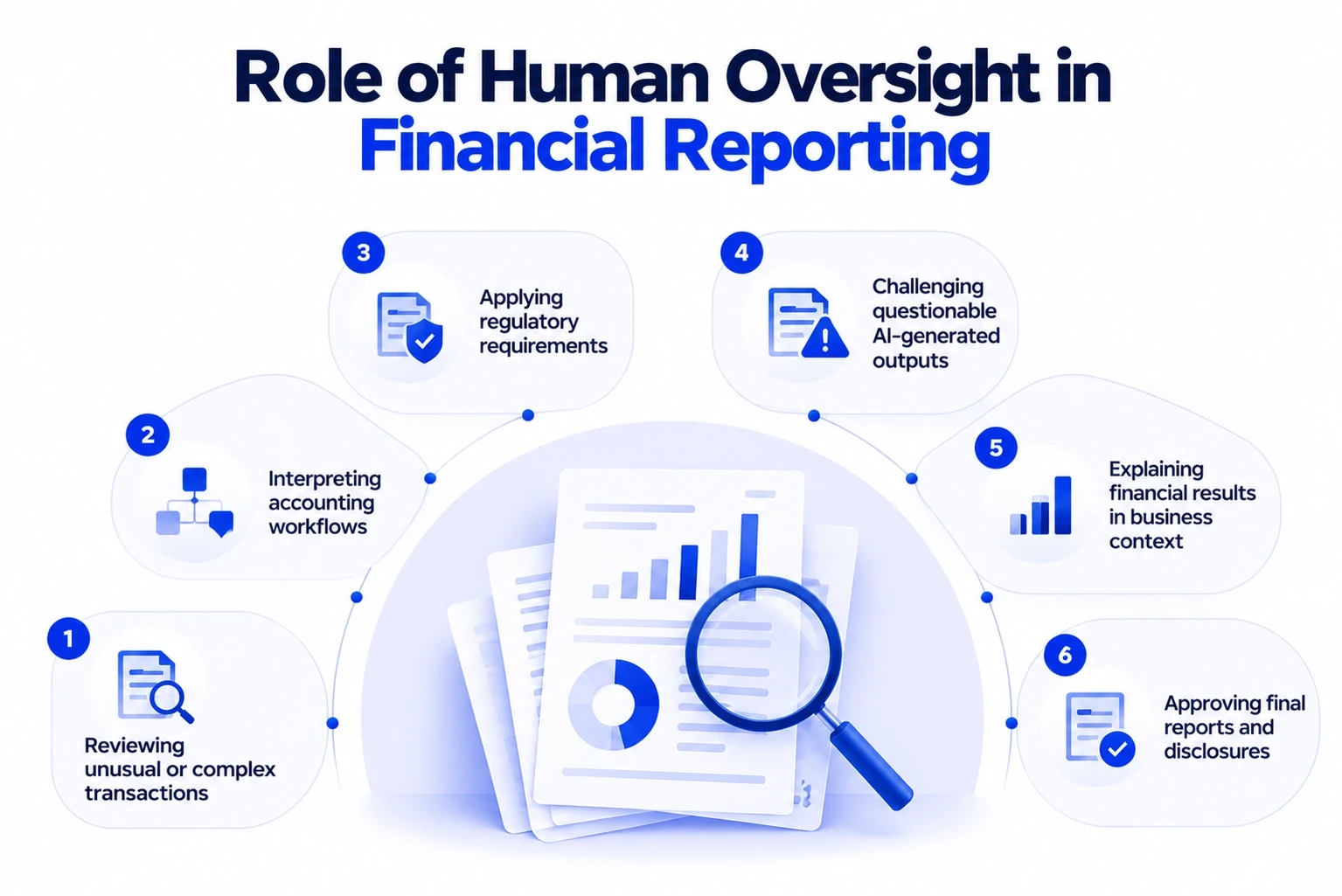
The distinction is important. AI may identify a variance, surface an anomaly, or draft an explanation, but it does not automatically understand whether that movement is commercially significant, whether an accounting treatment is appropriate, or whether additional investigation is required.
Building an AI-Ready Financial Reporting Process
AI will not improve financial reporting simply because it has been introduced into the workflow. The value comes from the foundation around it: reliable data, clearly defined processes, appropriate controls, suitable technology, and finance professionals who know when to question the output.
For businesses, the priority should be to strengthen the reporting process before trying to automate more of it. FBSPL’s financial services can support businesses in strengthening reporting, reconciliation, analysis, and related finance operations, helping create a more dependable base for technology-enabled finance.
Bhavishya Bhardwaj
Bhavishya Bhardwaj is the Digital Marketing Manager at FBSPL, bringing over a decade of experience across insurance, outsourcing, accounting, and digital transformation.
Leave a Comment
Table of Content
Subscribe our Newsletter
Get the latest insights on insurance operations, policy management, and industry best practices.