



Predictive analytics in finance: A strategic guide to smarter financial decision-making
18 MIN READ/May 15, 2026

Summary: Predictive analytics in finance helps organizations forecast outcomes, reduce risk, improve planning accuracy, and make faster strategic decisions using data, machine learning, and advanced modeling. This guide explores core models, use cases, implementation challenges, tools, and the evolving role of AI-driven financial intelligence.
Most finance teams are sitting on a goldmine of data; and most of them are still using it to look backward.
Quarterly reports. Year-end reconciliations. Variance analyses built on last month's actuals. These are all useful tools, but they share a fundamental limitation: they tell you what already happened. In a business landscape defined by rapid market shifts, tightening margins, and increasingly complex operations, that's rarely enough.
This is the problem predictive analytics in finance was built to solve — and it's reshaping how forward-thinking organizations plan, operate, and compete.
This guide breaks down exactly what predictive analytics means in a financial context, how it works in practice, which models and tools are driving adoption, and what it takes to implement it in a way that creates lasting operational value.
What is predictive analytics in finance?
Predictive analytics in finance refers to the use of statistical algorithms, machine learning models, and historical data to forecast future financial outcomes, identify patterns, and support more confident decision-making.
Unlike traditional financial reporting, which is inherently retrospective, financial predictive modeling is forward-looking. It doesn't just answer "What happened last quarter?" It answers "What is likely to happen next quarter, and what should we do about it now?"
In practical terms, this means a finance team can move from a 30-day-old spreadsheet to a live, continuously updated model that factors in customer behavior, market signals, economic indicators, and internal operational data; all at once.
The distinction matters because financial decisions made on stale data carry real risk: missed revenue forecasts, under-resourced growth initiatives, undetected fraud, or compliance failures that surface only after the fact.
Predictive analysis in finance closes that gap between data and decision.
Why predictive analytics in finance is no longer optional
The pressure on finance functions has never been higher. CFOs and financial leaders are being asked to do more than maintain accurate books; they're expected to drive strategic growth, manage enterprise-wide risk, and deliver real-time visibility across increasingly complex operations.
At the same time, the volume and velocity of financial data has exploded. Transaction records, customer behavior logs, ERP outputs, market feeds, regulatory filings; the raw material for intelligent analysis is abundant. The challenge is turning that abundance into clarity.
According to Grand View Research, the global predictive analytics market is projected to grow from USD 18.89 billion in 2024 to USD 82.35 billion by 2030, representing a CAGR of 28.3%; with the BFSI (banking, financial services, and insurance) sector leading adoption.
This growth isn't driven by technology enthusiasm alone. It's being driven by results. Organizations that implement predictive capabilities are reporting measurable improvements in forecasting accuracy, risk detection, and operational efficiency; outcomes that directly impact the bottom line.
What's more, the competitive pressure is real. Companies that delay adoption aren't just missing an opportunity; they're ceding ground to competitors who are already making faster, better-informed decisions.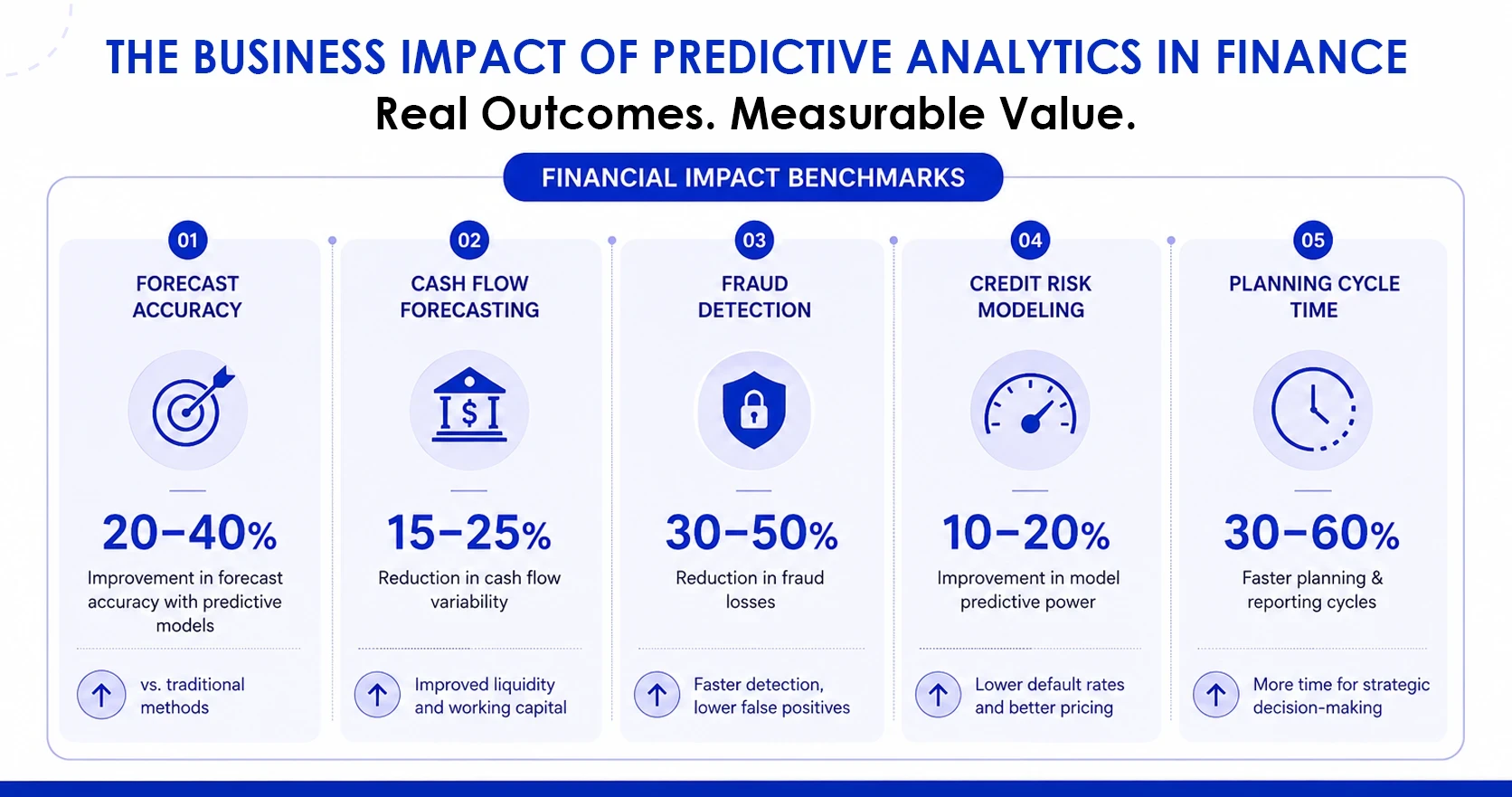
How financial predictive modeling actually works
Understanding predictive analytics doesn't require a data science degree. At its core, the process follows a consistent logic:
- Historical data is collected and cleaned — from transaction systems, ERP platforms, CRM tools, market data providers, and external economic sources.
- Statistical models and machine learning algorithms are trained on that data to identify patterns and relationships.
- Those patterns are used to generate forecasts — probability scores, numerical projections, risk ratings, and behavioral predictions.
- Outputs are integrated into decision workflows — feeding directly into planning cycles, risk committees, or automated operational processes.
What makes modern financial predictive modeling different from older statistical approaches is the role of machine learning. Traditional regression models are static: you define the variables, fit the model, and apply it until conditions change. Machine learning models are adaptive; they continuously update as new data flows in, improving their accuracy over time without manual recalibration.
This matters enormously in finance, where conditions change faster than most models can keep up. A machine learning-powered cash flow forecast doesn't just reflect last quarter's payment trends; it's learning from last week's transactions, adjusting in real time.
Core predictive analytics models used in finance
The effectiveness of any predictive analytics implementation depends on selecting the right models for the right objectives. Here's a practical breakdown of the most widely used approaches in financial settings: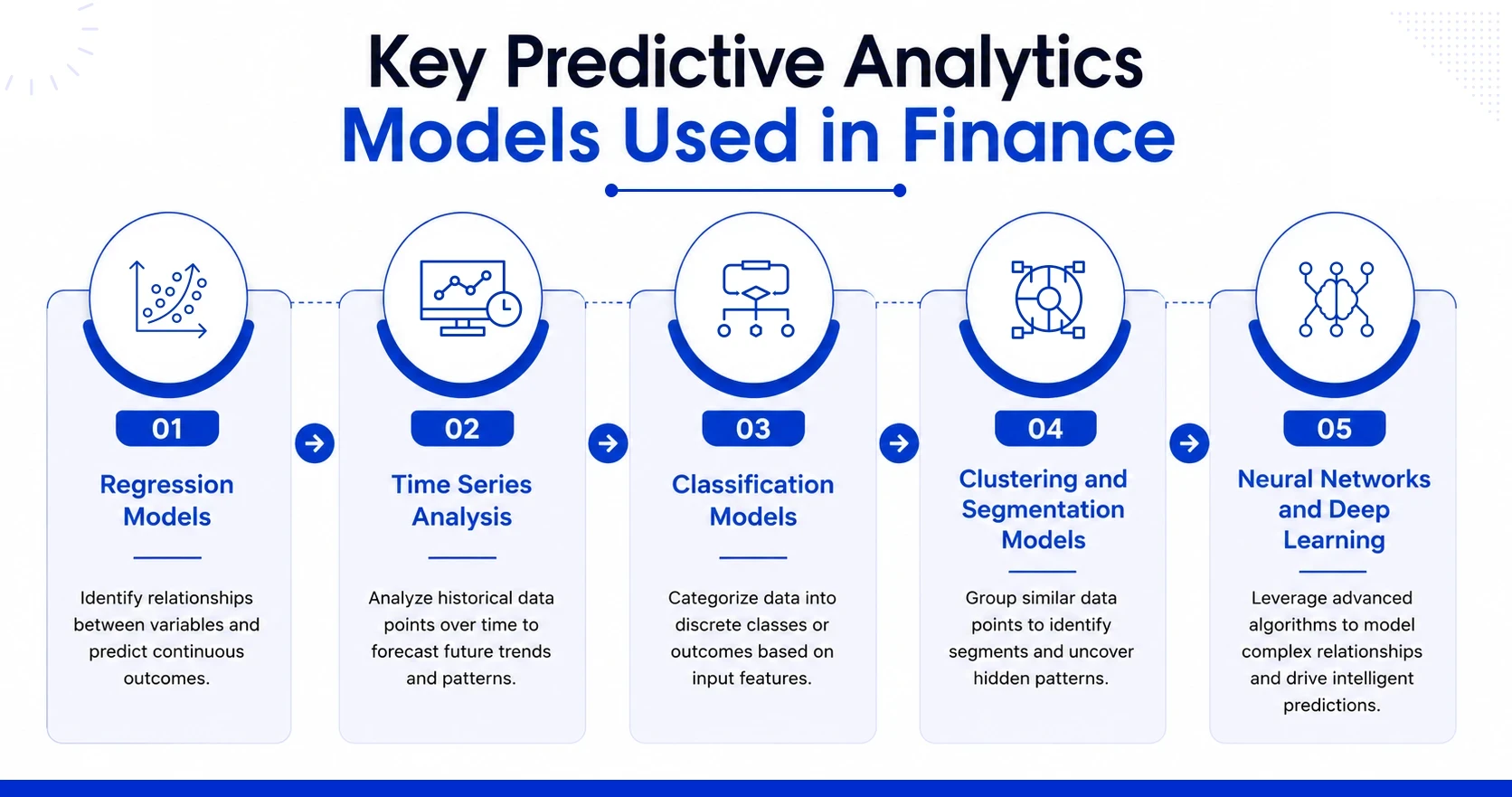
Regression models
The foundational tool in financial forecasting. Linear and logistic regression identify relationships between variables; such as the correlation between macroeconomic indicators and revenue performance; and project those relationships forward. Useful for revenue forecasting, expense modeling, and demand planning.
Time series analysis
Specifically designed for sequential data, time series models (ARIMA, SARIMA, Prophet) are built to capture seasonality, trends, and cyclical patterns in financial data. Finance professionals use them heavily for cash flow forecasting, working capital modeling, and quarterly revenue projections.
Classification models
Used when the goal is to assign a data point to a category; for example, "Will this loan applicant default? Yes or no?" Random forests, gradient boosting, and neural networks are commonly deployed for credit scoring, fraud flagging, and churn prediction.
Clustering and segmentation models
Rather than predicting a specific outcome, clustering models group entities with similar characteristics. In finance, this is used to segment customers by payment behavior, identify cohorts for targeted financial products, or detect anomalous transaction clusters that may indicate fraud.
Neural networks and deep learning
For the most complex, high-dimensional financial datasets; such as real-time market data or unstructured text from regulatory filings; deep learning models offer pattern detection capabilities that traditional statistics simply cannot match. These are increasingly deployed in trading algorithms, risk modeling, and advanced fraud detection.
In most real-world applications, finance professionals don't deploy a single model in isolation. They build model ensembles; combining multiple approaches to improve overall forecast accuracy and reduce the risk of individual model failures.
Key use cases: Where predictive analytics creates the most value in finance
Knowing the models is one thing. Understanding where they create measurable operational impact is what moves organizations from theory to action.
1. Cash flow forecasting and treasury management
Cash flow forecasting has historically been one of the most labor-intensive and error-prone tasks in corporate finance. Teams manually pull data from accounts payable, accounts receivable, and banking systems; then build static spreadsheet models that are outdated the moment they're saved.
Predictive analytics replaces this cycle with dynamic, continuously updated models that ingest real-time transaction data and behavioral payment patterns. The result is a forecast that reflects how customers actually pay, not how they were originally expected to.
For businesses managing complex working capital cycles; particularly in sectors with high transaction volumes or seasonal variability; this capability alone can meaningfully reduce borrowing costs and improve liquidity management.
2. Credit risk assessment and loan default prediction
Traditional credit scoring relies heavily on a limited set of variables: credit bureau scores, income levels, debt-to-income ratios. These are useful but inherently backward-looking; they measure what happened before, not what's likely to happen next.
Financial predictive modeling expands the variable set dramatically. Behavioral data, transaction patterns, industry trends, macroeconomic indicators, and even non-traditional data sources can be incorporated into advanced credit models. The output is a more granular, more accurate risk profile; enabling better lending decisions, more appropriate pricing, and fewer unexpected defaults.
This isn't just about reducing losses. It's about expanding access to credit for borrowers who would be unfairly penalized by blunt historical metrics alone.
3. Fraud detection and financial crime prevention
Fraud is one of the clearest illustrations of why reactive analytics fails. By the time a fraudulent transaction appears on a report, the damage is often done.
Predictive analytics shifts fraud detection from reactive to anticipatory. Machine learning models trained on historical fraud patterns can flag anomalous transactions in milliseconds; before they settle. They adapt continuously as fraud schemes evolve, catching new patterns that rules-based systems would miss entirely.
Credit card fraud losses increased from $28.4 billion globally in 2020 to $33.5 billion in 2022, according to research published in May 2025, a trajectory that makes proactive, AI-driven fraud detection not a competitive advantage but an operational necessity.
The operational implication for finance teams is significant: fewer false positives, less manual review burden, and faster containment when genuine fraud does occur.
4. Financial planning and analysis (FP&A)
FP&A is perhaps the most transformative application of predictive analytics for enterprise finance teams. The traditional FP&A model; annual planning cycles, quarterly updates, scenario analysis done manually in spreadsheets; was never designed for the pace at which businesses now need to make decisions.
Predictive analytics enables what's increasingly called continuous planning: a model that is always current, always incorporating the latest data, and always prepared to run scenario analysis on demand.
Finance professionals can test the P&L implications of a new pricing strategy, a market entry, or a supply chain disruption; not in a week-long modeling exercise, but in hours. This fundamentally changes the relationship between finance and the rest of the business: from scorekeepers to strategic co-pilots.
5. Investment portfolio optimization
For organizations managing investment portfolios; whether internal treasury assets, pension funds, or client-facing investment strategies; predictive modeling offers a more rigorous approach to portfolio construction and rebalancing.
Multi-variable models can simultaneously evaluate expected returns, volatility, correlation dynamics, and macro risk factors across asset classes. This enables more systematic allocation decisions and more disciplined risk management than traditional qualitative approaches.
6. Regulatory compliance and risk monitoring
Regulatory compliance is a growing source of operational burden for finance teams; and a growing source of risk when processes fail. Predictive analytics helps organizations move from reactive compliance (detecting violations after they occur) to proactive compliance (identifying risk patterns before they trigger regulatory exposure).
Regulatory horizon scanning models can monitor hundreds of jurisdictions simultaneously. Anomaly detection models can flag unusual reporting patterns before they attract regulatory scrutiny. And stress testing frameworks can simulate regulatory scenarios to ensure capital adequacy under adverse conditions.
7. Revenue forecasting and demand planning
Accurate revenue forecasting underpins virtually every other financial planning activity: headcount, capital allocation, inventory, working capital. Yet most organizations rely on methods; manager judgment, linear trend extrapolation; that are neither rigorous nor systematically updated.
Predictive analytics applies machine learning to historical revenue data, sales pipeline signals, market indicators, and macroeconomic variables to produce forecasts that are more accurate, more granular, and more responsive to changing conditions. This reduces planning errors and enables more confident resource allocation decisions.
Leading predictive analytics tools for finance professionals
The technology landscape for financial predictive analytics has matured significantly. Finance professionals today have access to a range of enterprise-grade tools depending on their scale, technical sophistication, and existing infrastructure:
- Enterprise planning platforms (Anaplan, Workday adaptive planning, Oracle EPM): Purpose-built for FP&A functions, these platforms embed predictive and AI-driven forecasting directly into planning workflows. They're designed to be accessible to finance professionals without deep data science expertise.
- Cloud data and analytics platforms (Snowflake, Databricks, Google BigQuery): For organizations with large, complex data environments, these platforms provide the computational infrastructure to run advanced predictive models at scale. They integrate with visualization tools like Tableau and Power BI for accessible reporting.
- Machine learning platforms (DataRobot, H2O.ai, SAS): Specialized tools for building, deploying, and monitoring predictive models. Increasingly offer AutoML capabilities that allow finance teams to develop models without writing code.
- Python and R ecosystems: For organizations with in-house data science capability, open-source tools like scikit-learn, TensorFlow, and PyTorch offer maximum flexibility for custom financial modeling work.
- ERP-Integrated analytics (SAP Analytics Cloud, Microsoft Dynamics + Power BI): For organizations already invested in SAP or Microsoft ERP environments, embedded analytics tools provide a natural path to predictive capability without significant infrastructure change.
The right tool selection depends on where the organization is starting from, what problems it's prioritizing, and how much in-house technical capability exists. Most successful implementations start with a narrowly scoped use case; cash flow forecasting, for example; before expanding to a broader analytics architecture.
The operational reality: What stands between finance teams and predictive capability
The gap between knowing that predictive analytics creates value and actually capturing that value is real; and it's worth being honest about.
For many organizations, the core challenges aren't technical. They're structural:
- Data quality and fragmentation. Predictive models are only as good as the data they're trained on. Organizations with fragmented ERP systems, inconsistent data definitions, or poor data governance find that building reliable predictive models is harder than expected. The model reveals the data problem.
- Organizational silos. The most powerful financial predictions draw on data from across the enterprise; operations, sales, HR, logistics. But many finance functions don't have systematic access to that data, or the relationships to acquire it reliably.
- Talent gaps. Building and maintaining predictive models requires a blend of financial domain expertise and analytical capability that is genuinely scarce. Many organizations find they have financial experts who don't know machine learning, and data scientists who don't know finance.
- Process inertia. Perhaps the most underestimated barrier: finance teams with deeply embedded manual workflows often find it genuinely difficult to integrate model outputs into day-to-day decision-making, even when those models are available. Culture change is slower than technology change.
- Model governance. In a regulated industry, deploying a model that makes consequential decisions; on credit, on risk, on fraud; without adequate documentation, validation, and ongoing monitoring creates its own compliance risk. Model risk management isn't optional.
These challenges are solvable. But they require a structured implementation approach; not just a technology purchase.
How to build a predictive analytics capability in finance: A practical roadmap
Phase 1: Define the problem before the solution
The most common mistake in predictive analytics implementation is starting with the technology. Start instead with a specific, high-value business problem: "We need to reduce cash flow forecast error by 40%" or "We need to reduce the time from transaction anomaly to fraud alert by 80%."
A well-defined problem statement shapes every subsequent decision: what data is needed, which models are appropriate, how success will be measured, and where the capability will be maintained.
Phase 2: Assess and strengthen the data foundation
Before building models, audit the data. Map data sources, identify gaps, assess quality, and establish governance protocols. For most organizations, this phase reveals more work than expected; but it's work that pays dividends far beyond any individual predictive analytics application.
The goal is a unified data layer: a consistent, governed, accessible environment where financial and operational data can be combined for analysis.
Phase 3: Start narrow, prove value, expand
Resist the temptation to build a comprehensive analytics platform on day one. Pick a single, well-scoped use case where the business value is clear and the data is available. Build the model, validate it, deploy it, and measure results. Then use that proof point to build organizational confidence and expand the program.
Phase 4: Integrate into decision workflows
A predictive model sitting in a data scientist's notebook creates no business value. The model needs to be integrated into the actual decision processes of finance teams; embedded in dashboards, surfaced in planning tools, or triggering automated alerts in operational systems.
This requires close collaboration between finance, technology, and operational leaders to ensure that model outputs are accessible, understandable, and actionable by the people who make decisions.
Phase 5: Establish model governance and ongoing monitoring
Once deployed, predictive models need ongoing maintenance. Data distributions change, business conditions shift, and model accuracy degrades over time if left unmonitored. A model governance framework should define how models are validated before deployment, how their performance is tracked after deployment, and when retraining or replacement is triggered.
In regulated financial environments, this governance is also a compliance requirement; increasingly scrutinized by internal audit functions and external regulators alike.
What's changing in predictive analytics right now
The integration of generative AI and large language models into predictive analytics workflows is accelerating a shift that was already underway.
By 2025, 45% of financial organizations worldwide are expected to adopt AI for data analysis, viewing it as critical to maintaining competitive advantage, according to SPD Technology's analysis of the financial analytics landscape.
What this means in practice for finance professionals:
- Natural language interfaces are making it possible for non-technical users to query predictive models and generate scenario analyses without writing code or navigating complex dashboards.
- Autonomous anomaly detection is reducing the manual burden on finance teams by surfacing exceptions that require human attention; rather than requiring humans to look for problems.
- Real-time data integration is collapsing the lag between when events occur and when finance teams can see and respond to them; enabling genuine continuous monitoring rather than periodic reporting.
- Synthetic data generation is enabling better model training in situations where historical data is sparse; such as stress testing for rare but high-impact scenarios.
The shift isn't about replacing financial judgment with algorithms. It's about giving finance professionals more powerful tools to exercise that judgment; with better information, at greater speed, and with more confidence.
What better workflows look like in financial predictive analytics
How do you know whether a predictive analytics investment is delivering value? The metrics vary by use case, but the following benchmarks are worth tracking:
Forecast accuracy improvement: Measured as a reduction in mean absolute percentage error (MAPE) on revenue, cash flow, or expense forecasts. Best-in-class implementations typically achieve 20–40% reduction in forecast error versus baseline.
Time savings in planning cycles: Predictive automation should measurably reduce the time finance teams spend on manual data collection, reconciliation, and model-building; freeing capacity for higher-value analysis.
Fraud loss reduction: For fraud detection applications, the primary metric is actual financial loss prevention, alongside false positive rates (which drive operational costs in their own right).
Risk metric accuracy: For credit and market risk applications, the predictive accuracy of default or loss models should improve measurably versus prior approaches.
Decision cycle time: How much faster can finance teams respond to changing conditions? This is often the most important strategic metric; and the hardest to quantify, but the most valuable when captured.
Common pitfalls that undermine predictive analytics initiatives
Having worked through the promise and the process, it's worth being direct about the ways these initiatives most commonly fail:
Treating it as a technology project, not a business transformation. When predictive analytics is owned entirely by IT or data science teams without genuine finance leadership sponsorship, it rarely gets embedded into actual decision workflows. The model gets built; the behavior doesn't change.
Underinvesting in data infrastructure. Organizations that try to build predictive models on top of messy, fragmented data are building on sand. The data work isn't glamorous, but it's foundational.
Scaling prematurely. Moving from a successful pilot to an enterprise rollout without pausing to codify what worked, address what didn't, and build internal capability often leads to expensive failures.
Neglecting change management. Finance professionals who've spent years building expertise in Excel-based models don't automatically embrace machine learning outputs. Adoption requires investment in training, in communication, and in demonstrating that the tools make their jobs better; not redundant.
Ignoring model risk. In financial services in particular, deploying models without adequate validation, documentation, and ongoing monitoring creates regulatory and reputational exposure that can far exceed any efficiency gain.
The strategic case: Predictive analytics as a competitive differentiator
There is a tendency to frame predictive analytics as an operational efficiency play; a way to do the same things faster and cheaper. That framing underestimates the real strategic opportunity.
When finance functions can see what's coming, not just what's happened, they change the nature of the conversations they have with the rest of the business. They become genuine strategic partners: challenging assumptions, identifying risks before they materialize, stress-testing strategies before capital is committed.
The worldwide financial analytics market was valued at $10.7 billion in 2025 and is forecast to reach $27.36 billion by 2034, reflecting the growing recognition that predictive capability is central to financial leadership; not peripheral to it (Nimble AppGenie).
The organizations building this capability now aren't just improving their finance function. They're building a durable strategic advantage; the ability to make better decisions, more quickly, with more confidence, across every part of the enterprise.
That is the real case for predictive analytics in finance. Not efficiency. Strategy.
Why predictive finance is becoming a business imperative
Predictive analytics in finance represents a fundamental shift in how finance functions operate; from reporting on the past to shaping the future. The technology is mature, the use cases are proven, and the business case is clear.
But the path from awareness to capability requires more than buying software. It requires a structured approach: defining the right problems, building a strong data foundation, selecting appropriate models, integrating outputs into real decision workflows, and establishing the governance frameworks to ensure sustained accuracy and compliance.
For organizations wrestling with forecasting uncertainty, manual processes that don't scale, or risk visibility that's always a step behind, predictive analytics isn't an aspirational technology investment. It's an operational imperative.
The question isn't whether to build this capability. It's where to start; and who to partner with to do it well.
Ready to turn your financial data into a strategic asset?
At FBSPL, we work with finance and operations leaders to design and implement analytics-driven transformation programs that create measurable, lasting business impact. Our approach combines deep financial domain expertise with proven analytical capability; helping organizations move from reactive reporting to proactive, predictive decision-making.


Bhavishya Bharadwaj
Bhavishya Bharadwaj is the Digital Marketing Manager at FBSPL, bringing over a decade of experience across insurance, outsourcing, accounting, and digital transformation.
Frequently Asked Questions
Predictive analytics in finance uses historical data, statistical techniques, and machine learning models to forecast future financial outcomes, identify risks, detect patterns, and support proactive business decision-making.

.png&w=3840&q=75)