
6 MIN READ·Apr 01, 2026·Written by Bhavishya Bharadwaj

Summary: This blog explains the difference between agentic AI systems and traditional automation in insurance. It explores how AI agents manage operational workflows, highlights practical use cases, outlines key AI benefits, and discusses how outsourcing partners help insurers implement scalable AI-driven operations.
Agentic AI enables insurers to move beyond rule-based automation by using intelligent AI agents that manage complex workflows and improve operational decision-making.
Insurance operations today run on tight timelines, strict compliance standards, and massive volumes of policy and claims data. Even small inefficiencies can slow down service delivery or increase operational costs. For years, insurers relied on traditional automation to speed up repetitive tasks such as data entry, document handling, and routine policy updates. While this helped reduce manual effort, many operational workflows still depend heavily on human intervention when situations become complex.
Now, a different approach is gaining attention: Agentic AI systems. These systems go beyond simple automation. Instead of only following predefined rules, they can interpret information, decide the next step in a process, and carry out tasks across different systems.
Adoption is rising quickly. One industry report shows that AI deployments in insurance increased by 87% year over year, with generative and agentic AI making up nearly 68% of deployments in late 2025. (Source)
In this blog, we will look closely at agentic AI vs traditional automation, explain how AI agents for insurance operations work, explore practical Agentic AI use cases, and discuss how agentic AI for insurance business is reshaping operational workflows.
Most automation tools in insurance were built to complete specific tasks. For example, extracting data from documents or routing requests to the correct department. They follow instructions exactly as programmed.
Agentic AI systems work differently. They operate as independent digital agents that focus on completing a goal rather than a single task. To do that, they can gather information, interpret context, decide what action to take, and then execute it.
When insurers implement agentic AI for insurance, these agents often work across several operational systems at once. They may interact with policy administration platforms, claims systems, CRM tools, and external databases.
An insurance AI agent can typically handle tasks such as:
What makes AI agents for insurance operations useful is their ability to coordinate several activities within one workflow.
Take claims processing as an example. An AI agent might:
This type of coordination is one of the reasons how agentic AI transforms insurance operations.
Some studies estimate that AI-driven automation can reduce claims processing time by 55–75%, depending on workflow complexity and data availability. (Source)
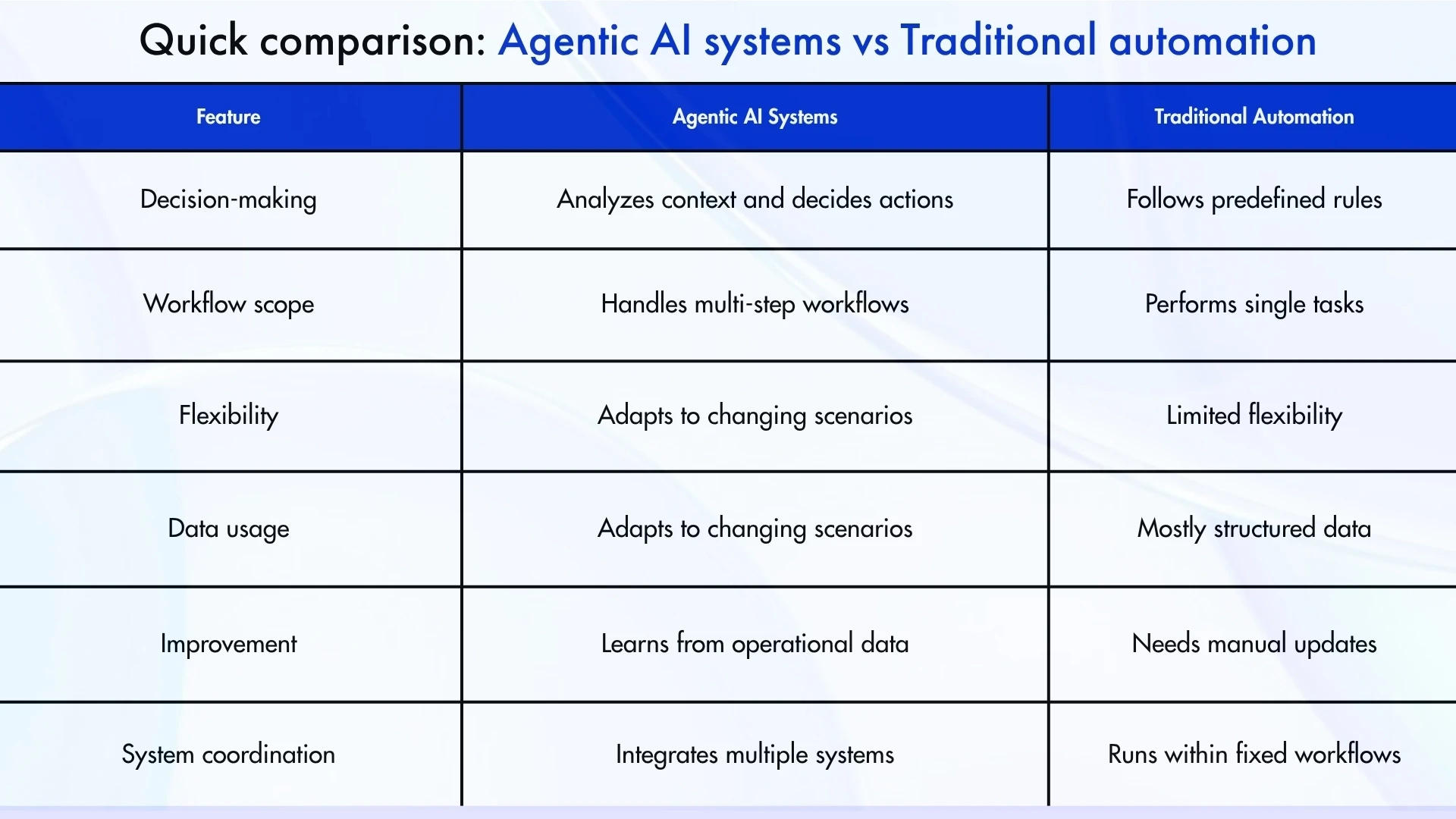
Many insurers already use automation tools, so the real question becomes how agentic AI vs traditional automation differs in practice.
Traditional automation platforms, such as RPA, operate through fixed rules. If a process changes or an exception occurs, the system often stops and requires manual intervention.
Insurance operations rarely follow a perfect script. Claims may contain incomplete information. Policy requests may involve unusual endorsements. Customer queries may vary widely.
This is where Agentic AI systems offer a different capability. Instead of following strict instructions, they evaluate the situation and determine what step should happen next.
Here are a few practical differences.
Because of these capabilities, insurers are starting to look at AI agents for insurance operations as a way to manage more complex processes without constant human oversight.
The potential of Agentic AI use cases becomes clearer when applied to real insurance processes. These systems can support multiple operational areas.
Claims operations involve document review, coverage checks, fraud detection, and customer updates. AI agents can manage many of these tasks automatically, helping teams process claims faster.
Underwriters rely on data from various sources. AI agents can analyze risk information, historical claims patterns, and external datasets to support faster decision-making.
Routine policy tasks; such as renewals, endorsements, and document verification; can be handled by AI agents without requiring manual review.
AI-powered service agents can respond to policyholder questions, provide coverage explanations, and handle simple service requests.
Insurance fraud detection often requires analyzing transaction patterns across multiple datasets. AI agents can continuously review these patterns and flag suspicious activities.
Insurance regulations change frequently. AI agents can help monitor regulatory requirements and ensure operational workflows stay compliant.
These examples show how agentic AI transforms insurance processes by automating more than just simple tasks.
The shift toward agentic AI for insurance business is largely driven by operational advantages.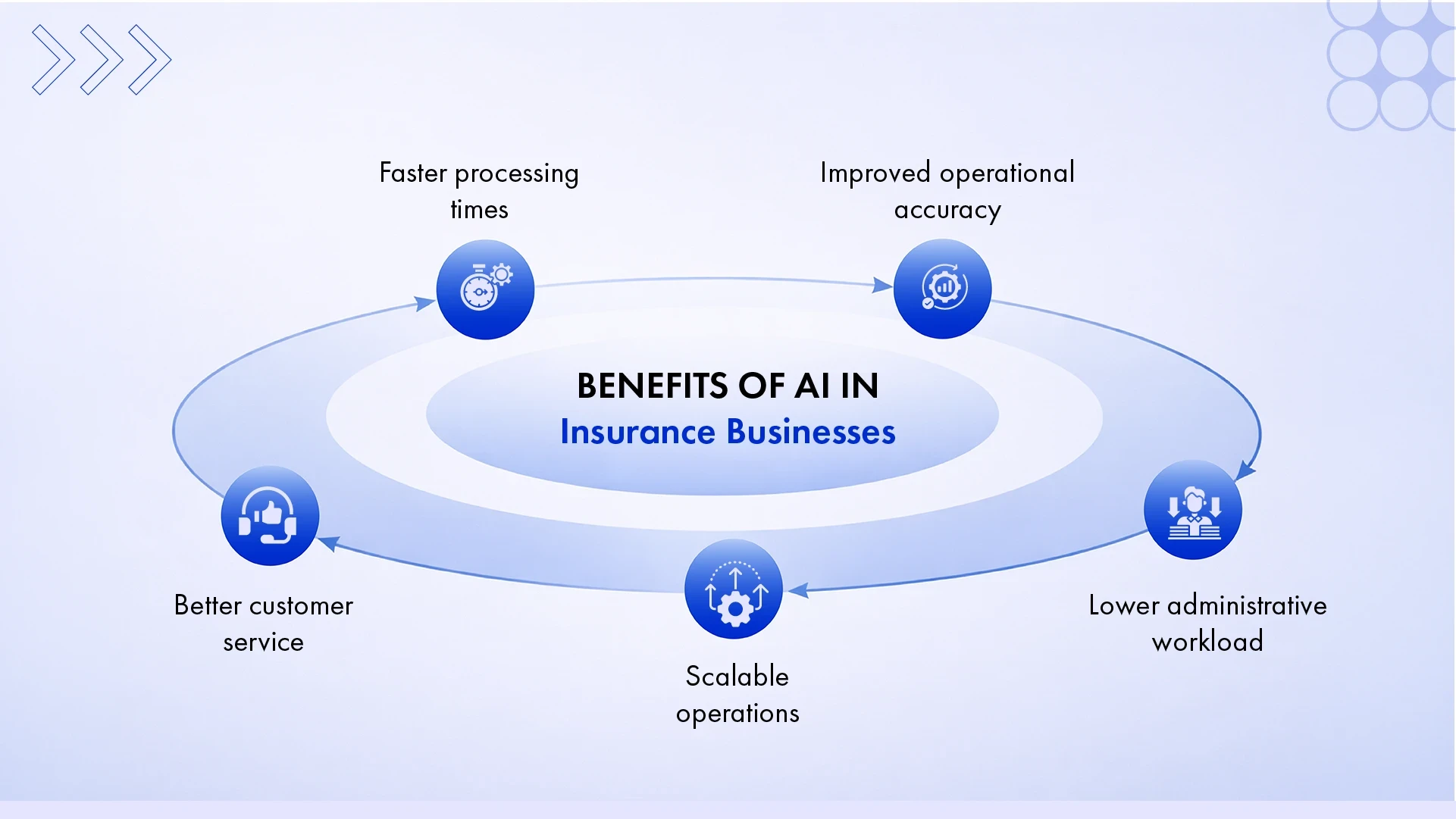
These AI benefits make agentic AI systems an attractive option for insurers trying to modernize operations while keeping costs under control.
Although the benefits are clear, implementing AI solutions is rarely simple. Insurance companies often work with legacy systems that are difficult to integrate with newer technologies.
Developing and maintaining AI systems also requires specialized expertise.
This is why many insurers turn to AI outsourcing services when exploring agentic AI.
Outsourcing partners typically support areas such as:
Working with experienced partners allows insurers to adopt agentic AI for insurance business without building large internal AI teams.
Insurance operations are evolving quickly. Traditional automation still plays a role in handling repetitive tasks, but it cannot manage the growing complexity of modern insurance workflows.
Agentic AI systems introduce a more capable model. They combine automation with reasoning and workflow coordination, allowing insurers to manage processes more efficiently.
As insurers continue exploring AI agents for insurance operations, the technology is expected to play a larger role in claims handling, underwriting, policy servicing, and customer support.
For organizations evaluating how to implement agentic AI for insurance or scale digital operations through AI outsourcing services, experienced partners can make the transition significantly smoother.
FBSPL works with insurance businesses to streamline operational workflows, integrate intelligent automation solutions, and support long-term process efficiency.
Get the latest insights on insurance operations, policy management, and industry best practices.