1 MIN READ·Sep 28, 2026·Written by Bhavishya Bharadwaj

Summary: Benefits enrollment and termination errors usually start with inconsistent processes rather than isolated mistakes. This blog explains where those errors occur, practical ways to prevent them, and how stronger operational workflows help agencies improve accuracy, compliance, and the overall client experience.
Benefits enrollment and termination sound simple on paper, but it is not.
A wrong effective date can create a coverage problem. A missing dependent document can hold up an enrollment. A termination that was updated internally but never completed with the carrier can show up weeks later as a billing issue. Then someone has to go back through emails, check the records, contact the carrier, and explain what happened to the client.
These problems become more challenging when an agency is handling more employees, more groups, and more carrier requirements. The team may know the benefits enrollment process well, but the issue lies in the number of requests moving through it.
The “2025 SHRM Employee Benefits Survey found that 88% of employers consider health benefits extremely crucial.” That matters to employees because their coverage affects access to healthcare. Employers also see benefits administration as an important part of employee experience. So, when an agency gets an enrollment or termination wrong, it is not just correcting an administrative detail.
The good news is that reducing these errors does not always mean adding more people or another approval stage. It often starts with looking at the work itself.
Those details can tell an agency a lot about where errors are coming from.
Most clients do not see an enrollment error when it happens. They see it later, when something they expected to be done has not been done. At that point, the agency has a problem to solve.
Some of the most common consequences include:
An employee or dependent may not receive coverage on the expected date because of a wrong effective date, missing document, incorrect eligibility information, or an update that was never completed with the carrier.
For instance, an employee submits everything required for enrollment, but the eligibility date is entered incorrectly in the carrier portal. Nobody notices immediately. The problem may only arise when the employee tries to use the plan or asks the employer about their coverage.
Now, a basic enrollment request has become a client service issue.
Termination errors are one of the major reasons behind a bad client experience.
If a former employee is not removed from the carrier's records on time, that person may continue appearing on the employer's bill. The employer then has to question the invoice, request an adjustment, and wait for the agency and carrier to sort out the record.
Clients should not have to keep asking what happened to a request.
Yet questions like “Has the employee been enrolled?” or “Has the termination been confirmed?” come up when there is no clear way to see where a request stands.
Sometimes the work has actually been completed. The problem is that nobody can quickly prove it. That usually points to a gap in tracking, ownership, or carrier follow-up.
Account managers often end up dealing with these problems because the client relationship sits with them.
They may have to search through an email chain, find out who processed the request, contact the operations team, chase the carrier, and then go back to the employer with an update. Such issues consume more of their time and shift their focus from renewals, client meetings, and other account work.
If clients repeatedly see incorrect enrollments, missed terminations, or billing discrepancies, they may start questioning the agency's processes. They may not know exactly where the problem occurred. But endless follow-ups leave them frustrated, and that’s where the trust issues begin.
Most benefit administration and termination errors do not stem from a single major failure. They occur at multiple points, especially when information moves between employers, agencies, carrier portals, and in-house teams.
Missing information is one of the most common reasons why a request is delayed or processed incorrectly.
For an enrollment, that could mean missing dependent information, employee details, or any document. For a termination, the request may not clearly state the employee's last working date, coverage end date, or which plans need to be updated.
Someone then has to stop the request and go back to the employer. This further increases the chance of missed details and duplicate work.
Employee information is often entered more than once.
It might go into the benefits administration platform, carrier portal, CRM, and an internal tracker. The more places the same information is entered, the more chances there are for errors to occur.
An employee's termination might be marked complete in the agency tracker while the carrier still shows active coverage. If nobody checks the records accurately, the mismatch may sit there until the next bill.
There may be three people involved in one request. One checks the information. Another submits it. Someone else follows up with the carrier.
That is not necessarily a problem. The problem is when nobody takes ownership of the request completion.
A carrier question can stay unanswered. Submissions can remain pending. A request can be marked complete simply because it was sent, even though the carrier has not confirmed the update.
One person does not need to do every task. Someone needs to own the outcome.
Carrier processes are not always interchangeable.
Forms, portals, documentation, deadlines, and processing rules can differ. A procedure used for one carrier may not work for another.
A carrier might require additional documentation for a dependent enrollment or qualifying life event. Another may have different requirements for termination dates.
If the team has to rely on memory every time, mistakes are more likely to occur. Carrier-specific instructions make the work much easier to handle consistently.
Eligibility and effective-date errors cause trouble in both enrollment and termination work.
Hire dates, waiting periods, employee classifications, qualifying events, and plan rules all need to be checked before a request is submitted.
With enrollment, an incorrect date can start coverage too early or too late. During employee offboarding, the employee's final working date may not be the same as the date their benefits should end.
Once the carrier has processed the wrong information, fixing it may affect billing, payroll deductions, and coverage records too.
Benefits enrollment errors often involve a small detail that is either entered incorrectly, left incomplete, or never verified.
The common ones include:
A careful verification before submission can be a savior from benefits administration mistakes.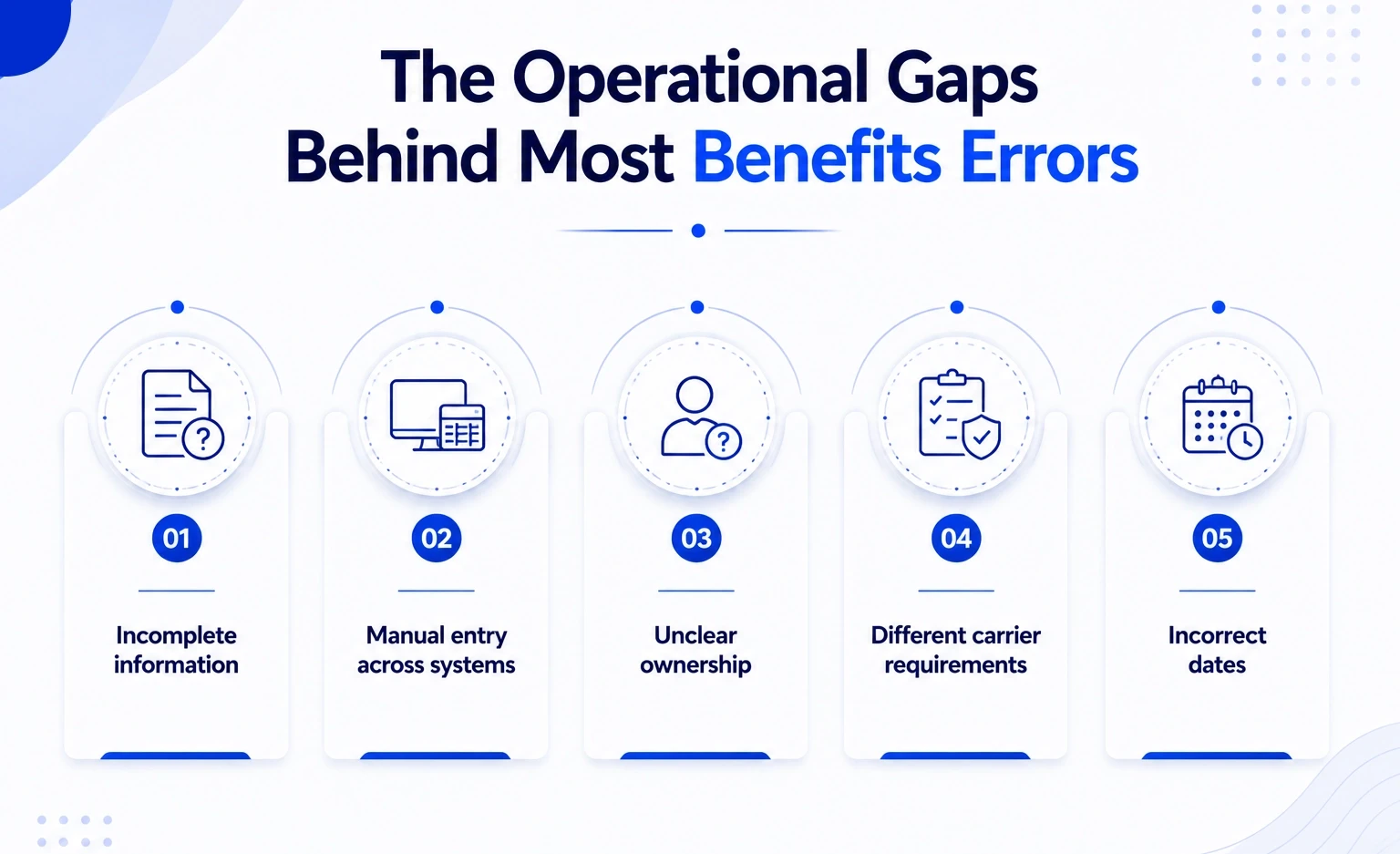
Employee termination work has its own set of problems that a lot of agencies failed to identify earlier. At the end, they keep looking for loopholes and that’s where they miss the errors.
Some of them are:
These errors often stay hidden until a bill is reviewed or a client notices something is wrong.
A good offboarding process should catch the problem before that happens.
Now that you are well-versed with new hire enrollment and termination errors, you might be wondering- “How can I reduce these benefits enrollment and termination errors?”
Here are the 10 practical ways you can implement to get rid of these benefits administration errors in one go.
Use separate forms or checklists for enrollments, qualifying events, and terminations. Make it obvious what information and documents are required before processing starts.
Check hire dates, waiting periods, employee classifications, qualifying events, and requested coverage dates.
Someone should be responsible for the request from the moment it arrives until the carrier confirms completion.
Keep instructions for carrier forms, portals, documents, deadlines, and follow-ups where the team can easily find them.
Before submitting, check the employee details, dependents, elections, effective dates, and termination instructions.
Record when the request came in, whether information is missing, when it was submitted, what the carrier said, and when the work was completed.
Sending a request is not the same as completing it. Check that the carrier actually processed the enrollment, coverage change, or termination.
The benefits platform, carrier portal, CRM, and internal tracker should agree. If they do not, find out why.
Carrier bills are another useful checkpoint. Check enrollments, terminations, dependents, and effective dates against agency records.
If the same mistake keeps coming back, fixing individual requests will only get the team so far. Look at what is happening earlier in the process and change that part.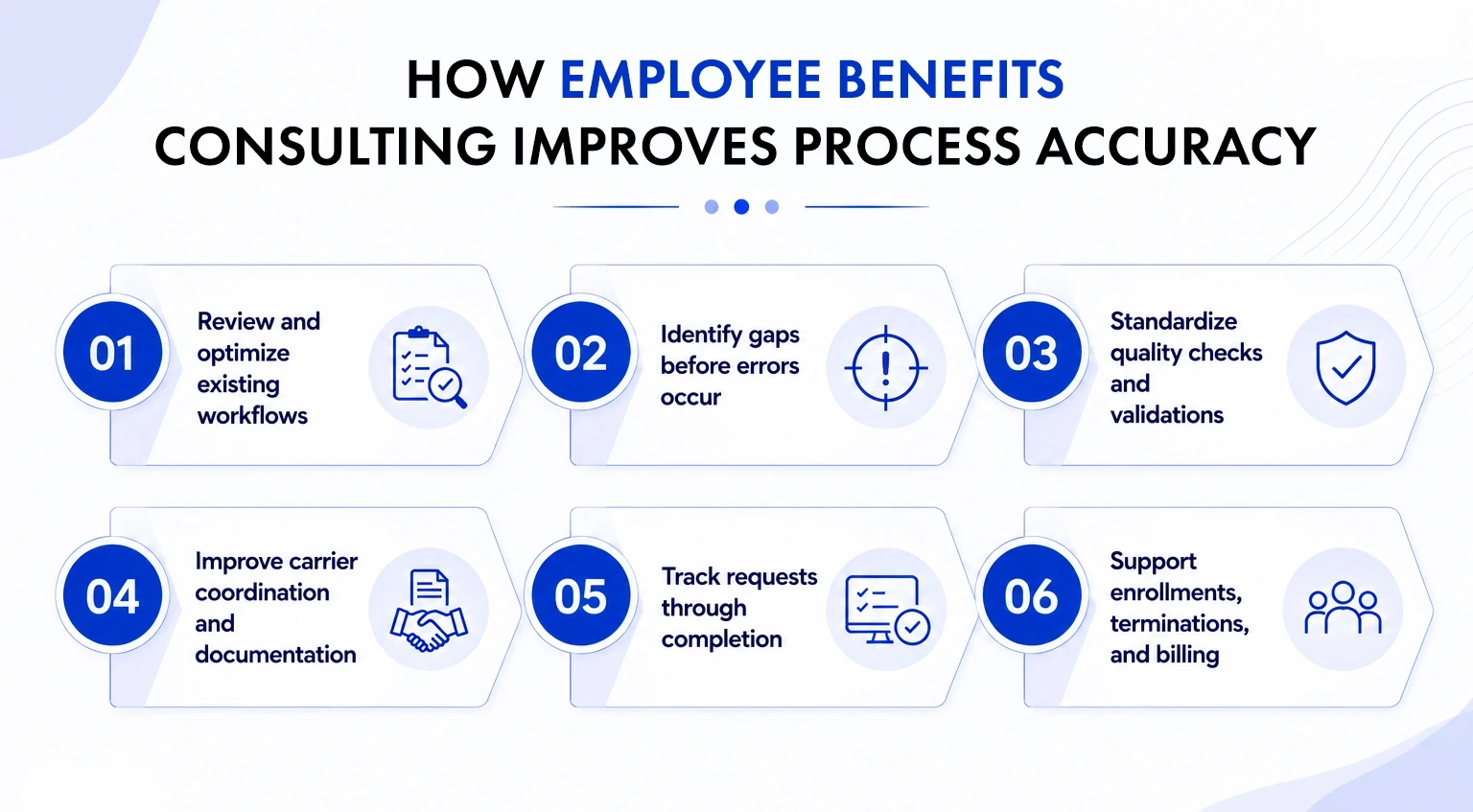
Most teams already know which of these gaps apply to their agency. Fixing it while running the daily business becomes challenging, which is where an experienced benefits administration consulting company earns its place.
Here's how the experts can help you -
Benefits administration might look easy to manage, but it keeps getting complex when your agency grows. An enrollment may be one request among hundreds for an agency, but for the employee waiting for coverage, it is not a small thing. A missed termination can also create more than an administrative correction. It can lead to billing questions, client follow-ups, and unnecessary work for the agency team.
As benefit programs become more complicated, agencies need processes that can keep up with the work. Clients expect their requests to be handled accurately, and they should not have to keep asking for updates or checking whether something was completed.
Reducing these errors does not necessarily mean adding more people or more approval steps. It starts with getting the basics right: collecting complete information, checking eligibility and dates, assigning ownership, following carrier requirements, and confirming that each request was actually completed.
For agencies dealing with the challenges of benefits enrollment, a good place to start is by looking at the requests that create the most rework, follow-ups, and escalations. Those patterns can show where the current process is falling short and where a few practical changes could make a difference. FBSPL’s employee benefits consulting services can help review your existing workflows, identify gaps, and strengthen enrollment, termination, carrier update, and billing processes.
Feel free to connect with our benefits administration experts, and they will help you smooth your employee benefits process.
Get the latest insights on insurance operations, policy management, and industry best practices.