
1 MIN READ·Sep 23, 2026·Written by Bhavishya Bharadwaj
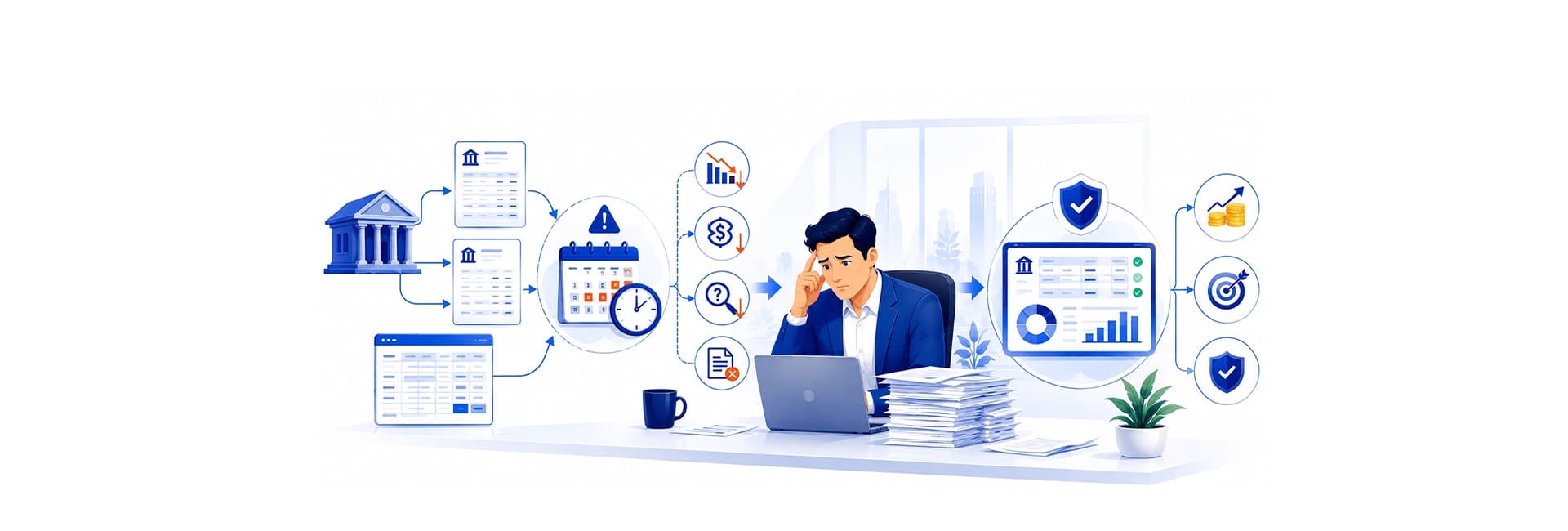
Summary: Delayed bank reconciliations reduce cash flow visibility, compromise financial accuracy, and slow critical business decisions. By adopting continuous reconciliation, automation, standardized controls, and expert financial support, organizations can strengthen reporting confidence, improve liquidity management, and create a more agile finance function.
Understand how timely bank reconciliation strengthens cash flow, reporting accuracy, and smarter financial decision-making.
Every finance leader has lived this moment: the bank balance on the screen doesn't match the ledger, the close is already three days behind schedule, and nobody can say with certainty how much cash is actually available to deploy. It looks like a paperwork problem. It isn't. Delayed bank reconciliation is one of the most underestimated operational risks in modern finance; a slow leak that distorts cash flow visibility, corrupts financial reporting, and quietly erodes the decisions built on top of both.
Bank reconciliation is supposed to be the simplest control in the accounting cycle: match what the bank says against what the books say. Yet across industries, this "simple" task has become one of the biggest bottlenecks in the financial close; and the cost of letting it slip is far higher than most businesses realize.
Reconciliation delays aren't isolated incidents anymore; they're structural. As transaction volumes grow across multiple banks, payment processors, and entities, the manual matching process simply cannot keep pace. According to Ledge's 2025 Month-End Close Benchmarks, half of finance teams need six or more business days to close their books, while cash reconciliation alone consumes between 20 and 50 hours every month for many organizations; making it the single most time-consuming activity in the entire close cycle.
That delay isn't contained to the accounting department. When reconciliation stalls, the trial balance can't be finalized, financial statements can't be issued, and every downstream decision; from vendor payments to expansion approvals; waits in line behind a spreadsheet.
Cash flow management depends on knowing, precisely, how much money is actually available right now; not what the ledger said a week ago. When reconciliation lags, businesses operate on assumed balances rather than confirmed ones. Outstanding checks, unposted fees, duplicate entries, and unrecorded deposits create a gap between "book cash" and "bank cash" that widens with every day of delay.
This gap is dangerous precisely because most businesses are operating with thinner cash buffers than they assume. The Federal Reserve Banks' 2025 Report on Employer Firms, based on the annual Small Business Credit Survey, found that 51% of firms cited uneven cash flows as a financial challenge, while 56% pointed to difficulty covering routine operating expenses. When cash positions are already tight, a reconciliation lag doesn't just create confusion; it can trigger overdraft fees, missed payment windows, or unnecessary short-term borrowing to cover a shortfall that may not have even existed once the numbers were properly matched.
Delayed reconciliation also masks how efficiently receivables are actually converting into usable cash. If incoming payments aren't matched against invoices promptly, collections teams chase customers who have already paid, credit decisions get made on stale data, and working capital that should be redeployed sits unidentified in the account. This problem compounds when payment delays are already part of the external environment; the Atradius Payment Practices Barometer for North America (2025) found that 43% of credit-based B2B sales in the US remain overdue, largely driven by customer-side cash flow pressures. Layering internal reconciliation delays on top of external payment delays leaves finance teams fighting a liquidity problem on two fronts simultaneously, often without realizing it until the gap is significant.
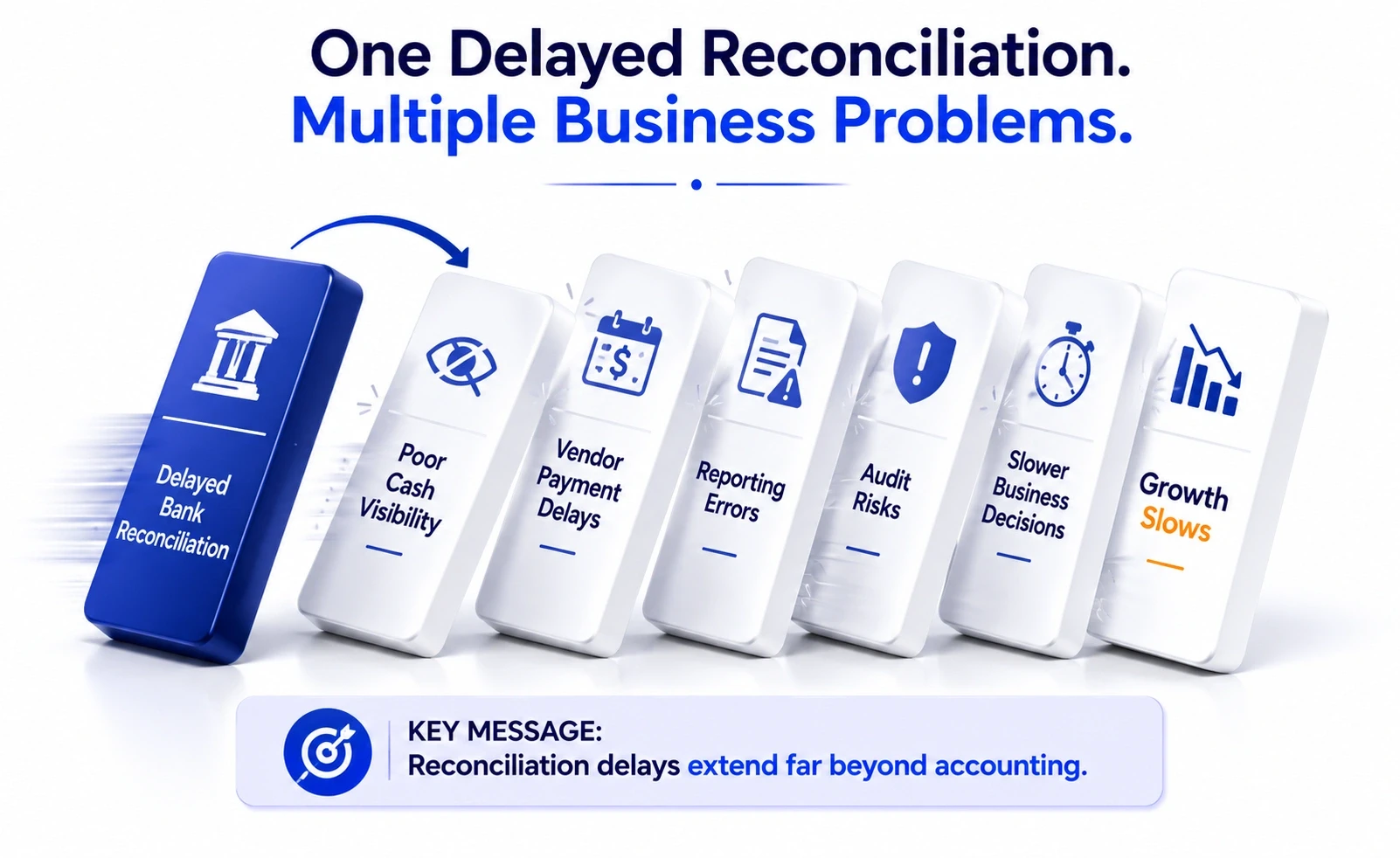
A single unmatched transaction rarely breaks a balance sheet. But reconciliation delays allow errors to stack; a miscoded fee here, a duplicate vendor payment there, a currency conversion rounding difference that never gets flagged. Left unresolved for weeks, these discrepancies migrate into management reports, board decks, and investor updates. By the time the error surfaces, it's no longer a two-minute fix; it's a restatement conversation.
Financial accuracy isn't just an internal metric; it's the foundation for tax filings, lender covenants, audit readiness, and investor trust. When reconciliations run behind, finance teams are forced to report provisional numbers, caveat their own figures, or delay reporting altogether. None of these are acceptable options for a business trying to raise capital, satisfy a lender, or pass an audit without findings.
It's worth naming why this keeps happening: most reconciliation work still runs through spreadsheets. Teams are exporting statements from multiple banks and payment gateways, then manually matching line items against the general ledger; a process that scales poorly as transaction volume and entity complexity grow. Every additional bank account, subsidiary, or payment processor multiplies the manual effort exponentially, not linearly, which is exactly why the backlog tends to grow faster than the finance team can hire to cover it.
Reconciliation delays rarely stay contained within accounting. When cash and account data aren't current:
In effect, a reconciliation delay in one ledger account becomes a visibility problem for the entire organization.
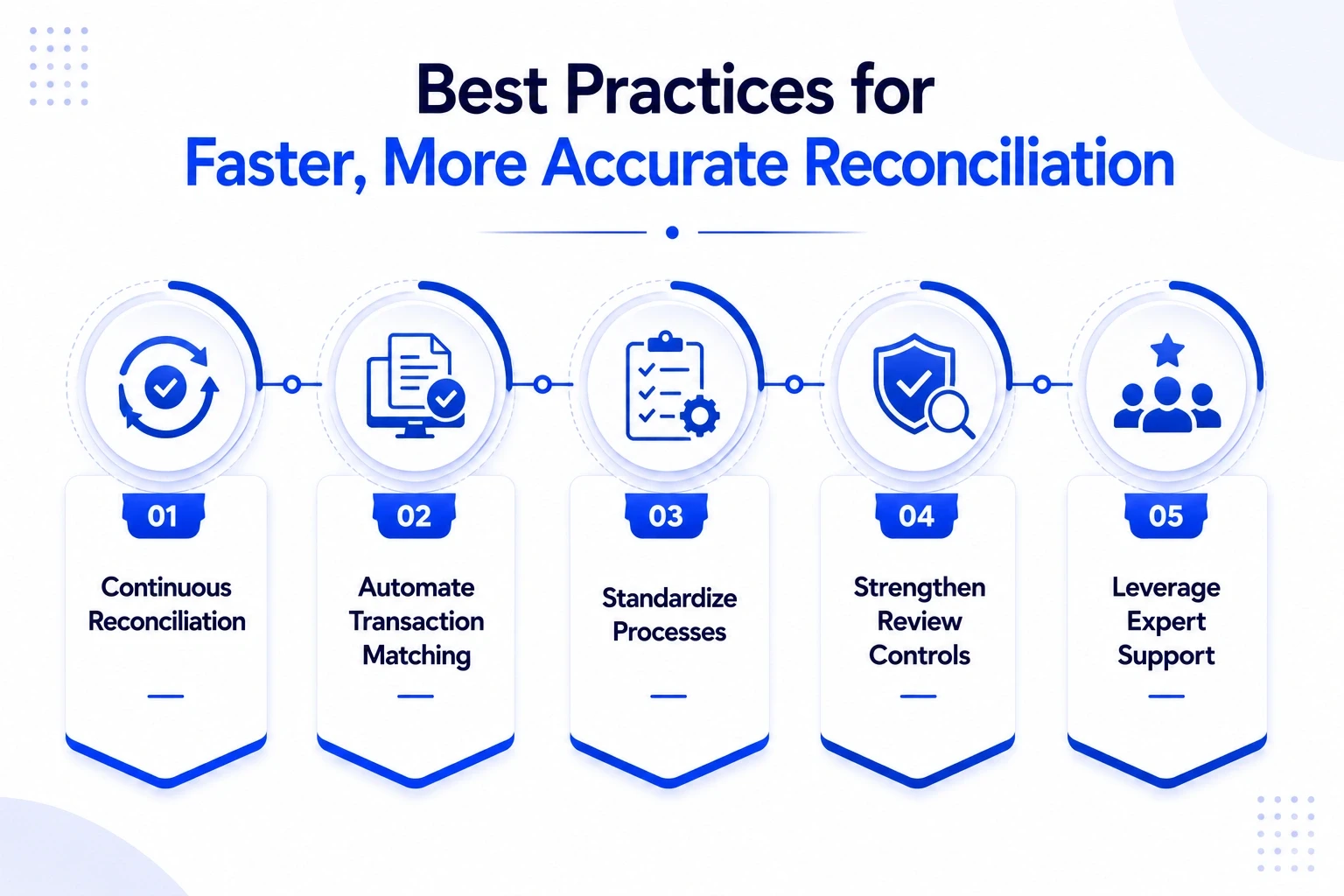
Reducing reconciliation delays requires more than working faster—it demands stronger processes, standardized controls, and technology that enables finance teams to maintain accurate records continuously rather than correcting issues at month-end.
Businesses that treat reconciliation as a strategic control; rather than a clerical afterthought; end up with more than clean books. They gain real-time visibility into cash, faster and more credible financial reporting, and a finance function that can actually support growth decisions instead of trailing behind them. The organizations pulling ahead in 2026 aren't necessarily the ones with the biggest finance teams; they're the ones whose financial data they can trust the moment they look at it.
Delayed bank reconciliation isn't a back-office inconvenience; it's a direct threat to cash flow visibility, financial accuracy, and the confidence of everyone who relies on your numbers, from your CFO to your auditors to your board. The businesses that get ahead of this don't just close their books faster; they operate with a level of financial clarity that becomes a genuine competitive advantage.
FBSPL partners with finance leaders as a strategic operations partner to re-engineer reconciliation and financial close workflows; replacing manual, error-prone processes with structured, accurate, and continuously reconciled financial operations. If your team is spending more time chasing discrepancies than acting on clean data, it's time to have that conversation.
Get the latest insights on insurance operations, policy management, and industry best practices.