
7 MIN READ·Jun 02, 2026·Written by Bhavishya Bharadwaj

Summary: Modern businesses are struggling with delayed financial close cycles caused by manual reconciliations, fragmented systems, operational inefficiencies, and growing reporting complexity. This blog explores the biggest month-end close challenges, their business impact, and the strategies finance leaders are adopting to accelerate financial reporting and improve operational control.
Discover the operational bottlenecks, reconciliation challenges, and modernization strategies transforming today’s month-end financial close processes.
Finance leaders today are under pressure to deliver faster reporting, sharper forecasting, stronger compliance, and real-time business visibility; all while managing growing operational complexity. Yet for many organizations, the month end close process remains one of the most resource-intensive and frustrating finance activities.
What was once a straightforward accounting cycle has evolved into a cross-functional operational challenge involving fragmented systems, manual reconciliations, delayed approvals, data inconsistencies, and increasing regulatory scrutiny. The result is delayed financial reporting, exhausted finance teams, and leadership decisions based on outdated numbers.
According to a 2025 benchmark report covered by CFO.com, 50% of finance teams still require more than six business days to complete their month-end close. The primary causes include data quality issues, spreadsheet dependency, reconciliation delays, and disconnected financial systems.
Organizations that continue relying on reactive finance operations often discover that their close process becomes slower as the business grows. Multi-entity structures, increasing transaction volumes, acquisitions, hybrid work environments, and evolving compliance expectations amplify operational inefficiencies already hidden inside finance workflows.
This is why modern businesses are rethinking what month-end close should look like; transforming it from a stressful accounting exercise into a strategic finance capability.
The month end close process accounting teams follow is the structured process of reviewing, reconciling, validating, and finalizing all financial transactions for a specific accounting period.
The process typically includes:
At its core, month-end close is not simply about “closing the books.” It is the operational foundation of financial reporting accuracy, forecasting reliability, strategic planning, investor confidence, and regulatory compliance.
When finance data is delayed or unreliable, leadership decisions become reactive instead of strategic. Budgeting loses precision. Cash flow forecasting weakens. Audit risks increase. Operational blind spots emerge.
This is exactly why the month-end close important process has become a major transformation priority for CFOs and controllership teams worldwide.
A Gartner finance survey found that 55% of finance functions are actively pursuing a “touchless close” model to improve speed, reduce manual effort, and enhance reporting accuracy.
Many finance teams still operate using processes designed for businesses that were significantly smaller and operationally simpler.
As organizations scale, the close process becomes vulnerable to operational bottlenecks across multiple areas simultaneously.
One of the biggest causes of delayed close cycles is fragmented data architecture.
Finance teams often pull information from ERP systems, banking platforms, payroll tools, billing systems, CRMs, spreadsheets, and operational databases; all structured differently and updated at different intervals.
This creates reconciliation gaps that require manual intervention.
Instead of analyzing business performance, finance professionals spend days validating whether the numbers are even correct.
Excel remains deeply embedded in many accounting environments. While spreadsheets are flexible, they become dangerous when used as the backbone of enterprise-scale financial operations.
Version control issues, formula errors, broken links, and undocumented adjustments create significant reporting risks.
In many organizations, institutional knowledge lives inside spreadsheets owned by a handful of employees, making finance operations highly vulnerable.
Finance cannot close the books in isolation.
The close process depends heavily on procurement, operations, payroll, sales, HR, inventory management, treasury, and leadership approvals. When upstream teams delay submissions or provide inconsistent information, finance workflows stall.
According to 2025 finance benchmarks referenced in Forbes, 56% of finance leaders identified cross-team dependencies as a primary cause of delayed close cycles.
Reconciliations are no longer limited to basic bank matching.
Modern finance environments require reconciliation across payment gateways, multi-currency accounts, intercompany transactions, subscription billing systems, claims platforms, commissions, and third-party integrations.
As transaction volumes increase, reconciliation becomes exponentially harder without automation and standardized workflows.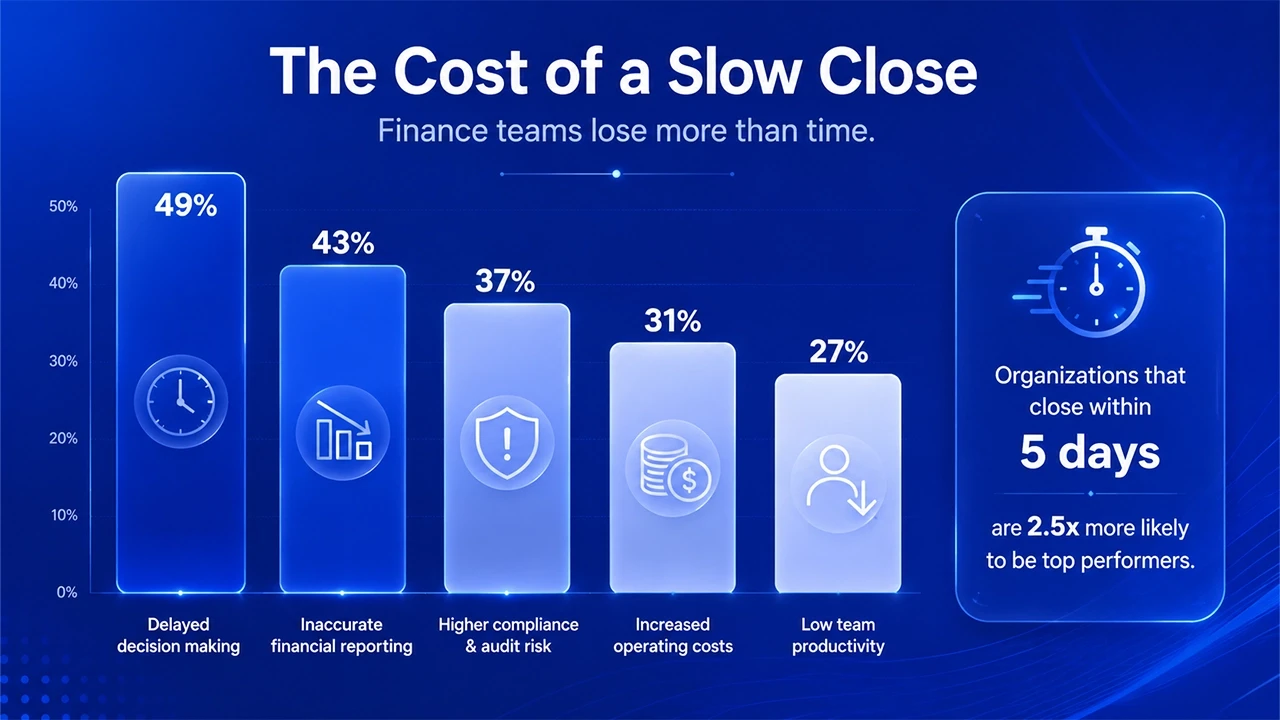
The most common month-end close challenges are rarely isolated problems. They are interconnected operational inefficiencies that compound over time.
When close cycles take 10–15 days, leadership teams operate using outdated numbers for nearly half the month. This reduces agility in budgeting, forecasting, investment planning, and operational decision-making.
Finance teams often spend large portions of their time chasing approvals, validating spreadsheets, correcting data mismatches, and reworking journal entries instead of performing strategic analysis.
Manual adjustments and undocumented processes make audit preparation difficult and increase compliance exposure.
As businesses expand across regions and regulatory frameworks, the financial close process must support stronger governance and traceability.
Month-end close frequently creates recurring “firefighting cycles” inside finance departments.
Long hours, repetitive reconciliation work, and deadline pressure reduce morale, increase turnover risk, and limit the team’s ability to focus on value-added financial strategy.
Organizations looking to modernize their close process should focus on operational redesign, not just task acceleration.
An effective checklist for month-end close should include the following transformation priorities:
Finance teams should establish centralized workflows, standardized reconciliation templates, documented approval structures, and shared close calendars.
Consistency reduces dependency on tribal knowledge and improves scalability.
Instead of waiting until month-end to identify issues, leading organizations validate data continuously throughout the month.
This includes ongoing reconciliations, exception monitoring, automated matching, and proactive discrepancy management.
Continuous accounting significantly reduces end-of-month bottlenecks.
Automation is especially effective for repetitive transactional activities such as:
Automation does not eliminate finance expertise; it enables finance professionals to focus on analysis instead of manual processing.
Integrated finance ecosystems reduce duplicate work, reconciliation delays, and reporting inconsistencies.
Modern ERP integrations, API-based workflows, and centralized financial data environments improve reporting reliability significantly.
Leading finance teams are moving toward real-time dashboards, live reconciliations, and automated exception alerts that improve decision-making speed across the business.
The future of financial reporting is increasingly driven by intelligent automation and AI-assisted finance operations.
Deloitte highlights that Generative AI is emerging as a catalyst for autonomous close environments by improving reconciliation efficiency, anomaly detection, task orchestration, and financial data analysis.
Forward-looking finance organizations are now implementing:
The objective is no longer just closing faster.
The objective is building a finance function capable of delivering accurate, decision-ready intelligence continuously.
Many organizations recognize operational inefficiencies inside finance but struggle to redesign the process internally.
This is where accounting consulting services play a critical role.
Strategic consulting partners help businesses evaluate close-cycle bottlenecks, redesign workflows, improve governance, optimize ERP utilization, standardize controls, and identify automation opportunities aligned with long-term business goals.
More importantly, they help finance leaders transition from transaction-heavy operations to scalable financial management frameworks capable of supporting growth.
Rather than functioning as service vendors, transformation-focused consulting firms operate as operational advisors that align finance infrastructure with broader business strategy.
The modern month end close process is no longer just an accounting responsibility. It is a direct reflection of operational maturity, financial visibility, and business scalability.
Organizations that continue relying on fragmented systems, spreadsheet-heavy workflows, and reactive reconciliations will increasingly struggle with reporting delays, compliance exposure, and inefficient finance operations.
The businesses achieving faster, cleaner, and more reliable close cycles are not simply “working harder.” They are redesigning finance operations around automation, standardization, continuous accounting, integrated systems, and intelligent financial workflows.
As financial complexity continues to grow, the ability to close accurately and efficiently will become a competitive operational advantage.
FBSPL helps organizations modernize finance operations through strategic process transformation, workflow optimization, scalable accounting support, and operational consulting designed for long-term business growth.
A delayed close limits leadership visibility into cash flow, profitability, operational performance, and financial risks. When reports are finalized too late, decisions are often made using outdated or incomplete financial data.
Get the latest insights on insurance operations, policy management, and industry best practices.