
7 MIN READ·Jul 10, 2026·Written by Bhavishya Bharadwaj

Summary: Financial forecasting remains unreliable because of fragmented data, spreadsheet dependency, outdated models, skills gaps, and weak governance. The blog explains how rolling forecasts, unified data, driver-based planning, AI, and structured governance help finance teams improve forecast accuracy and make faster, better-informed business decisions.
Learn why financial forecasting fails and the practical strategies finance teams use to improve accuracy and agility.
Every finance leader has lived through this moment: the board asks for next quarter's numbers, and instead of a confident answer, there's a scramble; three versions of the same spreadsheet, a debate over whose data is "right," and a forecast that will likely be wrong within thirty days anyway. This isn't a talent problem. It's a systems problem. And despite two decades of investment in ERPs, business intelligence dashboards, and planning software, financial forecasting remains one of the most persistently broken processes in the enterprise.
The irony is hard to miss. Finance teams are more data-rich than ever, yet forecast accuracy hasn't kept pace. Understanding why this gap persists; and what separates finance functions that have closed it from those still stuck in spreadsheet purgatory; is the difference between finance as a scorekeeper and finance as a strategic growth engine.
Before diagnosing the fix, it's worth sitting with how widespread this problem really is.
According to Cherry Bekaert's Middle Market CFO Survey 2025, which polled 200 CFOs and senior finance executives at U.S. middle-market enterprises, fragmented, unreliable data is directly undermining forecasting quality: 39% of respondents said data quality issues concern them, and nearly half, 49%, said poor data quality is actively blocking them from making critical financial decisions. That's not a fringe issue; it's nearly half of finance leadership admitting their forecasts are built on shaky ground.
The pressure isn't only internal. Protiviti's 2025 Global Finance Trends Survey, detailed in the firm's official release, found that tariff volatility alone is now reshaping planning cycles: 64% of finance leaders reported at least a moderate impact on their financial forecasting capabilities, and 62% said tariffs are affecting reporting timelines and accuracy. Macroeconomic shocks used to be occasional disruptions; now they're a standing variable finance teams must model continuously.
And even where technology adoption is accelerating, execution lags behind ambition. The Tech CFO Survey 2025, published by Founders Forum Group in partnership with Harmonic Finance, found that nearly half of tech CFOs expect AI to fundamentally reshape their role within five years, yet fewer than 1% have fully embedded these technologies into daily operations today, per the full report (PDF). The gap between forecasting ambition and forecasting reality has rarely been this visible.
If the tools exist, why does the process keep failing? The root causes are structural, not accidental.
Most finance functions pull numbers from an ERP, a CRM, a payroll system, and half a dozen department-owned spreadsheets; none of which speak the same language. Without a single source of truth, every forecast starts with a reconciliation exercise instead of an analysis exercise. Analysts spend the majority of their forecasting cycle cleaning and matching data rather than interpreting it.
Spreadsheets are flexible, familiar, and dangerously fragile at scale. Formula errors, version control chaos, and "final_final_v3.xlsx" syndrome introduce silent risk into numbers that boards and investors rely on. Manual consolidation isn't just slow; it caps how often a forecast can realistically be refreshed, which means decisions get made on stale assumptions.
Traditional forecasting leans heavily on trailing twelve-month trends and annual budget cycles. That approach assumes the near future resembles the recent past; an assumption that inflation swings, interest rate shifts, tariff changes, and supply chain disruption have repeatedly punished. A forecast that can't flex mid-quarter is a forecast that's already out of date the moment it's published.
Modern forecasting increasingly depends on data modeling, automation logic, and predictive analytics; skill sets that traditional finance training rarely covers. Teams are often caught between technologists who don't understand financial nuance and finance professionals who aren't yet comfortable with the tools that could transform their output. This gap slows adoption of even proven forecasting technology.
Many organizations never formally define what "accurate" means for their forecast. Without agreed variance thresholds, ownership of assumptions, or a documented review cadence, forecasting becomes a once-a-quarter ritual rather than a living, governed process that leadership can actually trust.
Individually, each of these issues is manageable. Together, they reinforce each other; bad data feeds slow spreadsheets, slow spreadsheets feed stale assumptions, and stale assumptions feed reactive decisions that miss targets and erode credibility with the board.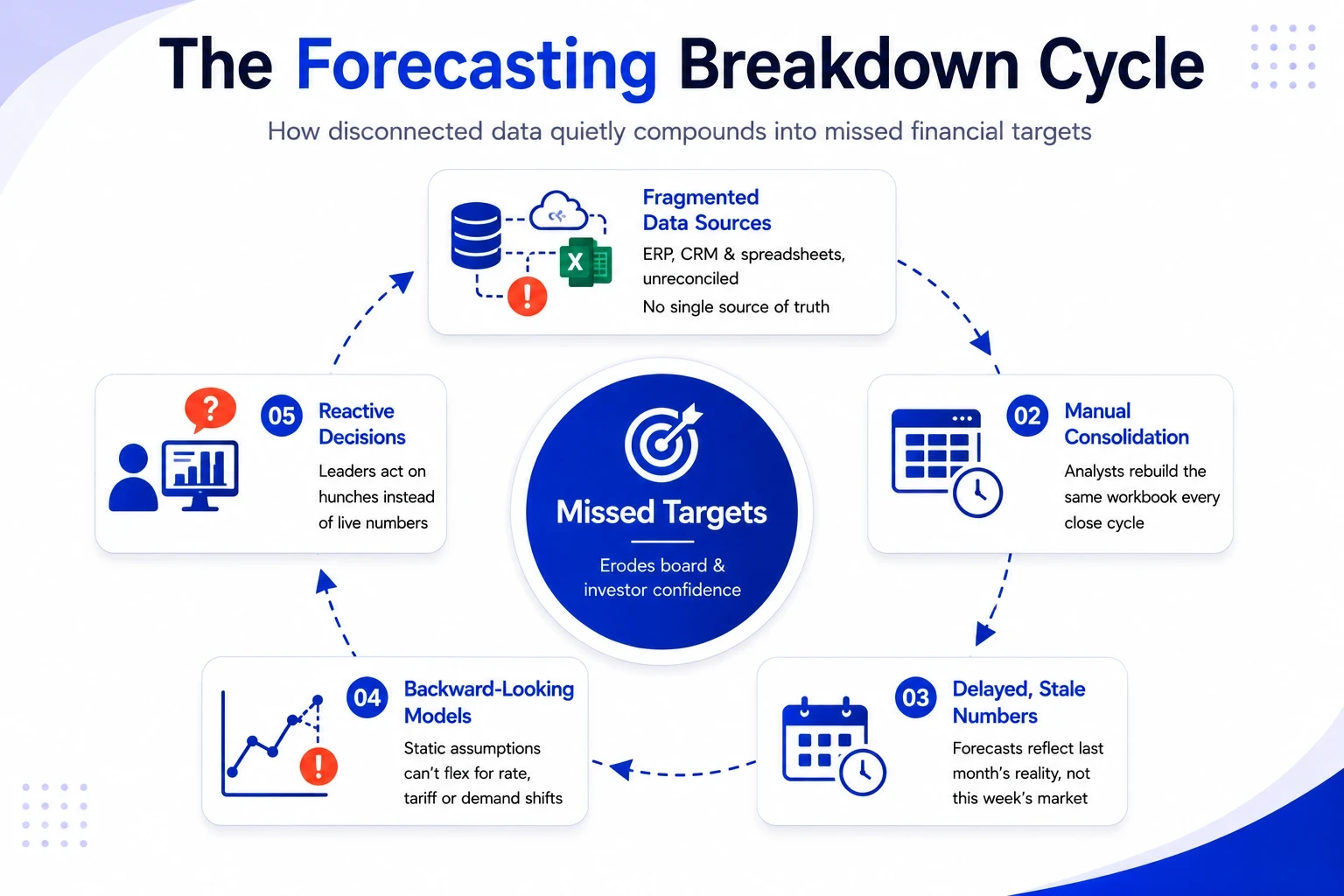
An inaccurate forecast is never just a finance problem; it ripples outward. Capital gets allocated against the wrong assumptions. Hiring plans outpace or lag real demand. Inventory and procurement decisions get made on numbers that were already outdated by the time they reached the operations team. And every missed forecast chips away at the credibility finance needs to influence strategic decisions in the room where they're made.
There's also a quieter cost: the opportunity cost of finance talent. Skilled analysts spending their time reconciling spreadsheets are analysts who aren't spending time on scenario modeling, margin analysis, or the strategic questions that actually move the business forward. Forecasting inefficiency doesn't just produce wrong numbers; it produces underused people.
The finance functions that have broken out of this cycle share a common pattern: they treat forecasting as a process to be engineered, not a report to be produced.
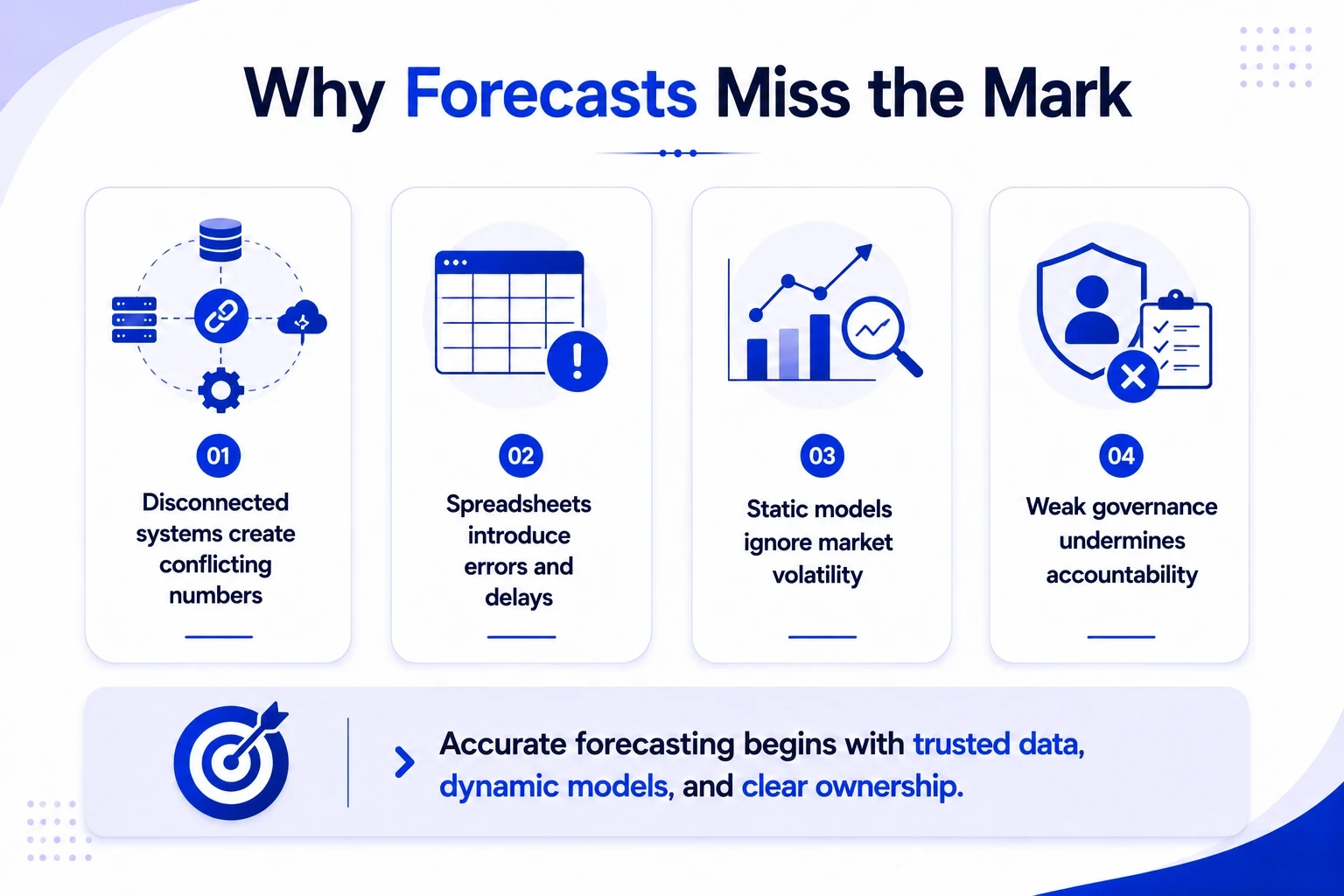
None of this requires ripping out existing systems or pausing operations for a year-long transformation project. The finance teams making the fastest progress are the ones pairing the right process design with the right operational execution; integrating data, redesigning workflows, and building forecasting models that hold up under real-world volatility, without losing momentum on the close, reporting, and compliance work that can't stop in the meantime.
This is precisely where a experienced finance operations and analytics partner earns its place; not as a vendor bolting on another tool, but as a strategic partner embedded in how the forecasting process actually runs day to day. FBSPL works alongside finance leaders to rebuild forecasting from the data layer up: consolidating fragmented systems into a single source of truth, designing driver-based and rolling forecast models suited to how the business actually operates, and building the governance structures that make forecast accuracy a measurable, improving discipline rather than a quarterly guessing game.
Most organizations benefit from updating forecasts monthly, while businesses operating in volatile markets may need bi-weekly or continuous rolling forecasts to respond quickly to changing conditions.
Get the latest insights on insurance operations, policy management, and industry best practices.