
6 MIN READ·Jul 28, 2026·Written by Bhavishya Bharadwaj
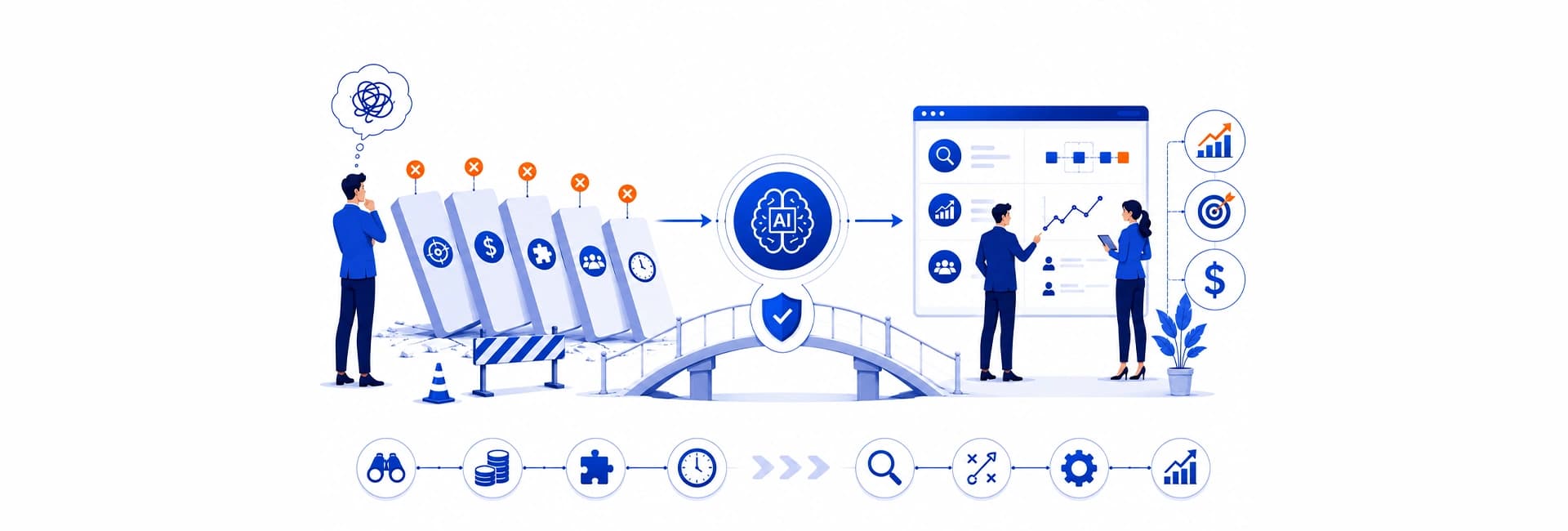
Summary: The blog explains why many AI initiatives miss ROI targets and identifies ten recurring investment mistakes. It shows how strategic consulting improves data readiness, governance, workflow redesign, change management, and phased implementation, enabling organizations to achieve sustainable and measurable AI transformation.
A disciplined AI strategy and experienced guidance convert experimentation into measurable, enterprise-wide business value creation.
AI is no longer optional; it's a boardroom priority. Yet most organizations pouring money into it are quietly failing. A recent Gartner survey of 782 infrastructure and operations leaders found that only 28% of AI use cases fully meet ROI expectations, while 20% fail outright, with leaders most often citing rushed timelines and unrealistic expectations as the reason. The technology isn't the problem; the approach is. This is where a deliberate AI investment strategy, guided by experienced AI consulting services, separates companies that scale AI profitably from those stuck in endless pilots.
Enterprise appetite for AI has never been higher, but adoption and value creation are two different things. McKinsey's November 2025 global survey found that 88% of organizations now use AI in at least one business function, yet just 39% report any measurable EBIT impact at the enterprise level. The gap isn't about better algorithms; it's about strategy, data readiness, and execution discipline. Understanding the common AI investment mistakes behind this gap is the first step toward closing it.
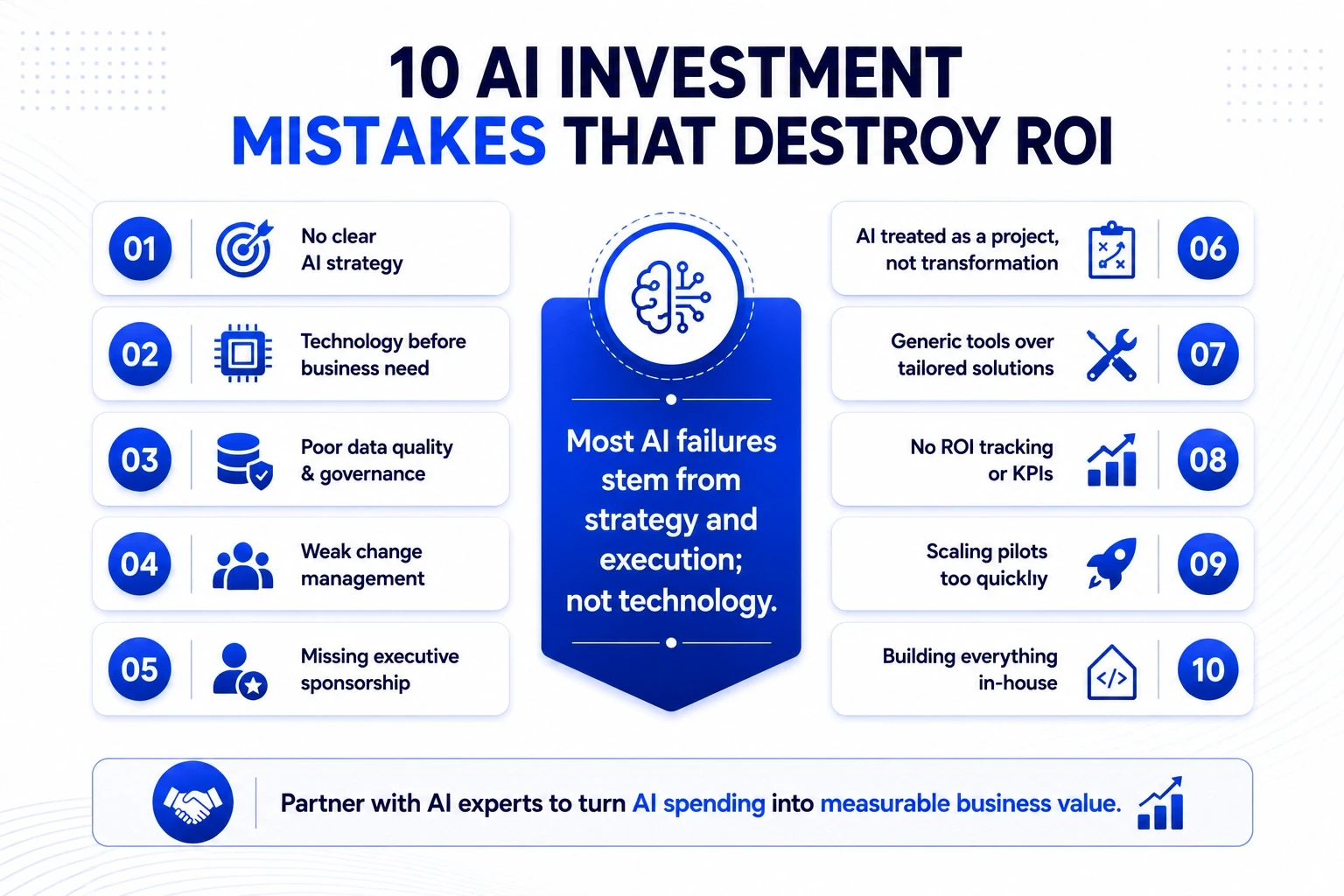
Before fixing the gap between AI spend and AI value, it helps to see exactly where that spend typically goes wrong. Here are the ten mistakes that show up most often across enterprise AI initiatives.
Many businesses fund AI projects before defining what business outcome they're solving for; revenue growth, cost reduction, or customer experience. Without this anchor, initiatives drift and lose executive support.
Teams often start with "which AI tool should we buy" instead of "which workflow is broken." This technology-first mindset produces flashy pilots that never touch the P&L.
Poor data quality remains the single biggest technical obstacle to AI success, undermining model accuracy and eroding organizational trust before a project even launches.
Deploying a model is easy; getting frontline teams to trust and use it is not. Skipping structured adoption plans is one of the fastest ways to kill AI value.
AI initiatives without genuine C-suite ownership lose funding priority the moment business conditions shift, stalling momentum before results appear.
Bolting AI onto legacy processes rarely works. Real value comes from redesigning the workflow itself; a mindset shift often described as genuine AI transformation.
Generic tools solve generic problems. Businesses with unique operating models need customized deployments aligned to their specific data, systems, and goals.
Without a dedicated budget and defined KPIs from day one, it's nearly impossible to prove; or scale; what's working.
Scaling before a use case is proven multiplies risk instead of value. Sustainable rollouts follow a tested, phased roadmap.
Assembling an internal AI team from scratch is slow, expensive, and often duplicates capability that already exists in the market; usually at a fraction of the cost and risk.
Each of these mistakes traces back to the same root cause: attempting AI without the strategic, technical, and organizational discipline it demands. Here's how the right consulting partner closes that gap at every stage.
The right AI consulting company starts with your business objectives, not a technology wish list; mapping use cases to measurable financial outcomes before a single model is built. This ensures every dollar of AI spend is tied directly to revenue, margin, or efficiency targets.
Consulting partners audit and structure your data foundation; governance, quality gates, and pipelines; so models are trained on information the business can actually trust and defend to stakeholders and regulators alike.
Rather than layering AI on top of old processes, experienced consultants rebuild the workflow around it. This distinction matters: RAND Corporation's analysis of AI project failures found that AI initiatives fail at more than twice the rate of standard IT projects, largely due to leadership and process gaps rather than technology limitations (RAND Corporation, 2025). A structured, consulting-led approach directly closes that execution gap.
Beyond deployment, the right partner trains internal teams, embeds feedback loops, and ensures the organization can operate and evolve the solution independently; not remain dependent on the vendor indefinitely.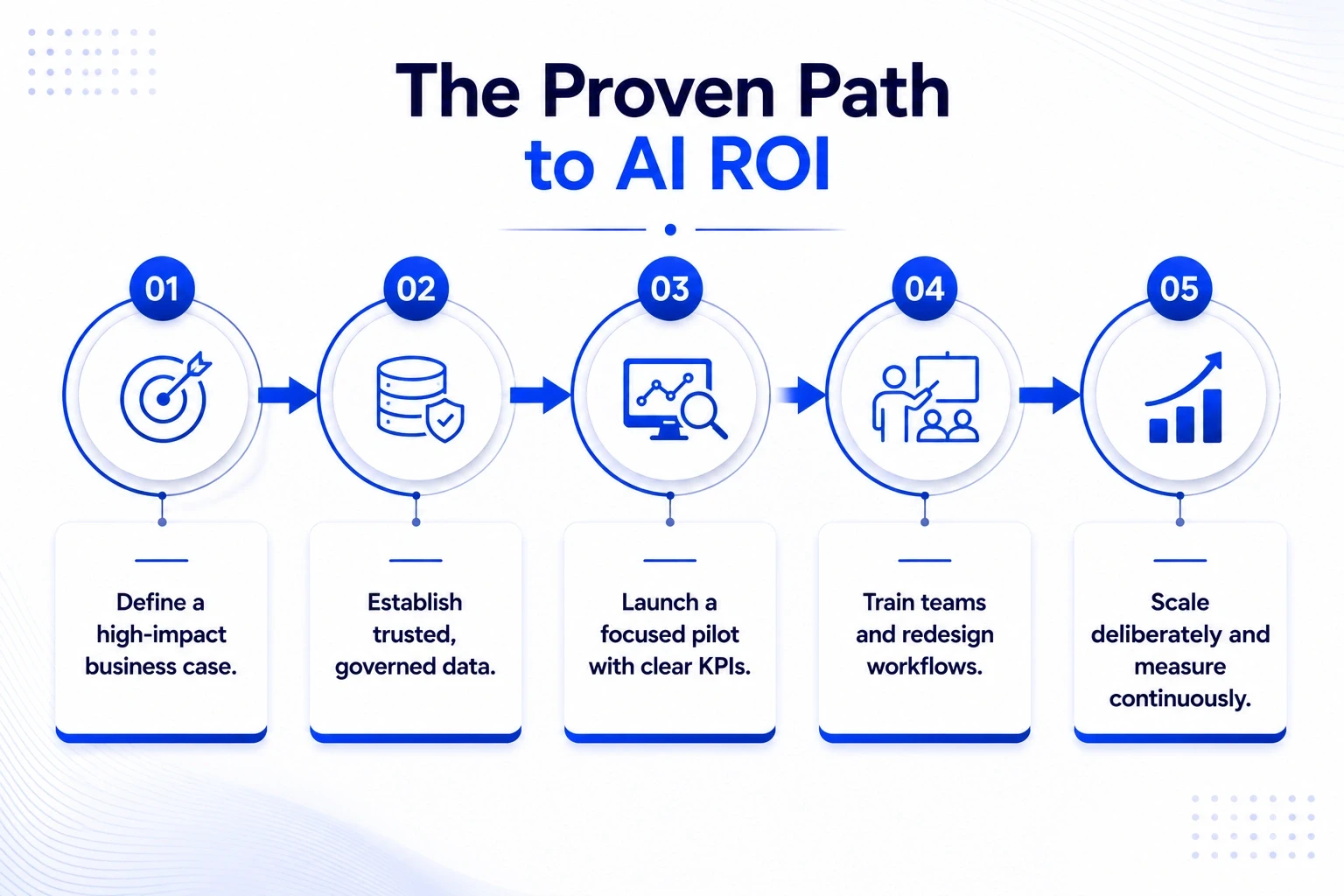
Knowing how to implement AI in business successfully comes down to sequence and discipline:
This sequence is exactly where AI consulting for businesses earns its value; replacing guesswork with a proven, repeatable operating model.
The businesses extracting real value from AI aren't necessarily the ones with the biggest budgets; they're the ones with the clearest strategy and the right partner beside them. A capable AI consulting firm operates as a strategic ally embedded in your transformation journey; not a vendor selling a one-time deployment. This is the difference between AI that generates a case study and AI that transforms operations, margins, and competitive position for years to come.
AI investment mistakes are common, predictable, and; most importantly; avoidable with the right strategic guidance. Instead of joining the majority struggling to prove ROI, businesses that pair a disciplined AI investment strategy with experienced AI consulting services consistently pull ahead.
FBSPL works as a strategic AI consulting partner to businesses navigating exactly this journey; from strategy and data readiness to workflow redesign and enterprise-wide scaling. If your organization is ready to move from AI experimentation to measurable AI transformation, talk to our AI consulting team today and build an investment strategy engineered for real business outcomes.
Most well-scoped AI projects begin showing measurable benefits within 6–12 months, though enterprise-wide transformations may take longer.
Get the latest insights on insurance operations, policy management, and industry best practices.