How to Build a Strong AI Implementation Strategy
1 MIN READ·Nov 19, 2026·Written by Bhavishya Bhardwaj

An AI system might extract information from hundreds of documents in minutes, but that is only one part of the job. Someone still needs to deal with missing data, verify uncertain results, move information into the right system, and decide what happens when the output is wrong. If these details are left unresolved, the technology can add work instead of reducing it.
This is where an AI implementation strategy matters. It requires a clear understanding of the process being changed, the outcome expected, and the conditions required for reliable solutions. It also means deciding how performance will be assessed once the system is live, rather than relying on a successful demonstration as proof of value.
For businesses exploring new AI capabilities, the real task is to turn a promising use case into an approach that works within existing operations, earns employee confidence, and justifies further investment.
What is an AI Implementation Strategy?
An AI implementation strategy defines how a business will apply artificial intelligence to businesses' operational or commercial goals. It covers the use cases to prioritize, the data and systems required, workflow changes, employee responsibilities, and the measures used to evaluate results.
While an AI strategy establishes why and where AI should be used, the implementation strategy explains how to put those priorities into practice. It turns business objectives into a practical plan for deploying AI, managing risks, and assessing whether the investment delivers value.
Step-by-Step Process to Build a Strong AI Implementation Strategy
A practical AI implementation strategy connects business priorities with the data, processes, technology, and people needed to deliver results. These seven steps help businesses evaluate opportunities, prepare for implementation, and determine whether an AI solution is worth scaling.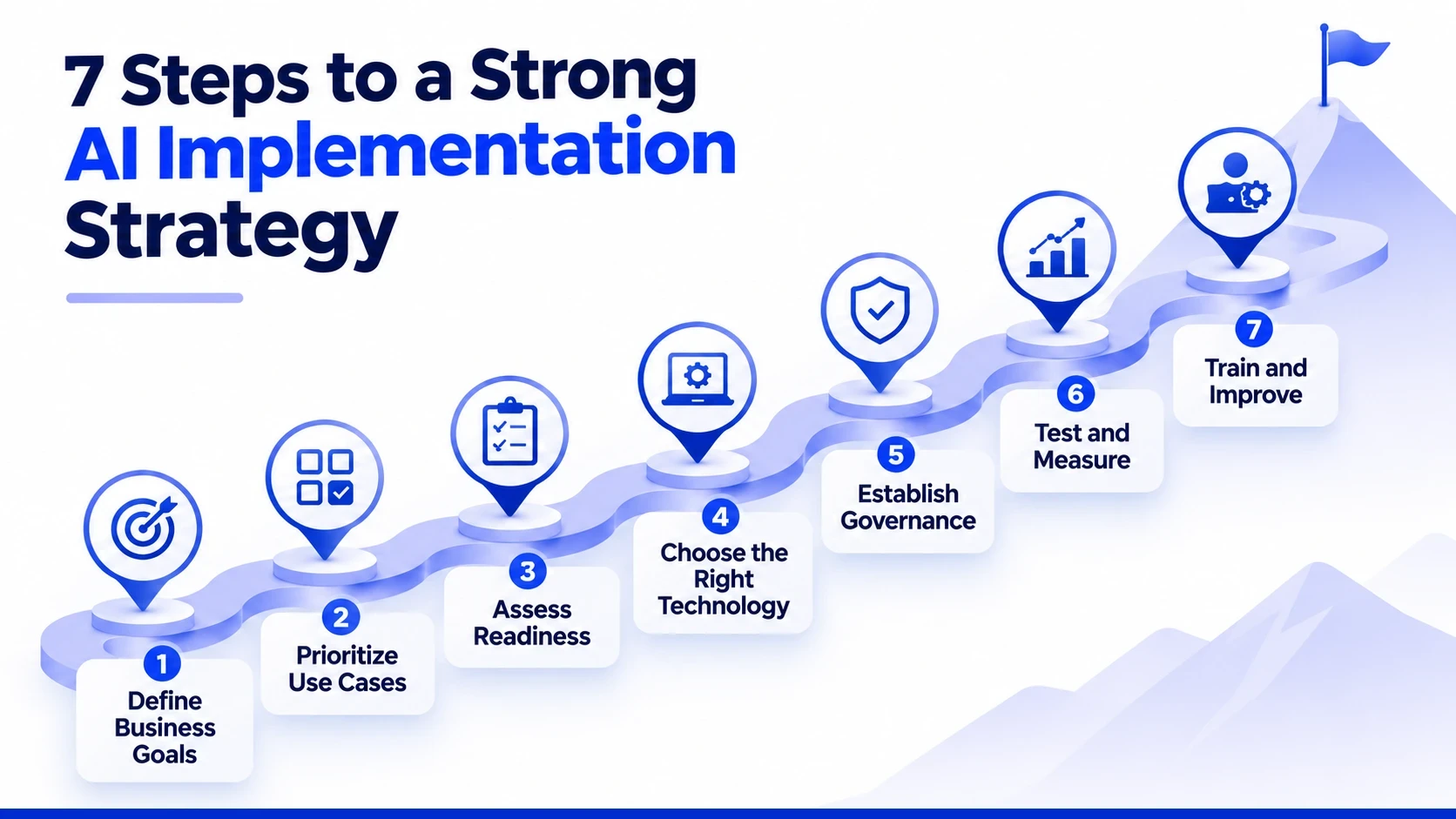
1. Define the Business Outcome First
Start with a problem that matters to the business. It could be a slow document review process, recurring data-entry errors, delayed customer responses, or limited visibility into operational performance.
Be specific about the intended improvement. Reducing processing time, improving accuracy, or lowering the effort required for routine tasks gives the project a clear direction and a baseline against which results can be measured.
2. Prioritize Use Cases with Measurable Value
Not every process needs AI, and not every opportunity deserves immediate investment. Compare potential use cases based on business impact, implementation effort, data availability, and the consequences of inaccurate outputs.
A repetitive task with reliable input data may be a better starting point than a complex decision-making process involving inconsistent information. This assessment helps businesses focus on opportunities that are both feasible and worthwhile.
3. Assess Data, Systems, and Workflow Readiness
Before implementing AI in business operations, examine how the selected process works today. Identify data gaps, disconnected applications, duplicate tasks, unnecessary handoffs, and points where employees regularly correct errors.
Check whether the required information is accurate and accessible, and whether existing systems can integrate with the proposed solution. Some workflows may also need to be standardized before AI is introduced. In certain cases, conventional automation or clearer process rules may be sufficient without adding AI.
For a closer look at this approach, read how process optimization improves business performance.
4. Select Technology That Fits the Requirement
New AI advancements can make the latest platforms look appealing, but technical capability alone is not a sound reason to invest. Evaluate solutions against business requirements, existing technology, security needs, integration costs, and ongoing maintenance.
Depending on the use case, the right option might be an AI feature already available in a business application, a specialized tool, or a tailored solution.
5. Establish Governance and Human Oversight
Decide who owns the solution, who can access its outputs, and who is responsible when something goes wrong. Define rules for data privacy, security, output validation, and escalation before deployment.
AI-generated drafts may need a routine check, while outputs affecting financial decisions, customer commitments, or regulated activities may require stricter approval. These safeguards should be built into the AI implementation process from the beginning.
For further guidance, FBSPL's AI security and defense strategies guide discusses data governance, access controls, security risks, and oversight requirements.
6. Test The Solution Under Real Operating Conditions
A successful demonstration does not guarantee reliable performance in daily operations. Run a controlled pilot using realistic inputs, including incomplete records and unusual cases the system may struggle to handle.
Measure results against the original objectives. Depending on the application, this could include processing time, accuracy, exception rates, or employee effort. Use the findings to decide whether the solution is ready to expand or needs adjustment.
Case study: How an insurance provider reduced manual work by 40%
A specialty insurance provider faced delays due to manual commission processing and disconnected systems. FBSPL helped improve operations through automation and system integration, achieving:
➜ 50% Reduction in commission reconciliation time➜ 40% Less manual intervention in commission processing
➜ 98% Reported financial reporting accuracy
The case highlights how improving processes and system integration can deliver measurable operational results before introducing more advanced AI capabilities.
Read the complete FBSPL case study.
7. Prepare Teams and Plan for Ongoing Improvement
Even a technically sound solution can struggle if employees do not understand how to use it or when to question its output. Explain how the new workflow will affect their responsibilities, provide relevant training, and document how exceptions should be handled.
Once the solution is live, assign responsibility for monitoring performance and addressing issues. As the business gains experience adopting AI, it can use those findings to improve existing implementations and identify other suitable opportunities.
AI Implementation Use Cases Across Business Functions
The most practical AI implementation use cases addresses specific bottlenecks rather than entire business functions. Here are four areas where implementing AI in business can deliver measurable value.
- Document processing: Extract information from invoices, contracts, and applications, flag missing details, and route exceptions for review.
- Customer service: Retrieve information from approved knowledge sources and help teams prepare responses to routine queries.
- Finance operations: Flag unusual transactions, categorize records, and identify discrepancies that require further investigation.
- Sales and proposals: Gather relevant information from approved materials and prepare initial proposal drafts for review.
The right use case depends on data quality, workflow complexity, and the consequences of errors. Start with a clearly defined need, then measure whether AI improves accuracy, turnaround time, or employee effort before expanding its role.
Common Mistakes to Avoid When Implementing AI
The following are one of the most common mistakes to avoid before implementing in any of the AI tools.
1. Choosing tools without a clear goal
Investing in AI because a tool offers advanced features can lead to solutions that have little impact on business priorities. Hence, businesses should define the problem and expected outcome before investing in AI.
2. Ignoring data quality issues
Incomplete records, inconsistent data, and disconnected systems can affect the reliability of AI outputs. Address these gaps before deployment instead of expecting the technology to compensate for them.
3. Automating a broken process
Introducing AI into a workflow with unnecessary steps, unclear responsibilities, or recurring errors can carry those problems into the new system. Review and improve the process before deciding what to automate.
4. Scaling before proving results
A successful pilot does not guarantee consistent performance across different teams or operating conditions. Test the solution against realistic scenarios and measurable criteria before expanding its use.
5. Overlooking employee readiness
Employees need to understand how AI fits into their work, when its outputs require verification, and how to handle exceptions. Without proper training and clear responsibilities, adoption can remain low even when technology works well.
When Should Businesses Consider Artificial Intelligence Consulting Services?
Businesses do not always need external expertise to begin adopting AI. However, artificial intelligence consulting can be valuable when internal teams are unsure which use cases deserve investment, whether existing systems are ready, or how to move from a pilot to a reliable operational solution.
An experienced consulting partner can help assess current workflows, identify practical opportunities, evaluate technology options, and build an implementation roadmap tied to business objectives. This is particularly useful when integration requirements, data limitations, or governance concerns make implementation more complex.
FBSPL's AI and automation consulting services help businesses assess automation opportunities and plan solutions around their operational requirements, with a focus on practical implementation and measurable outcomes.
Bhavishya Bhardwaj
Bhavishya Bhardwaj is the Digital Marketing Manager at FBSPL, bringing over a decade of experience across insurance, outsourcing, accounting, and digital transformation.
Frequently Asked Questions
Start by identifying a specific business problem and defining the outcome you want to achieve. Assess potential use cases based on business value, data availability, implementation effort, and risk before selecting a solution.
Leave a Comment
Table of Content
Subscribe our Newsletter
Get the latest insights on insurance operations, policy management, and industry best practices.