The future of customer support: Why businesses need both AI and human agents
1 MIN READ·Sep 24, 2026·Written by Bhavishya Bharadwaj

Summary: AI is reshaping customer support by improving speed, efficiency, and consistency, but lasting customer satisfaction still depends on human expertise. A hybrid support model that combines intelligent automation with empathetic agents helps businesses deliver better experiences, stronger loyalty, and scalable service operations.
How combining AI efficiency with human expertise creates smarter, scalable, and customer-focused support experiences for businesses.
Customer expectations have changed faster than most support organizations can keep up with. People want instant answers, they want context carried across every channel, and they still want to feel heard when something goes wrong. This is the tension sitting at the center of every conversation about AI in customer service today: how do you move fast without losing the human judgment that builds trust?
The honest answer is that this was never meant to be an either-or decision. AI customer support is not a replacement for people; it's a force multiplier for them. Businesses that treat this as a binary choice, "bots versus agents," are the ones getting stuck. The businesses pulling ahead are the ones building a deliberate operating model where conversational AI customer service handles volume, speed, and routine resolution, while human agents own judgment, empathy, and the moments that actually determine customer loyalty.
This blog breaks down what's really happening in the future of customer support, how AI powered customer service works in practice, where it delivers the most value, and why the winning strategy is a hybrid one; not an AI-only one.
Why AI won't replace customer support agents
For the past two years, a lot of boardroom conversation assumed AI would eventually eliminate the need for human support staff. The 2025-2026 data tells a very different story.
A Gartner survey of 321 customer service and support leaders conducted in October 2025 found that despite widespread predictions of AI-driven job losses, only 20% of leaders had actually reduced agent headcount because of AI; the majority reported stable staffing even while handling significantly higher customer volumes, which points to AI improving efficiency rather than replacing people.
That's not an isolated finding either. In an earlier Gartner poll of 163 customer service leaders conducted in March 2025, 95% said they planned to retain human agents specifically to define and govern AI's role in the support function, favoring what Gartner describes as a "digital first, but not digital only" strategy (Gartner, June 2025).
The practical takeaway: the use of AI in customer service is scaling fast, but it's scaling around human agents, not instead of them. Leaders who built agentless strategies are now walking them back because customers still escalate complex, emotional, or high-stakes issues to a real person; and they expect that person to be available.
How AI agents work in customer service
To use AI well, it helps to understand what it's actually doing behind the scenes. How AI agents for customer service work comes down to three layers working together:
1. Natural language understanding
Conversational AI parses a customer's message, identifies intent, and pulls in relevant context; order history, past tickets, account status; often before a human ever sees the conversation.
2. Knowledge and workflow integration
The AI agent connects to your CRM, knowledge base, billing system, and ticketing platform to actually retrieve information or trigger an action, rather than just generating a plausible-sounding response.
3. Decision and escalation logic
This is the layer most companies underinvest in. A well-designed AI agent knows the boundary of its own competence; it resolves what it can resolve confidently, and hands off everything else to a human with full context attached, so the customer never has to repeat themselves.
This third layer is exactly where AI-driven communication either builds trust or destroys it. A bot that loops a frustrated customer through the same three questions creates more friction than no automation at all. A bot that recognizes escalation triggers early and routes to the right specialist with full context is the difference between a churn event and a saved account.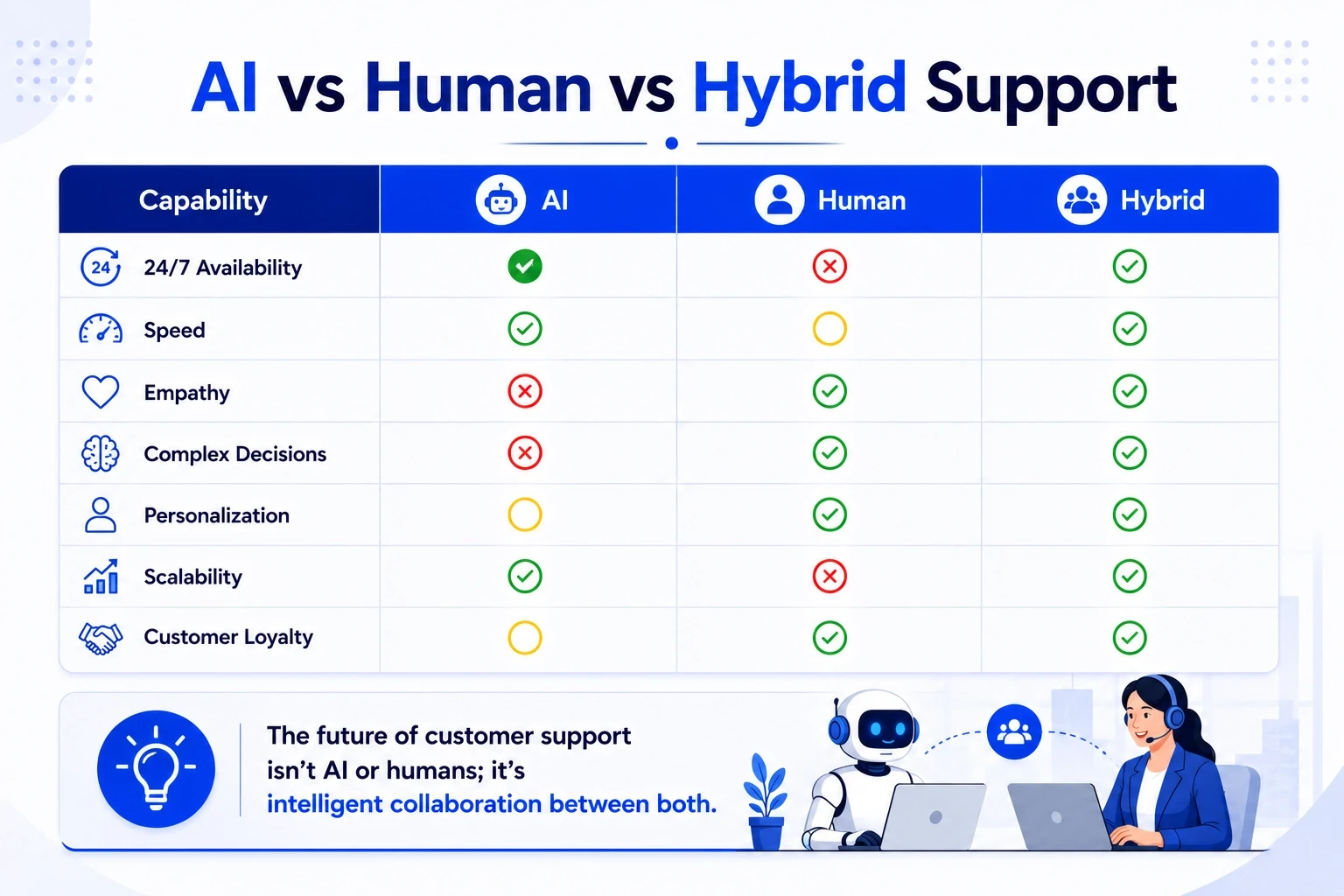
Use cases for AI agents in customer service
The real value of AI customer support shows up in specific, high-frequency scenarios rather than as a blanket replacement for support teams. Some of the most proven use cases include:
- Tier-1 query resolution — password resets, order status, billing FAQs, and account changes handled instantly, 24/7, without queue time.
- Intelligent ticket triage and routing — AI classifies incoming tickets by intent and urgency and routes them to the right team or specialist automatically, cutting first-response time.
- Proactive support — AI agents flag anomalies (a failed payment, a shipping delay) and reach out before the customer has to raise a complaint.
- Agent-assist during live conversations — AI surfaces relevant knowledge base articles, past interaction history, and suggested responses in real time, so human agents resolve issues faster and more consistently.
- Multilingual and omnichannel support — a single AI layer maintains context across chat, email, voice, and social, so customers never have to restart their story on a new channel.
- Post-resolution analysis — AI mines closed tickets for recurring issues, product gaps, and sentiment trends that feed directly into product and CX strategy.
Each of these use cases has a common thread: AI is doing the repetitive, structured, high-volume work so human agents can spend their time on the 10–20% of interactions that actually require judgment, negotiation, or empathy.
How AI agents can help without replacing humans
The businesses getting the most out of AI powered customer service aren't asking "what can AI take off our plate?" They're asking "how does AI make our human agents better at their job?"
That reframing matters. Done well, conversational AI for customer service helps agents in several concrete ways:
- Removes repetitive cognitive load, so agents aren't mentally exhausted from answering the same ten questions all day and can bring more patience and problem-solving energy to complex cases.
- Shortens handle time by pre-populating context, so the agent isn't asking the customer to repeat their issue.
- Builds consistency, ensuring every customer gets accurate, policy-aligned information regardless of which agent; or which AI system; they interact with.
- Surfaces sentiment and risk signals early, prompting a human to step in before a situation escalates publicly.
This is also where AI and customer service intersect with retention economics directly. Zendesk's 2026 CX Trends report, based on surveys of more than 11,000 consumers and CX professionals across 22 countries, found that 85% of CX leaders believe a single unresolved issue is enough to lose a customer for good. That statistic alone should reframe how leadership teams think about AI investment; the goal isn't deflection volume, it's first-contact resolution quality, and that requires AI and humans working from the same context in real time.
The real challenge: Governance, not technology
Most companies don't struggle to deploy an AI chatbot. They struggle to govern it responsibly at scale; deciding what it's allowed to say, when it must escalate, how it's monitored, and how its knowledge base stays current as products and policies change.
Gartner's own research underscores this: agentic AI is forecast to autonomously resolve up to 80% of common customer service issues by 2029, which Gartner projects could reduce operational costs by roughly 30%; but that same research is explicit that this shift depends on organizations building the right operating model, knowledge infrastructure, and escalation governance around it, not simply switching on a tool.
This is precisely where most internal teams get stuck; not because the AI technology isn't capable, but because nobody has mapped which decisions belong to AI, which belong to humans, and how the two hand off cleanly. Getting this operating model wrong is expensive: it shows up as customer churn, inconsistent policy enforcement, and agents who don't trust the tools meant to help them.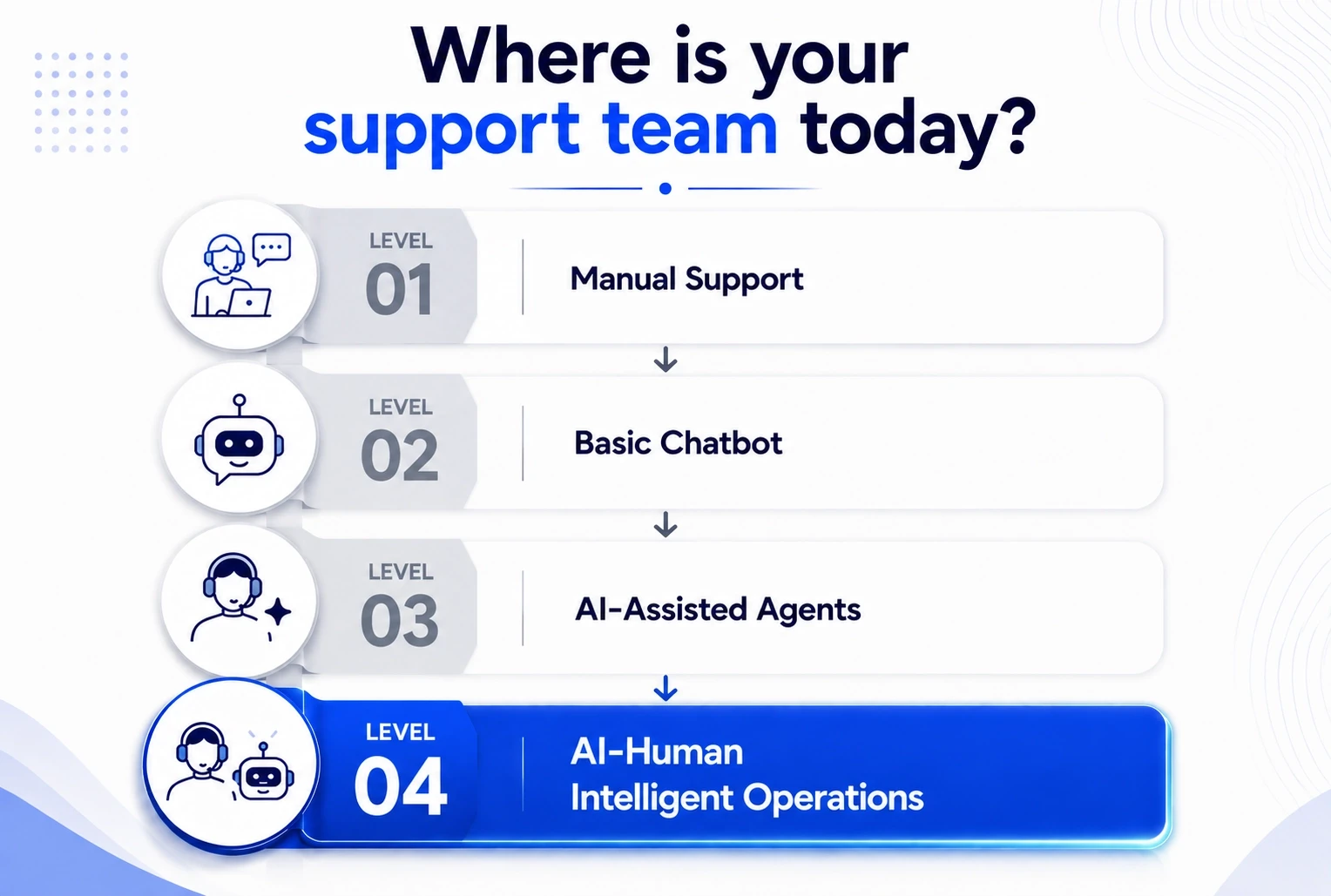
Building a support strategy that actually works
The future of customer support isn't about choosing between AI and human agent; it's about combining the strengths of both. AI excels at handling repetitive tasks, delivering instant responses, and improving operational efficiency, while human agents provide the empathy, judgment, and problem-solving needed for complex situations. Businesses that build a well-governed hybrid support model will be better equipped to deliver faster resolutions, consistent experiences, and stronger customer loyalty as expectations continue to evolve.
FBSPL helps businesses design and implement customer support strategies that balance intelligent automation with human expertise. From optimizing workflows and integrating AI into existing support systems to building scalable operating models, FBSPL enables organizations to improve efficiency without compromising customer experience. With the right mix of technology, processes, and skilled professionals, businesses can create support operations that are ready for future growth.
Bhavishya Bharadwaj
Bhavishya Bharadwaj is the Digital Marketing Manager at FBSPL, bringing over a decade of experience across insurance, outsourcing, accounting, and digital transformation.
Frequently Asked Questions
Start by identifying repetitive, rule-based, and high-volume interactions such as FAQs, order tracking, or password resets. Complex, emotional, or exception-based issues should remain with human agents to ensure better customer outcomes.
Leave a Comment
Table of Content
Subscribe our Newsletter
Get the latest insights on insurance operations, policy management, and industry best practices.