
9 MIN READ·Oct 24, 2025·Written by Bhavishya Bharadwaj

Explore how business intelligence outsourcing delivers cost-effective, clear insights that empower smarter, faster data-driven decision-making with tools like Power BI.
Data, every company’s greatest promise and biggest burden. It’s everywhere, multiplying faster than decisions can keep up. The funny thing is, most organizations don’t suffer from lack of data, it’s the opposite. They have too much of it, scattered across tools, teams, and time zones. The question isn’t where to find insight anymore. It’s how to make sense of it fast enough to stay ahead.
Here’s a truth many businesses quietly admit but rarely say aloud: in-house analytics setups are expensive. Maintaining servers, hiring visualization experts, and aligning departments, it all adds up quicker than expected. One delay and the numbers lose relevance. That’s when business intelligence (BI) outsourcing suddenly stops looking like a convenience and starts resembling survival.
Using cost effective business intelligence services isn’t about cutting corners; it’s about cutting the chaos. When done right, outsourcing doesn’t just trim expenses; it sharpens decision-making. It fills the gap between fragmented data and intelligent business decisions that move markets.
In this piece, we dive into how BI outsourcing reshapes modern analytics, the challenges it solves, the mistakes to avoid, and why it may become the backbone of every data-driven decision making framework of tomorrow.
Ask any business leader today what keeps them up at night, it's probably the flood of dashboards that say everything but answer nothing. Reports keep arriving. Numbers look impressive. Yet clarity? Missing.
A paradox unfolds here. Organizations implement business intelligence and data visualization tools expecting transformation. But tools alone don’t guarantee transformation. Without alignment across teams, data becomes static art, pretty but pointless.
One of the biggest BI mistakes happens right here. Companies rush into technology before defining what they truly want from it. They buy platforms that promise miracles, but forget to build the bridge between software and strategy. The outcome? Confusion dressed up as intelligence.
There’s also the human factor. Decision-makers get buried in reports that aren’t telling coherent stories. Analysts spend hours creating visuals no one interprets. It’s like owning an expensive telescope but forgetting to look through it.
Another reality, maintaining an internal BI department requires specialized staff, high licenses, and constant updates. For small and mid-sized enterprises, those costs can suffocate progress. That’s why business intelligence outsourcing steps in, not as an escape hatch, but as a recalibration. It converts bulky, directionless setups into lean, focused structures where clarity finally becomes accessible.
The economic rationale behind cost effective business intelligence boils down to a simple yet powerful principle: less heavy lifting in infrastructure, more delivery of sharp, actionable insight. It’s not rocket science, it’s smart resource sharing. When companies outsource their BI, they tap into deep expertise and ready-made tools without the usual bulk of big internal projects. Think of it as switching on a highly trained brain that’s already handled challenges across industries. Here’s why this approach truly works: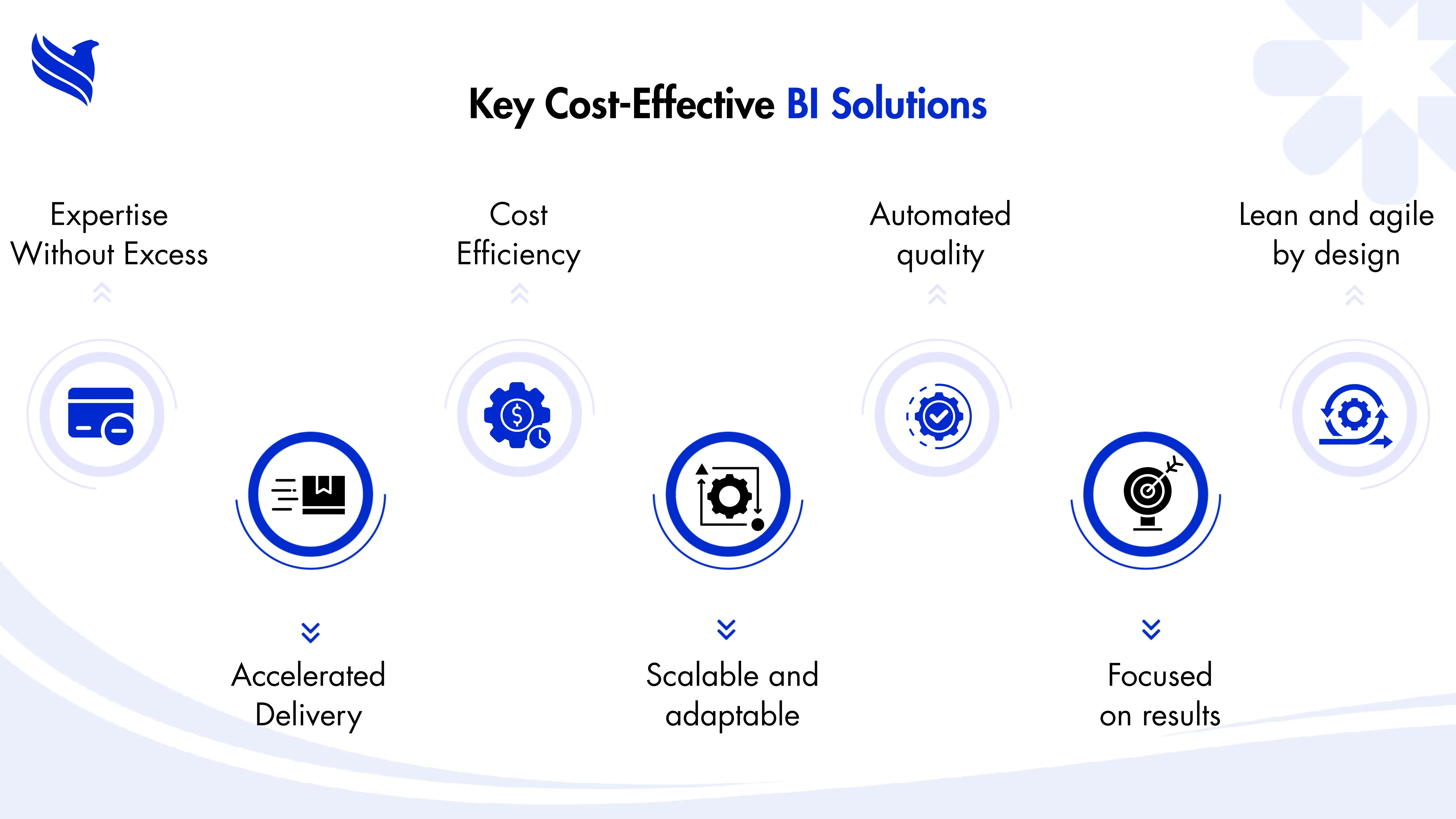
This blend of expertise, technology, and flexibility is why business intelligence outsourcing stands out as a smart investment for smarter, faster data-driven decision making.
Every BI journey starts with enthusiasm. The adrenaline rush of dashboards, KPIs, and visuals. But the ones that last, the ones that produce meaningful results, start with something quieter: intention.
Before anything else, decision-makers need direction. Not another dataset, but a purpose statement. What exactly should the BI system solve? Miss that step, and the rest unravels.
Crafting that roadmap involves a blend of clarity and realism:
The sequence above isn’t a checklist; it’s a mindset shift. The goal is no longer about reporting what happened yesterday, but predicting what might happen next week and preparing accordingly.
Ask why business intelligence is important, and the typical response is data-driven growth. But the truth is deeper. BI isn’t just a system. It’s how organizations start seeing themselves differently, how they translate performance into patterns.
As technology matures, BI is crossing into predictive and prescriptive territory. It doesn’t stop at showing results; it tells where those results might lead. Algorithms sketch future outcomes, visualize market tension, and warn against potential missteps.
Modern BI platforms backed by AI and automation are driving this change. Cloud-based frameworks ensure real-time insights flow across continents in seconds. Outsourced BI teams are already integrating machine learning to enhance outsourcing decision making, where decision accuracy becomes a science rather than guesswork.
Imagine a manufacturing organization using predictive BI to monitor equipment downtimes before failures occur. Or a financial firm forecasting client churn with behavioral data. These aren’t experiments. They’re active transformations made efficient through BI outsourcing.
The future of BI lies in accessibility and adaptability. What was once privilege for large corporations is now power available to all sizes, through intelligent outsourcing ecosystems.
It’s common for leaders to worry about control, handing over data feels like giving away part of the company’s soul. But modern business intelligence outsourcing works differently. It’s not about shifting responsibility; it’s about sharing insight.
Outsourcing partners operate like extended think tanks. They provide specialized infrastructure but keep governance tightly aligned to client networks. Dashboards remain accessible, data stays encrypted, and every metric traces back to verified internal sources.
Here’s what typically happens when organizations embrace outsourcing legitimately:
The irony is that outsourcing restores control instead of destroying it. It frees leadership from maintenance headaches and lets them focus on interpretation, the part that matters most in crafting intelligent business decisions.
Behind the jargon, business intelligence outsourcing survives because it creates practical advantages at ground level. The kind of outcomes that resonate not in theory but in board meetings and balance sheets.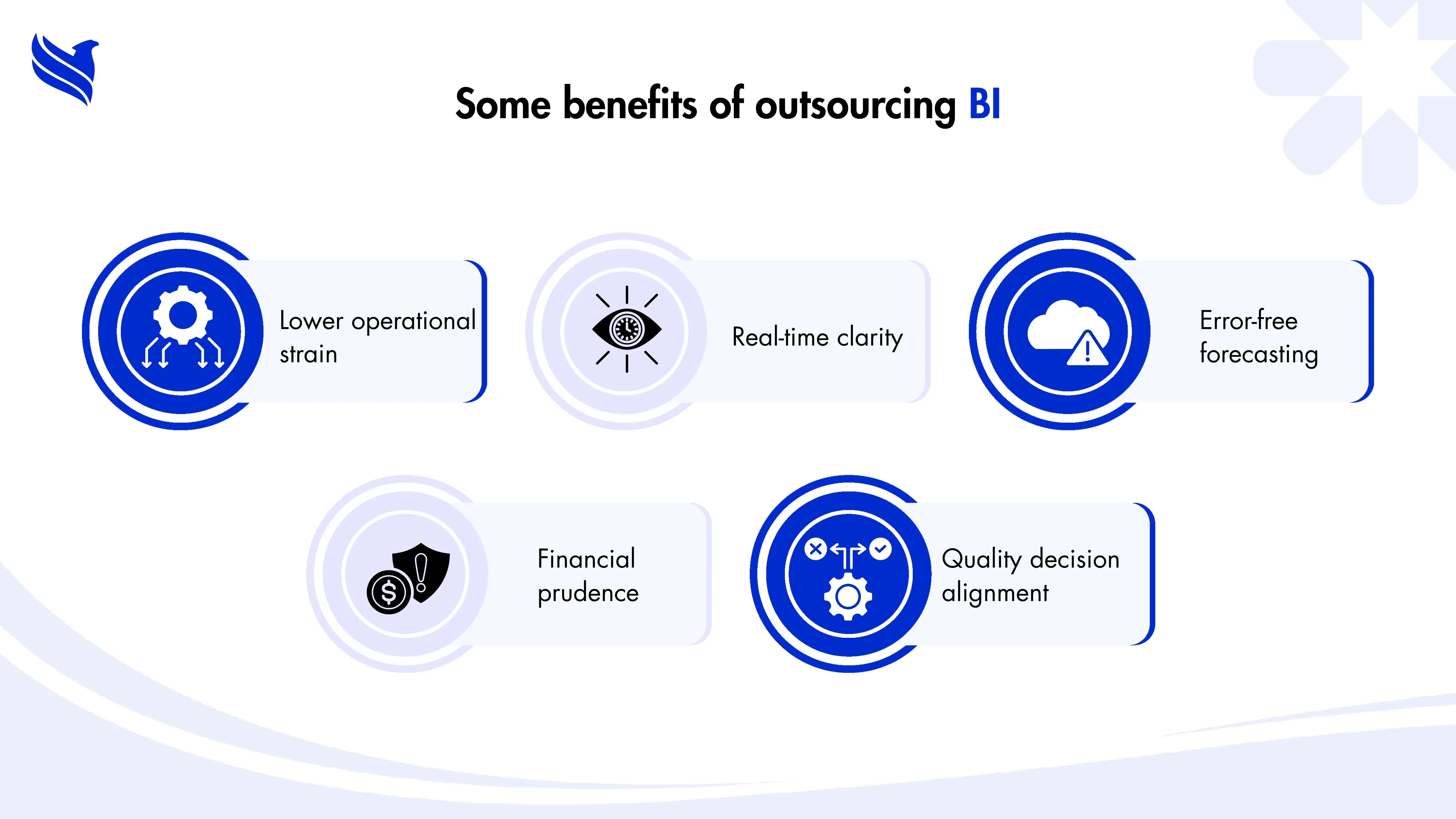
It’s an exchange of resources for results. And it’s changing how companies, from startups to global operations, structure their analytical roadmaps.
To understand the impact of BI, imagine running a business blindfolded. You might move forward, but not necessarily in the right direction. Why is business intelligence important? Because it removes that blindfold and gives clarity when instinct falls short.
Data, when transformed properly, becomes foresight. It’s what helps organizations cut through noise and interpret real signals. Yet technology alone can’t achieve that transformation, interpretation does. That’s what well-structured BI solutions and skilled outsourcing deliver: a translation layer between chaos and clarity.
When dashboards start narrating actual stories, the “why” behind trends, decisions gain depth. The act of outsourcing decision making isn’t about surrender, it’s about making room for objectivity, efficiency, and expertise that keeps decisions grounded.
In the end, every conversation about BI circles back to one goal, turning information into direction. Reliable analytics make it possible. Affordable execution keeps it sustainable. And BI outsourcing ties both together, so companies, regardless of size, can act smarter.
Those who master BI aren’t the ones collecting the most data; they’re the ones interpreting it better. The difference between surviving and thriving often depends on clarity, per decision, per day. Outsourcing amplifies that clarity.
By blending Power BI for best analytical solutions, adaptable visualization tools, and proven outsourcing frameworks, businesses finally reach the sweet spot, insight without inflation. The model is flexible, human-centric, and transparent enough to grow with you.
The takeaway? Cost effective business intelligence isn’t a trend; it’s a reality guiding future growth. Smart companies are no longer asking, “Should we outsource BI?” They’re asking, “How soon can we start?” Because the race to stay data-centered isn’t slowing down anytime soon.
Partnering with FBSPL gives enterprises the precision of technology and the wisdom of experience, both bundled into one intelligent outsourcing pathway. When your data starts speaking clearly, your decisions will too.
Get the latest insights on insurance operations, policy management, and industry best practices.