
8 MIN READ·Jun 08, 2026·Written by Bhavishya Bharadwaj

Summary: As insurance businesses grow, operational complexity often outpaces existing processes and systems. This blog explores the key challenges in insurance operations management, the role of digital transformation and compliance automation, and how structured operations enable sustainable, scalable, and profitable growth.
Growing an insurance business feels like a victory; until your operations can't keep up with it. New policies, expanding compliance requirements, growing client rosters, and mounting back-office complexity begin to pile up. What once ran on a lean team and a shared spreadsheet now demands precision infrastructure. And without it, growth doesn't accelerate; it stalls.
This is the quiet crisis facing hundreds of insurance carriers, MGAs, and brokers today. The operational foundations built for a $10M business cannot sustain a $50M one. Yet too many leaders only recognize this misalignment after the damage is already done: missed SLAs, regulatory exposure, frustrated clients, and operational costs that grow faster than revenue.
If you're leading an insurance operation in a period of growth, this piece is written for you.
Insurance is inherently a high-volume, process-intensive business. Every new policy triggers a chain of workflows; documentation, compliance verification, endorsements, renewals, and claims handling. When you're writing 500 policies a month, manual processes are manageable. At 5,000 policies, they become a liability.
The challenge compounds because insurance operations don't just scale linearly. Each additional line of business, state license, or product type introduces new regulatory requirements, new data touchpoints, and new possibilities for error. The operational surface area expands exponentially; while most insurers' back-office infrastructure remains largely static.
According to McKinsey's Global Insurance Report 2025, the majority of an insurer's financial performance is driven not by where they operate, but by how they operate; a finding that underscores just how central operational capability is to competitive advantage.
The "how"; the daily mechanics of insurance operations management; is where most growing firms are quietly hemorrhaging value.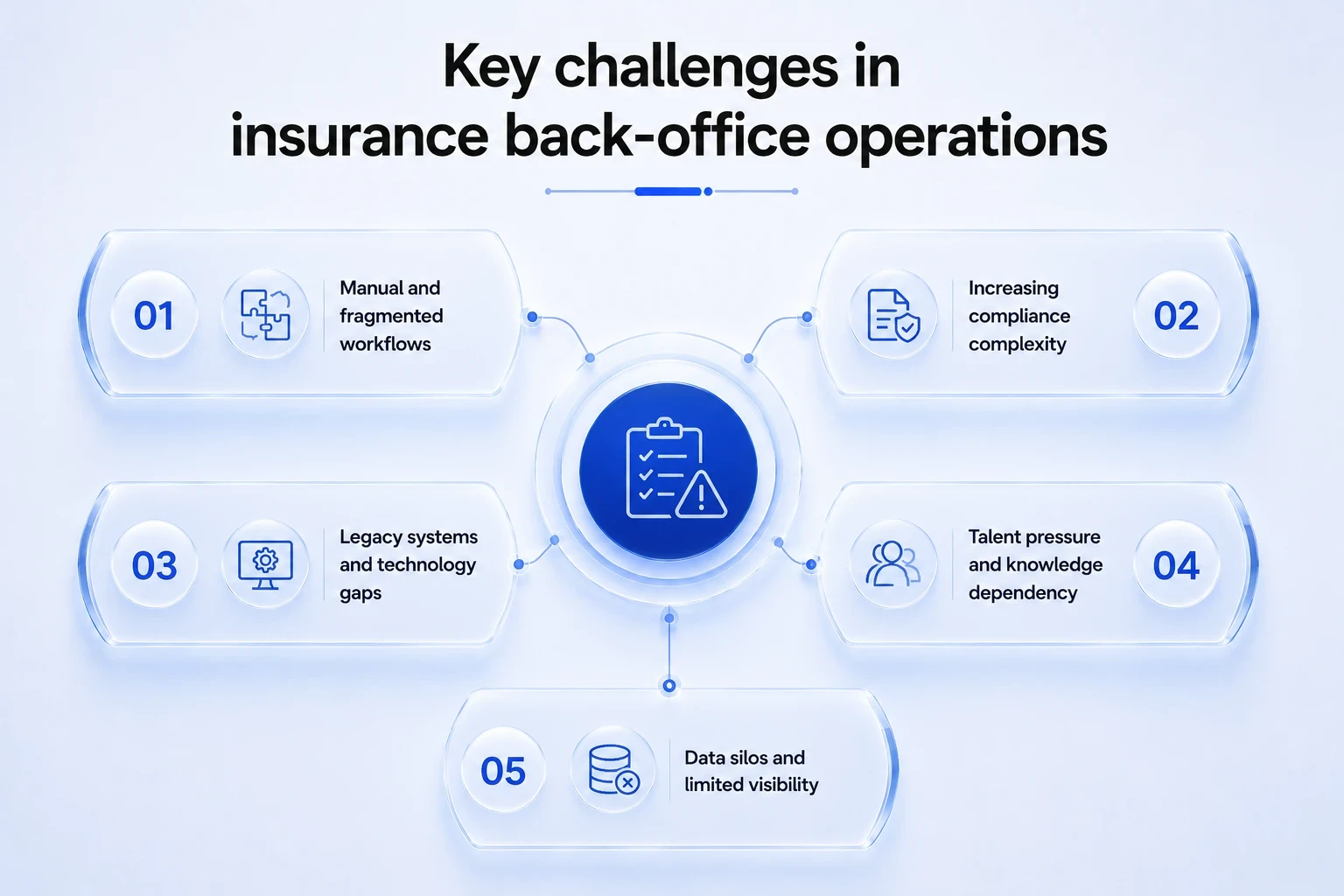
Understanding why insurance operations struggle at scale requires an honest look at the specific friction points that compound as a business grows.
Most insurance back offices evolved organically. A team member here handles renewals. Another manages endorsements over email. A third maintains compliance checklists in Excel. These informal systems work; until they don't. When volume surges, manual workflows create processing delays, version control failures, and accountability gaps that are nearly impossible to audit or fix at speed.
The result is a silent erosion of throughput. Teams become bottlenecks. Turnaround times slip. And the client experience; which is increasingly the primary differentiator in insurance; suffers quietly.
Regulatory requirements in insurance are not static. State-by-state filing rules, NAIC guidelines, evolving data privacy mandates, and emerging AI governance frameworks all require continuous monitoring and operational adaptation. For a growing insurer expanding geographically or into new product lines, the compliance burden grows at a rate that in-house teams can rarely match.
Deloitte's 2025 Insurance Outlook directly flags this risk: carriers that fail to address back-office inefficiencies and aging core systems will be structurally challenged to maintain profitability, especially during disruption.
Compliance automation; the use of structured workflows, rule-based processing, and real-time regulatory monitoring; is increasingly the only practical solution. Yet many growing insurers treat compliance as a periodic audit function rather than a continuous operational discipline, which is where exposure builds.
Insurance has historically been a late adopter of technology modernization. Many carriers still rely on core systems built a decade ago, patched together with point solutions and manual overrides. When business grows, these systems don't flex; they fracture.
Policy administration platforms that can't communicate with claims systems. CRM tools that don't sync with underwriting workflows. Reporting that requires manual data pulls across three different platforms. Each integration gap adds friction, creates error risk, and slows the entire operation.
Growth creates hiring pressure. Hiring pressure in a specialized field like insurance creates talent gaps. And in many back-office environments, critical institutional knowledge is concentrated in two or three individuals. When those people leave, or when volume simply exceeds their bandwidth, operations become dangerously fragile.
This is the hidden cost of under-structured insurance operations: the business becomes dependent on heroics rather than systems, which is never a sustainable operational model.
Effective insurance operations management depends on clean, accessible, real-time data. But in most growing firms, data lives in silos; underwriting data here, claims data there, compliance records in a third system. Leaders making decisions about capacity, risk exposure, and operational investment are often working from incomplete or delayed information.
When data doesn't flow, decisions slow. And in a competitive market where agility is an advantage, slow decisions are expensive.
It's tempting to view operational inefficiency as an internal inconvenience; a problem that can be tolerated as long as revenues are growing. This is a costly misconception.
Operational dysfunction in insurance has direct, measurable consequences:
The structural fix is not simply adding headcount. It's building deliberate, documented, scalable insurance operations infrastructure; and often, it requires bringing in partners with specialized expertise to accelerate that transformation.
The insurance industry is undergoing a structural shift in how operations are designed and executed. Digital transformation in insurance is no longer a forward-looking aspiration; it is an operational necessity for firms that intend to remain competitive.
According to Accenture's research on insurance business process modernization, automating back-office processing can increase productivity by 15–20%, while modernizing core systems can accelerate time-to-market for new product launches by up to 60%.
This isn't technology for technology's sake. It's the recognition that modern insurance operations; underwriting support, policy servicing, endorsements, renewals, compliance tracking, claims intake; require purpose-built systems and structured workflows to operate reliably at scale.
The benefits of structured back-office operations in insurance aren't abstract. In practice, they translate to:
Each of these is not merely a process improvement. Cumulatively, they represent the difference between an operation that constrains growth and one that enables it.
Of all the challenges in the insurance industry, compliance management is among the most operationally intensive and reputationally sensitive. The regulatory environment is not becoming simpler.
In 2025, AI governance guidelines have been adopted by nearly half of US states, per Deloitte's research, and regulators are increasing scrutiny around explainability, data usage, and AI model risk; adding new layers of compliance obligation for carriers deploying modern technologies.
Insurance compliance automation addresses this challenge by converting what is typically an ad hoc, labor-intensive process into a structured, trackable, auditable workflow. Automated compliance systems can:
The strategic value of compliance automation is not only in avoiding penalties; it's in freeing compliance professionals to focus on strategic interpretation and risk assessment rather than administrative tracking.
Insurance operations rarely fail in a single dramatic moment. More often, the breakdown happens gradually; through missed deadlines, growing backlogs, compliance gaps, fragmented workflows, and increasing pressure on teams. As policy volumes rise and regulatory requirements become more complex, operational inefficiencies that once seemed manageable can quickly become barriers to growth.
The organizations that scale successfully recognize that operational excellence is not just an internal function; it is a strategic capability. Investing in structured processes, integrated systems, compliance automation, and scalable workflows before problems become critical allows insurers to grow with confidence. These organizations are better positioned to improve service quality, maintain regulatory compliance, increase operational efficiency, and respond faster to changing market demands.
If your insurance operation is growing and you're beginning to feel the strain, now is the time to evaluate whether your operational infrastructure is built for the next stage of growth. The earlier inefficiencies, risks, and scalability challenges are identified, the easier they are to address before they impact performance, profitability, or customer experience.
At FBSPL, we help insurance carriers, MGAs, and brokers transform insurance operations into a scalable growth engine. Through operational assessments, process optimization, compliance-focused workflows, and technology-enabled back-office support, we help organizations build resilient, efficient, and future-ready insurance operations that support sustainable long-term growth.
Insurance companies can track operational efficiency using metrics such as policy processing time, claims turnaround time, error rates, SLA adherence, customer satisfaction scores, cost per policy, and employee productivity.
Get the latest insights on insurance operations, policy management, and industry best practices.