
8 MIN READ·Jul 23, 2026·Written by Bhavishya Bharadwaj

Summary: Insurance agencies face growing finance challenges in reconciliation, closing, cash flow, compliance, and staffing. Combining AI with specialized outsourcing automates repetitive work while providing human judgment and accountability, creating a faster, more accurate, and scalable finance operating model for sustained growth.
How AI and outsourced expertise eliminate hidden finance bottlenecks, improving accuracy, visibility, compliance, and scalability today.
Insurance agencies don't lose money because they write bad business. They lose it quietly, in the back office; in a commission statement that doesn't match the ledger, a month-end close that slips into week three, a compliance report assembled at midnight before a deadline. None of this shows up in a book of business review. All of it shows up in the P&L.
For years, agencies have treated insurance finance operations as a cost center to be minimized rather than a function to be engineered. That approach worked when policy counts were smaller and carrier relationships were simpler. It doesn't work now. Growing agencies are discovering that their finance and accounting workflows; commission reconciliation, close cycles, cash-flow visibility, premium accounting, and staffing; were never built for the volume, complexity, or speed the business now demands.
The fix isn't choosing between AI for insurance finance and finance and accounting outsourcing. It's combining them. AI removes the repetitive, error-prone grind. Outsourced finance experts supply the judgment, oversight, and scalable capacity AI alone can't provide. Together, they close gaps that neither can close alone. Here are the five that matter most.
Finance teams inside insurance agencies are being asked to do more with fewer experienced hands. This isn't a perception problem; it's a documented one. In Deloitte's 1Q 2025 CFO Signals survey of finance chiefs at large North American companies, only 15% of respondents said their organization was not experiencing a shortage of accountants or other finance talent, meaning the overwhelming majority are already short-staffed in the exact function agencies depend on to keep commissions, reconciliations, and reporting accurate.
At the same time, insurers and agencies are being told, correctly, that AI is no longer optional. But recognizing the need and executing on it are two different things. Another research done by Deloitte found that 90% of insurance leaders agree on the urgency of reinventing how work gets done through human-AI collaboration, yet only 25% have taken tangible action to make it happen. That 65-point gap between intention and execution is exactly where most agencies' finance functions are stuck today; aware of the problem, unsure how to move past it.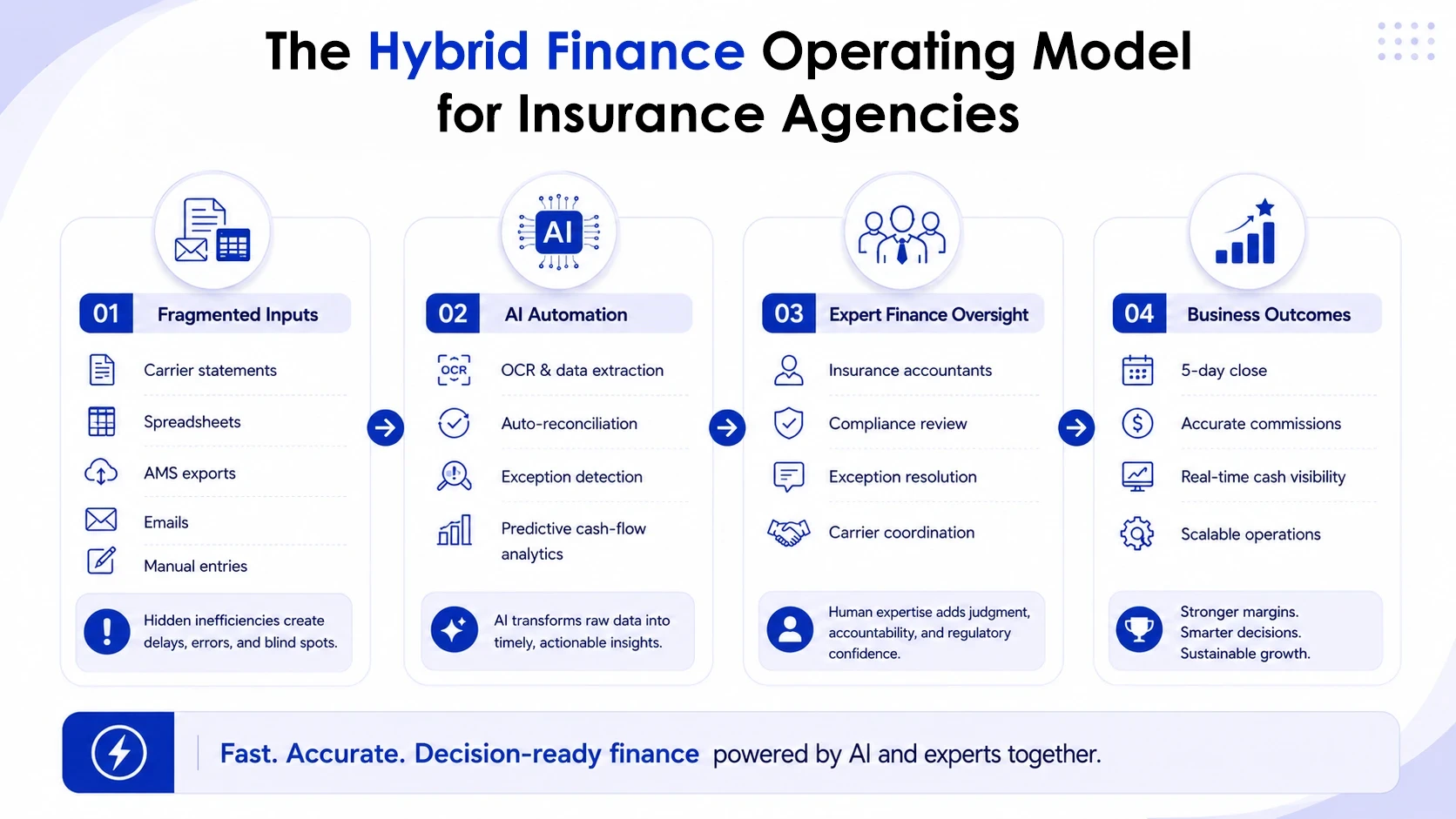
Commission reconciliation is the single biggest time drain in most agency finance departments, and it's rarely discussed outside the back office. Every carrier sends statements in a different format, on a different schedule, with different codes for the same transaction type. Multiply that across dozens of carrier relationships and thousands of policies, and reconciliation becomes a monthly scramble of spreadsheets, PDFs, and manual cross-checking.
What's broken: Analysts spend days matching expected commission against what actually lands in the bank account, often finding discrepancies weeks after they occurred; long after the window to dispute them with a carrier has narrowed.
How AI and outsourcing close it together: AI-based matching engines can ingest carrier statements in any format, auto-match transactions against policy and producer records, and flag only the true exceptions for human review. But someone still has to resolve those exceptions, chase carriers for clarification, and make the judgment calls that automation can't. That's where an outsourced finance team, trained specifically on insurance commission structures, becomes the difference between a tool that flags problems and a process that actually fixes them.
Ask any agency principal when they get a reliable view of the previous month's financial performance, and the honest answer is rarely "the first week of the next month." Manual data entry, disconnected systems, and reconciliation backlogs push the close further out every cycle, which means decisions get made on stale numbers.
The pace of change AI can bring to insurance-adjacent workflows is already measurable. McKinsey's analysis of AI adoption across the insurance value chain found that in reviewed cases, quoting times for certain commercial and specialty lines have compressed from more than a month to just days, and in some cases from two to three days down to one to two hours, once AI-supported tools were layered onto existing processes. The same principle applies directly to the close cycle: when data capture, categorization, and reconciliation are automated at the front end, the close stops being a fire drill and starts being a checklist. Pairing that automation with a dedicated outsourced close team; one that owns the calendar, not just the tasks; is what actually gets agencies to a five-day close instead of a twenty-day one.
Insurance agencies operate on a cash-flow rhythm shaped by premium collections, carrier payables, contingent and override commissions, and financing arrangements for premium finance books. When that visibility is trapped in disconnected spreadsheets, leadership finds out about a shortfall or an opportunity after the moment to act on it has passed.
McKinsey estimates that generative AI alone could unlock between $50 billion and $70 billion in additional insurance industry revenue, with the sharpest impact concentrated in marketing, customer operations, and software engineering functions that touch financial and operational data daily. For agencies, the practical translation of that number is smaller in scale but identical in principle: predictive cash-flow models built on AI can surface a collections gap or a payables spike days before it hits the bank account, instead of weeks after. That forward-looking visibility is only useful, though, if there's a finance team positioned to act on it; reworking a payment schedule, renegotiating terms, or reprioritizing collections; which is precisely the operational layer outsourcing is built to provide.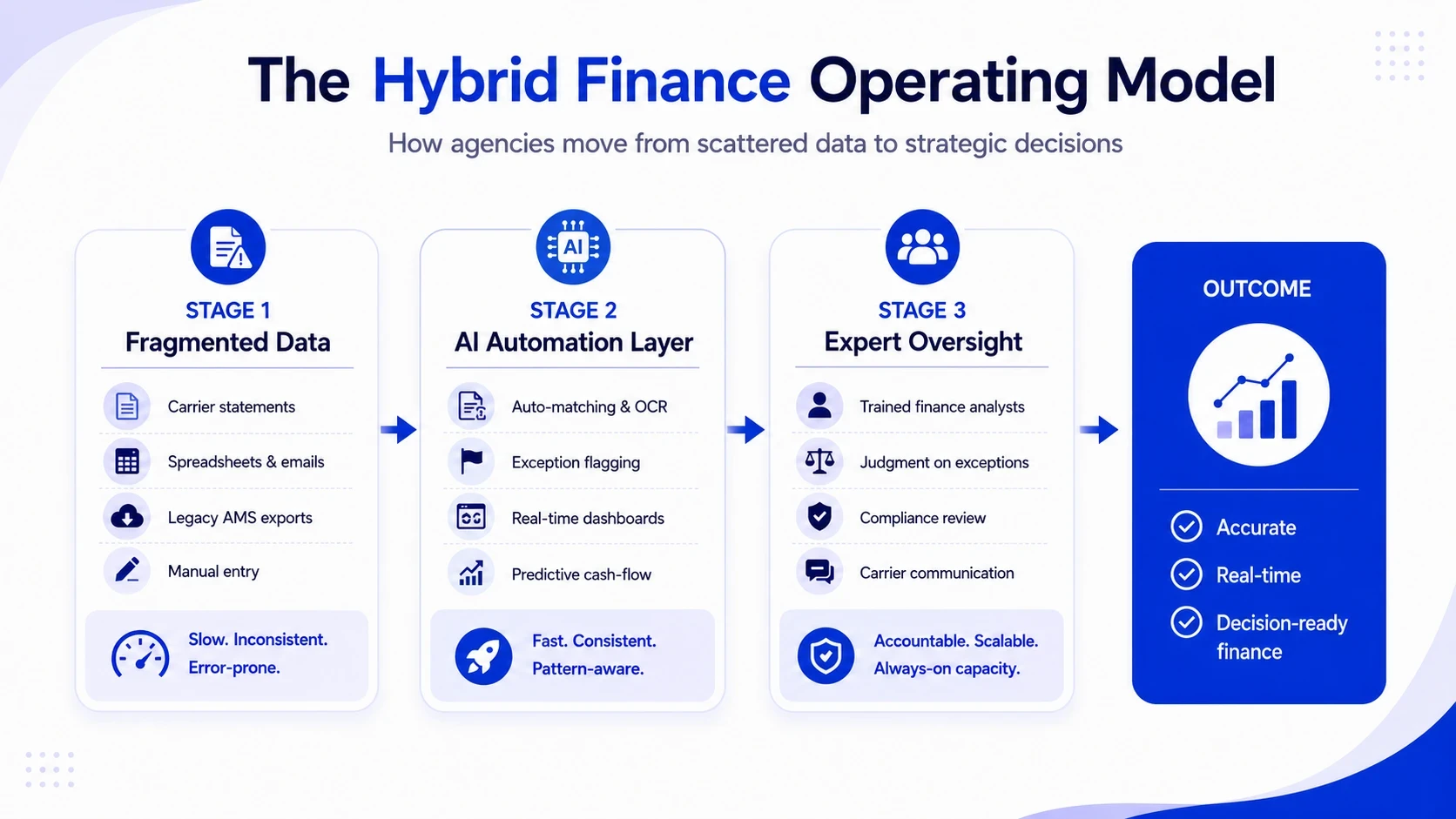
Premium accounting sits at the intersection of everything that can go wrong in an agency's books: earned versus unearned premium, agency bill versus direct bill reconciliation, trust accounting compliance, and state-specific regulatory reporting requirements that vary by license and line of business. Getting any one of these wrong doesn't just create a bookkeeping headache; it creates regulatory exposure.
This is where the intention-execution gap Deloitte identified becomes most costly. Agencies that recognize they need better controls around premium accounting but haven't restructured the workflow are the ones most likely to be caught flat-footed during an audit or a carrier compliance review. AI-driven rules engines can continuously check premium transactions against regulatory and trust accounting requirements in real time rather than at quarter-end, catching a misclassified transaction the day it happens instead of the day an auditor finds it. Outsourced compliance-trained accountants then apply the regulatory judgment those rules engines can flag but can't fully resolve on their own; because insurance trust accounting rules differ by state, and software alone doesn't carry that context.
Even agencies that want to modernize their finance function run into the same wall: it's genuinely difficult to hire and retain accountants who understand insurance-specific concepts like direct bill reconciliation, contingent commission accruals, and agency-carrier trust requirements. General accounting talent needs months of ramp-up before they're productive on insurance-specific work, and turnover resets that clock constantly.
This talent gap is exactly why the AI-plus-outsourcing model matters more than either piece alone. AI can absorb the repetitive volume that used to require headcount. But the agencies making real progress are the ones pairing that automation with an outsourced bench of finance professionals who already understand insurance accounting on day one; no ramp-up, no training cost, and capacity that flexes up during renewal season and back down when volume normalizes.
It's tempting to treat this as an either/or decision. It isn't. AI without human oversight produces fast answers that are sometimes fast and wrong; a mismatched commission auto-approved, a compliance flag dismissed by a model that doesn't understand state-specific nuance. Outsourcing without AI just moves the same manual, error-prone process to a different desk, without fixing the underlying workflow.
The agencies seeing real results are building what amounts to a layered operating model: automation handles volume and pattern recognition, and a dedicated outsourced finance team handles judgment, exceptions, and accountability. Each layer compensates for what the other can't do on its own.
Getting this right isn't a matter of buying software and separately hiring a vendor. It requires someone who understands both the technology and the operational reality of how insurance agencies actually run their books; someone who can map which parts of commission reconciliation, close, cash-flow reporting, premium accounting, and staffing should be automated, which should be outsourced, and where the two need to work in tandem.
That's the role FBSPL plays for insurance agencies: not as a software vendor bolting on a tool, and not as a traditional back-office outsourcing firm running the same manual process for less money; but as a strategic finance transformation partner that designs the AI-plus-outsourcing model around how a specific agency actually operates, then runs it. The goal isn't to hand over tasks. It's to close the structural gaps in agency finance operations so the numbers are accurate, the close is fast, and leadership can finally see the business clearly enough to grow it with confidence.
Processes that are repetitive, rules-based, and high-volume are ideal for AI, while exceptions, compliance decisions, and strategic oversight should remain with experienced finance professionals.
Get the latest insights on insurance operations, policy management, and industry best practices.