
7 MIN READ·Jun 04, 2026·Written by Bhavishya Bharadwaj

Summary: Businesses in 2026 are investing heavily in workflow consulting and operational transformation to eliminate inefficiencies, improve scalability, enable automation, and strengthen operational agility. Modern consulting helps organizations redesign workflows, integrate systems, optimize processes, and build future-ready operations that support sustainable business growth.
In 2026, operational inefficiency is no longer viewed as a manageable inconvenience. It has become a direct threat to growth, profitability, customer experience, and scalability.
Across industries, businesses are dealing with rising operational complexity, fragmented systems, disconnected workflows, growing compliance pressure, and increasing expectations for speed and visibility. At the same time, leadership teams are being asked to do more with fewer resources while accelerating digital transformation initiatives.
This shift is one of the primary reasons organizations are aggressively investing in workflow consulting, operational consulting, and Workflow Automation initiatives.
What was once considered an internal optimization exercise has now become a boardroom-level strategic priority.
Companies are realizing that technology alone cannot solve operational problems. Automating broken workflows only accelerates inefficiency. Sustainable transformation requires process redesign, governance alignment, operational visibility, and strategic execution.
That is where a modern business workflow consultant plays a critical role.
At its core, what is operations consulting can be defined as the strategic evaluation, redesign, and optimization of business operations to improve efficiency, scalability, agility, and performance.
Modern operational consulting goes far beyond cost reduction exercises. It focuses on helping organizations:
In 2026, operational consulting is increasingly connected with digital transformation, enterprise workflow modernization, automation governance, and process intelligence.
Organizations are no longer asking whether they should modernize workflows. They are asking how quickly they can do it without disrupting operations.
According to a 2025 study by Deloitte, transformation initiatives are becoming central to executive strategy as businesses respond to constant disruption, operational volatility, and evolving customer expectations.
Many organizations still operate with workflows that were designed for a very different business environment.
Processes built years ago are now struggling to support modern operational demands, especially in enterprises managing hybrid teams, multi-location operations, global compliance requirements, and increasing customer expectations.
The most common operational breakdowns include:
Many businesses continue relying on spreadsheet-driven processes, email approvals, disconnected systems, and manual handoffs between departments.
These inefficiencies create operational delays, inconsistent outputs, data silos, and visibility gaps that become more damaging as organizations scale.
Organizations often invest heavily in technology but fail to integrate systems effectively.
As a result, teams operate across disconnected platforms for finance, operations, CRM, HR, procurement, and customer support. This fragmentation slows decision-making and creates duplicate work.
Leadership teams increasingly struggle to answer simple operational questions in real time:
Without operational intelligence, businesses cannot scale efficiently.
What works for a 50-person company often breaks at 500 employees.
As businesses grow, operational complexity expands exponentially. Processes that once relied on tribal knowledge or manual coordination become unsustainable.
This is one of the biggest drivers behind increased demand for workflow consulting services in 2026.
One of the most important lessons businesses have learned over the past few years is that automation without process redesign rarely delivers sustainable ROI.
Many organizations rushed into automation initiatives without first evaluating operational readiness, workflow structure, or governance models.
The result has been inconsistent outcomes.
According to Gartner, only 28% of AI use cases in infrastructure and operations fully succeeded in meeting ROI expectations, while 20% failed outright. Gartner identified poor workflow integration and unrealistic implementation expectations as major causes of failure.
This is precisely why organizations are turning to experienced workflow automation consultants before deploying large-scale automation programs.
Successful transformation requires businesses to first examine:
Businesses that redesign workflows before automating them consistently achieve better operational outcomes.
The rapid adoption of AI technologies is significantly increasing demand for workflow consulting services.
AI systems are highly dependent on workflow quality, structured processes, reliable data environments, and governance frameworks.
Organizations are discovering that AI cannot compensate for poorly designed operations.
Instead, AI amplifies existing operational strengths and weaknesses.
This is creating a major shift in how businesses approach operational transformation.
Rather than implementing isolated automation tools, companies are investing in enterprise-wide workflow modernization strategies that combine:
According to Gartner Research, 54% of infrastructure and operations leaders are adopting AI primarily to optimize costs and operational efficiency. However, integration complexity remains one of the biggest implementation challenges.
This operational reality is pushing organizations to seek strategic consulting partners capable of aligning automation initiatives with operational goals.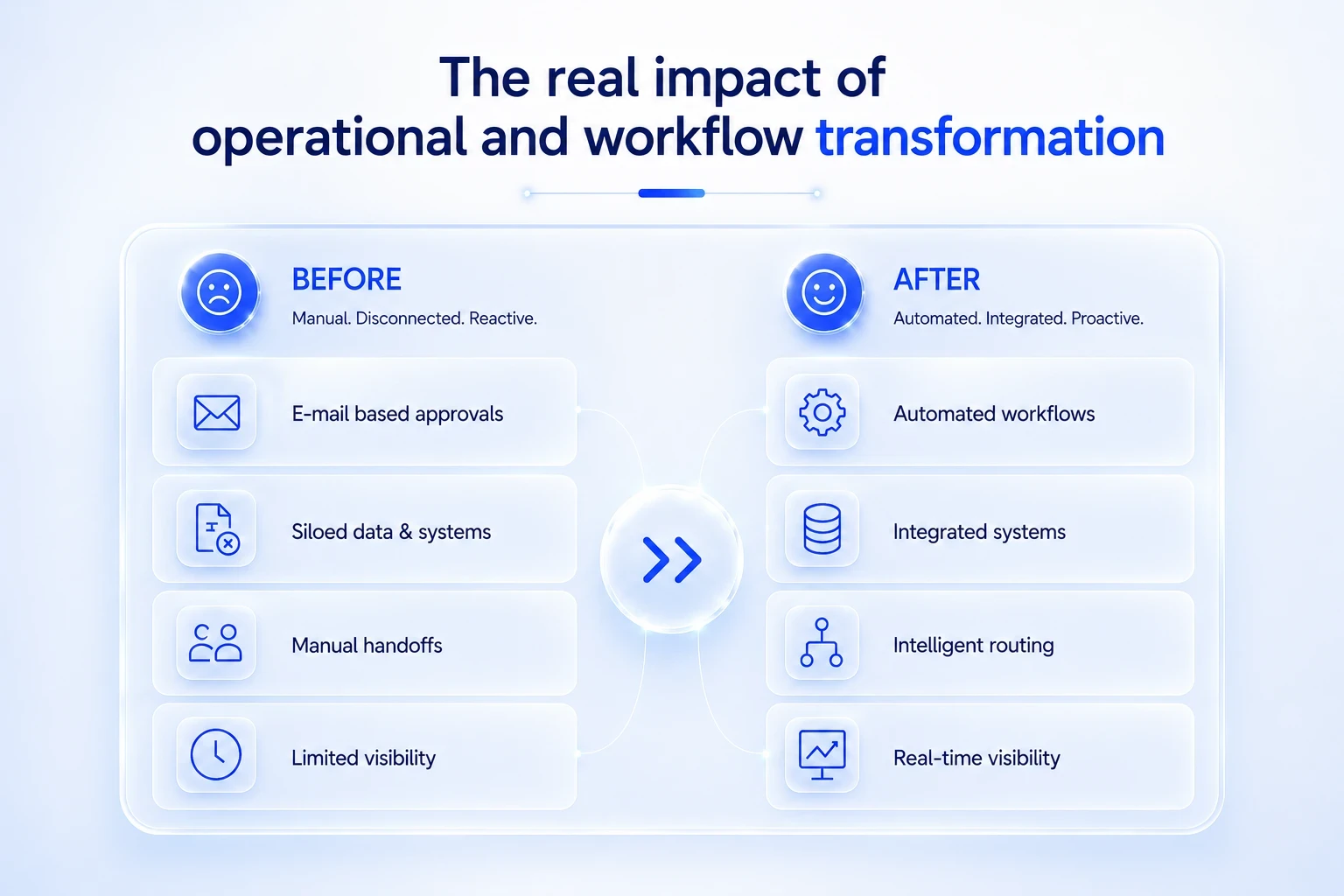
The value of operational consulting extends far beyond efficiency improvements.
Organizations that successfully modernize workflows often experience measurable improvements across multiple business functions.
Integrated workflows and centralized operational visibility enable leadership teams to make faster, more informed decisions.
This becomes especially important in industries where operational delays directly affect revenue, customer experience, or compliance.
Modern workflows reduce repetitive administrative work, approval delays, duplicate data entry, and operational confusion.
Teams spend less time managing process friction and more time focusing on strategic execution.
A 2025 manufacturing and operations study published by Deloitte Insights found that organizations implementing smarter operational models reported up to 20% improvement in employee productivity and production output.
Well-designed workflows allow organizations to scale without operational chaos.
Standardized processes reduce dependency on institutional knowledge while improving consistency across departments and regions.
Operational bottlenecks often become customer experience problems.
Delayed approvals, slow service delivery, inconsistent communication, and fragmented systems directly impact customer satisfaction.
Workflow optimization helps create faster, more responsive customer operations.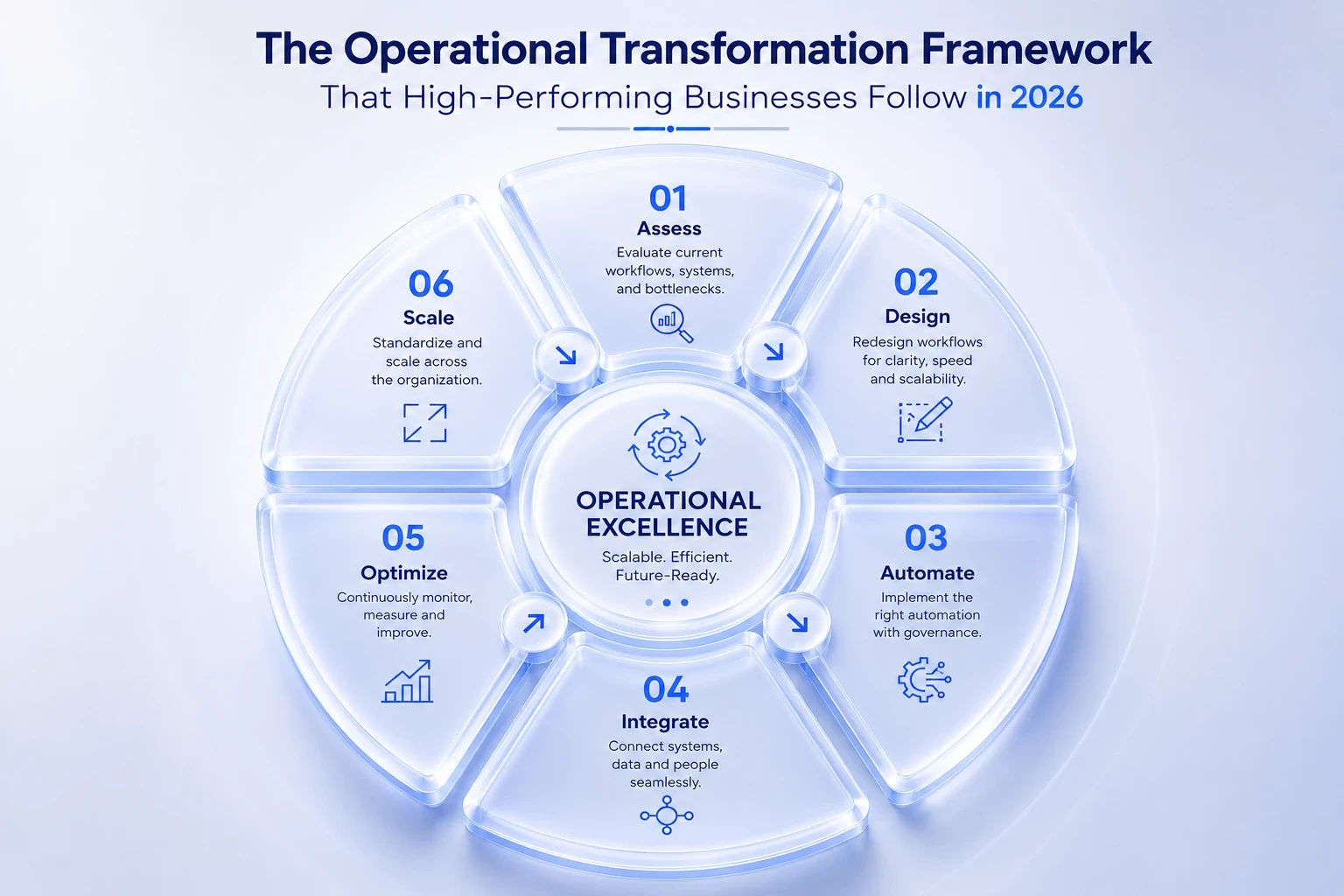
Not all consulting engagements deliver transformation outcomes.
Businesses should evaluate consulting partners based on their ability to combine operational strategy with execution expertise.
An effective business workflow consultant should bring capabilities such as:
Understanding how workflows currently operate across departments, systems, and teams.
Identifying inefficiencies, simplifying process structures, and improving operational alignment.
Determining which workflows should be automated, partially automated, or redesigned before automation.
Aligning workflow strategies with enterprise systems, AI tools, ERP environments, CRM platforms, and operational technologies.
Helping organizations manage operational adoption, accountability structures, and process sustainability.
The most successful consulting relationships are built around long-term operational evolution rather than one-time process fixes.
Operational consulting is rapidly evolving into a strategic transformation discipline.
The future of workflow consulting will increasingly focus on:
Businesses are moving toward “always-on transformation” models where operational improvement becomes continuous rather than project-based.
Organizations that fail to modernize workflows will likely struggle with rising operational costs, slower execution cycles, compliance risk, employee burnout, and reduced competitiveness.
Those investing strategically in operational transformation today are positioning themselves for long-term scalability and resilience.
The growing investment in workflow consulting, operational consulting, and Workflow Automation is not a temporary trend. It reflects a fundamental shift in how organizations approach operational performance, scalability, and transformation in 2026.
Modern enterprises need operational structures capable of supporting speed, visibility, automation, compliance, and adaptability simultaneously. This is where strategic consulting becomes invaluable.
At FBSPL, we help organizations rethink operational workflows, modernize business processes, and build scalable operational ecosystems designed for long-term growth. Whether businesses are struggling with fragmented workflows, manual operational dependencies, or large-scale transformation initiatives, the right operational strategy can create measurable business impact across the enterprise.
If your organization is evaluating workflow modernization, operational transformation, or intelligent automation initiatives, now is the time to assess whether your current operating model is truly built for the future.
Common signs include recurring operational delays, excessive manual work, inconsistent reporting, poor cross-functional coordination, rising operational costs, slow approvals, customer service bottlenecks, and difficulty scaling existing processes as the business grows.
Get the latest insights on insurance operations, policy management, and industry best practices.