
1 MIN READ·Sep 30, 2026·Written by Bhavishya Bharadwaj

Summary: Growing businesses often outpace basic bookkeeping before they realize it. This blog highlights ten warning signs that indicate the need for a more strategic finance function, explaining how stronger financial processes, reporting, forecasting, and leadership enable smarter decisions and sustainable long-term growth.
Most companies don't outgrow their bookkeeping in one dramatic moment. It happens quietly; a bank reconciliation that used to take an hour now takes a day, a board member asks a forecasting question nobody can answer with confidence, or a lender wants a cash flow projection that simply doesn't exist. Each incident looks minor in isolation. Together, they describe a business that has scaled past the financial infrastructure supporting it.
This is one of the most common; and most expensive; blind spots in growing organizations. Basic bookkeeping and accounting support exists to record transactions accurately and keep you compliant. It was never built to help you make decisions, manage multi-entity complexity, or defend your numbers to a bank, investor, or acquirer. When growth outpaces financial infrastructure, the cost isn't just inefficiency; it's misinformed decisions, missed opportunities, and, in some cases, existential risk.
Below are ten reliable signals that your business has moved past what basic bookkeeping and accounting can support; along with what a more mature financial function actually looks like.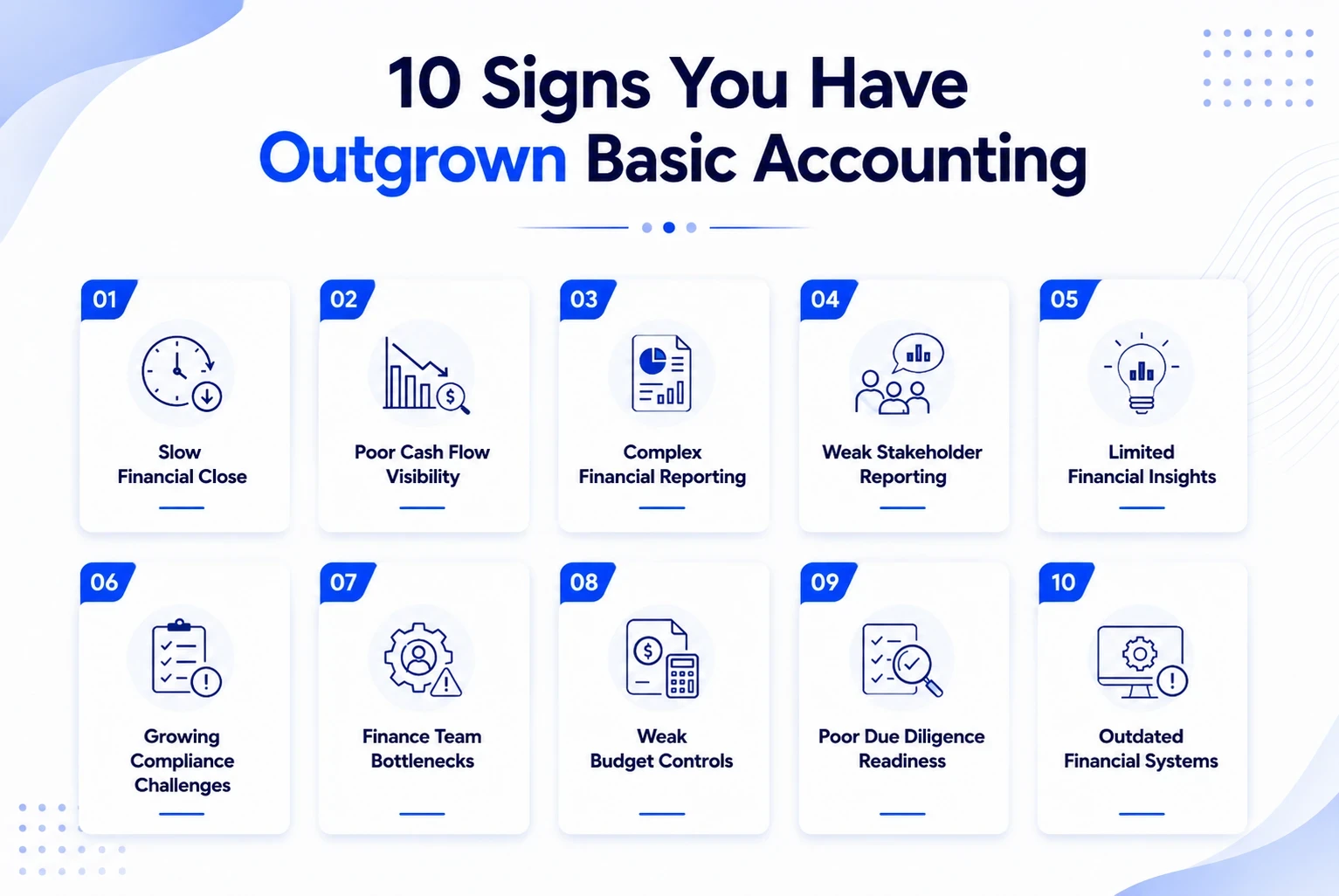
If closing your books reliably takes two, three, or four weeks, you're not looking at "current" numbers when you make decisions; you're looking at ancient history. A slow close usually points to manual reconciliations, disconnected systems, or a bookkeeping process that was never designed for your current transaction volume. Growing businesses need a close cycle fast enough to inform real-time decisions, not just satisfy year-end compliance.
Recent research from Intuit QuickBooks' ongoing Small Business Insights survey found that while 50% of small and midsize businesses report growth, 81% say they want it; a gap that often traces back to weak forward visibility rather than a lack of ambition. Basic bookkeeping tells you what happened last month. It does not build rolling forecasts, model working capital needs, or flag a liquidity crunch before it hits. If cash flow planning still lives in your head, or in an outdated spreadsheet nobody trusts, that's a structural gap, not a tooling problem.
Single-entity, single-location reporting is where most bookkeeping tools and processes stop scaling. The moment you add a second entity, a new state or country, multiple currencies, or several revenue lines with different margin profiles, consolidated reporting becomes exponentially harder. If your team is manually stitching together spreadsheets from different systems to produce one "true" number, your reporting infrastructure has already been outgrown.
There's a specific moment many founders describe: a lender asks for a debt-service coverage projection, or a board member asks how a pricing change will affect margin by segment, and the finance function goes quiet. Gartner's most recent CFO priorities research highlights just how central this tension has become at scale; its August 2025 survey of finance leaders found that capital allocation for new growth opportunities was ranked the single highest priority by more CFOs than any other item, even as cost discipline remained a top concern. If your business can't produce investor-grade analysis on demand, you are not equipped for the capital conversations that fuel your next stage of growth.
Bookkeeping answers "what did we spend?" It rarely answers "what should we do next?" When margin analysis by product, customer, or channel doesn't exist, leadership ends up greenlighting new hires, price changes, or market expansion based on instinct rather than unit economics. That's a coin flip your competitors with real financial planning & analysis (FP&A) capability aren't making.
Multi-state sales tax nexus, R&D tax credits, revenue recognition under ASC 606, transfer pricing between entities, payroll across jurisdictions; these aren't bookkeeping tasks. They require technical accounting judgment and, often, coordination with tax and legal counsel. A generalist bookkeeper flagging "something looks off" is very different from a controller who can proactively design the right revenue recognition policy before an auditor finds the gap.
If every department has to wait on finance for basic answers; margin by SKU, budget-to-actual variance, headcount cost by function; finance has become a queue rather than a resource. This is one of the clearest signs of a function stuck in transactional mode. According to Cherry Bekaert's 2025 Middle Market CFO Survey, finance leaders are already responding to this exact pressure: 71% are upskilling their teams, 61% are hiring, and 17% are turning to outsourcing to sustain momentum without delay, precisely because internal teams can't absorb rising analytical demands on their own.
A budget that's built once a year and never revisited isn't a planning tool; it's a formality. Businesses that have outgrown basic accounting support typically lack a living, monthly budget-to-actual variance process that explains why numbers moved, not just that they did. Without this discipline, small deviations compound into large surprises by Q3.
Due diligence is where bookkeeping gaps become brutally visible. Buyers and investors expect clean, auditable, well-documented financials with a clear audit trail, consistent policies, and defensible projections. If your books would not survive a serious diligence process today, that's not a future problem; it's a present one, because the work to fix it takes months, not days.
Manual data entry, disconnected point solutions, and spreadsheets patched together with formulas are common at the bookkeeping stage; and dangerous at scale. The same Cherry Bekaert research found a persistent capability gap driving this exact issue: 44% of CFOs say their tech experts lack finance knowledge, while 40% say their finance teams are uncomfortable with the technology now expected to run modern reporting and automation. Without integrated systems and the right talent to run them, growing businesses end up with more data and less clarity.
The consequences of ignoring these signs rarely show up as a single catastrophic event. More often, they show up as a slow accumulation of avoidable damage: pricing decisions that quietly erode margin, missed tax credits, a financing round that stalls during diligence, or a lender relationship strained by late, unreliable reporting. Growth compounds every one of these gaps. A reporting delay that cost you a few hours at $2M in revenue can cost you weeks; and real strategic ground; at $20M.
Outgrowing basic bookkeeping doesn't mean your existing team failed you. It means your business has reached a stage where financial operations need to shift from recording the past to shaping the future. That shift typically requires:
This is less about hiring more bookkeepers and more about rebuilding the financial function around decision-making, not just data entry.
Businesses that navigate this transition well tend to follow a similar playbook:
None of these ten signs are cause for alarm on their own. But if you recognize three, four, or more of them in your business today, the underlying issue is the same: your financial infrastructure was built for an earlier, smaller version of your company, and it hasn't caught up. Businesses that address this proactively; before a lender, investor, or auditor forces the issue; consistently make better, faster, and more confident decisions than those that wait.
This is exactly the gap FBSPL was built to close. Rather than layering more transactional headcount onto an already-strained process, FBSPL works alongside growing businesses as a strategic finance and accounting partner; combining process rigor, technology-enabled reporting, and senior financial expertise to move companies from basic bookkeeping to a finance function that can genuinely support the next stage of growth.
Bhavishya Bharadwaj is the Digital Marketing Manager at FBSPL, bringing over a decade of experience across insurance, outsourcing, accounting, and digital transformation.
Get the latest insights on insurance operations, policy management, and industry best practices.