
7 MIN READ·Jul 24, 2026·Written by Bhavishya Bharadwaj
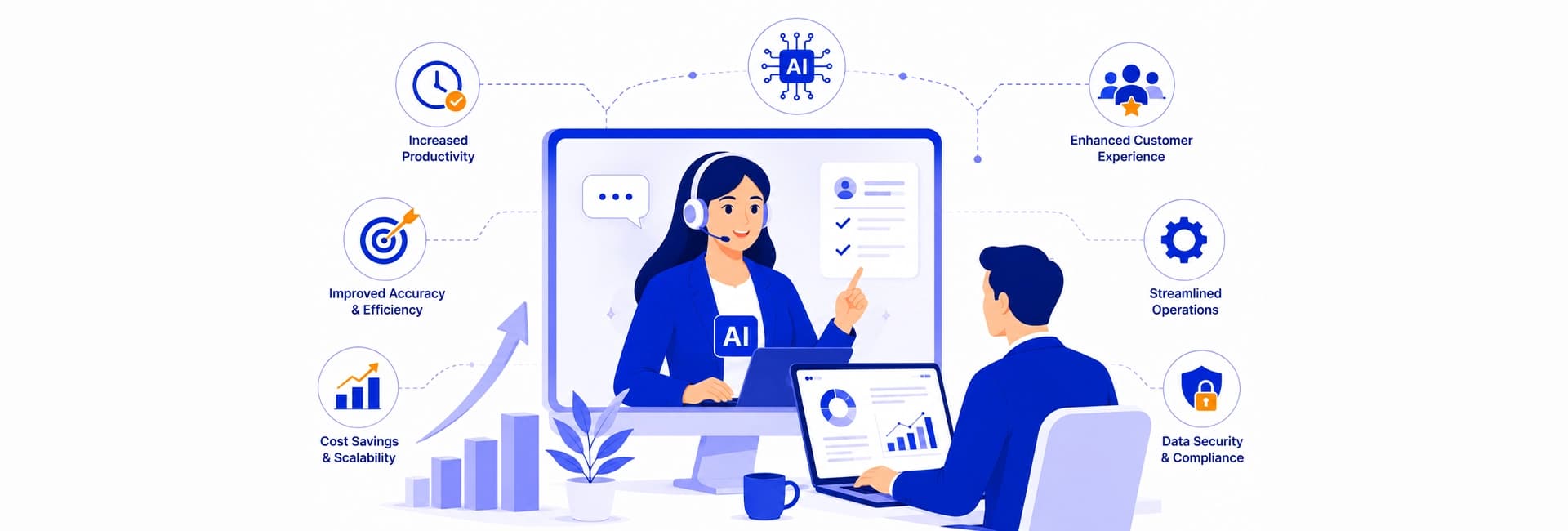
Summary: The blog explains how AI-powered virtual assistants have evolved into context-aware enterprise agents that enhance customer service, sales, HR, finance, and IT. Success depends on strategic integration, strong governance, measurable outcomes, and viewing AI as an operating-model transformation.
AI virtual assistants are reshaping enterprise workflows through automation, governance, integration, and human collaboration for growth.
Every business leader has heard the pitch on artificial intelligence technology by now. Fewer have felt the actual operational strain that makes the pitch necessary: support queues that never shrink, sales reps buried in follow-ups instead of selling, finance teams reconciling invoices at midnight, and IT tickets piling up faster than headcount allows. The businesses pulling ahead in 2026 aren't the ones with the flashiest AI slogans; they're the ones that quietly rebuilt their workflows around AI virtual assistants that actually do the work, not just talk about it.
This isn't a story about chatbots getting chattier. It's about how AI-powered virtual assistants are being written into the operating model of enterprises; reshaping how customer service, sales, HR, and finance functions run day to day. If you're evaluating where virtual assistance fits into your business strategy, here's what the data, the use cases, and the hard lessons of early adopters actually show.
For years, "virtual assistant" meant a scripted chatbot that could answer three FAQs before routing the customer to a human. That era is closing fast. Enterprise software is being rebuilt around embedded, context-aware assistants that understand intent, pull live data from business systems, and complete multi-step tasks with minimal supervision.
Gartner captures the scale of this shift precisely: by the end of 2026, Gartner predicts that 40% of enterprise applications will include task-specific AI agents, compared with less than 5% in 2025. This rapid evolution reflects how enterprise software is being redesigned around intelligent, task-specific AI capabilities rather than standalone automation features. That kind of trajectory doesn't happen because a technology is interesting. It happens because the operational cost of delaying AI adoption has become too visible to ignore—longer resolution times, higher cost-to-serve, fragmented workflows, and slower decision-making while competitors move faster. 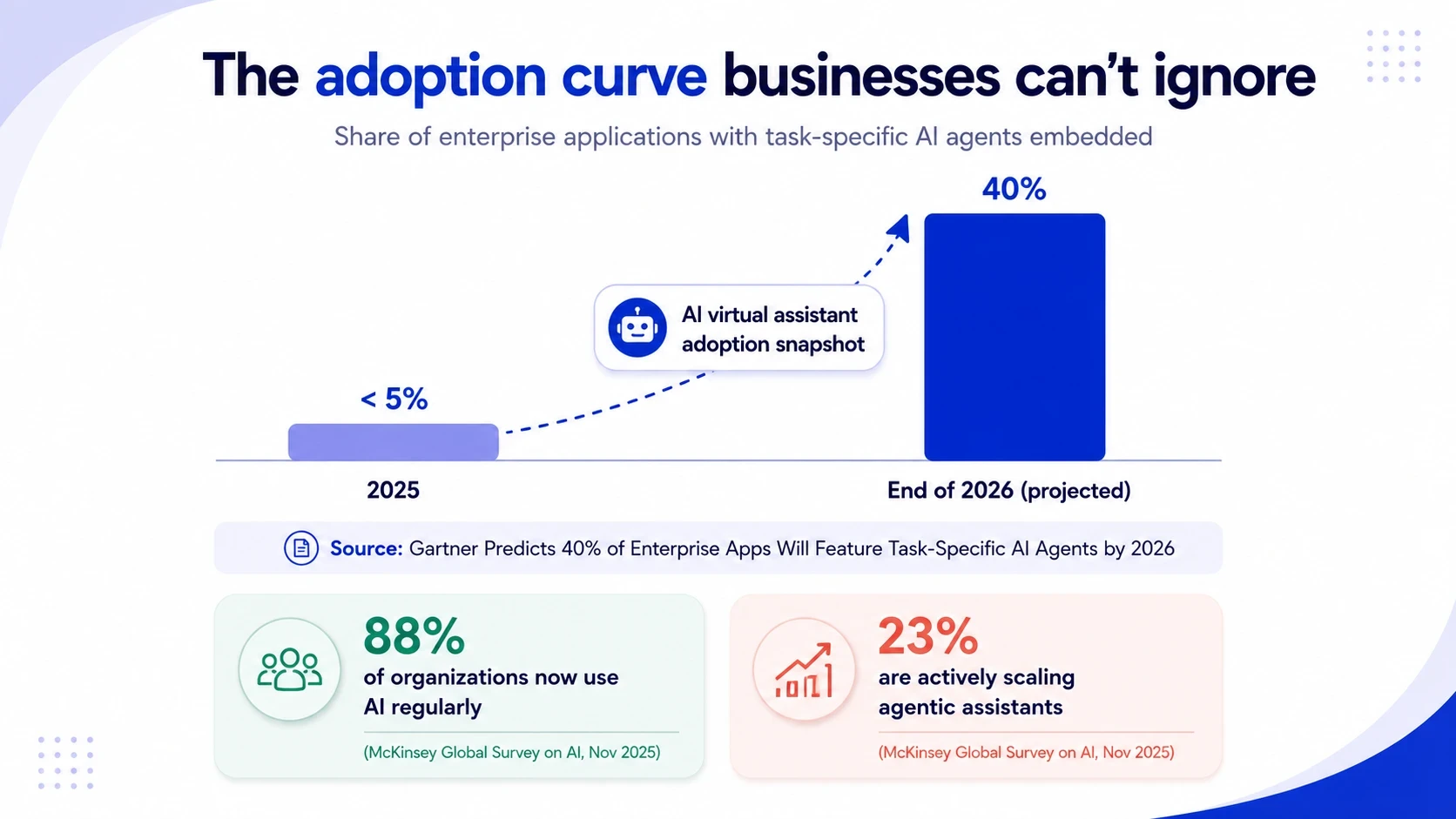
Traditional automation; rules-based bots, IVR trees, static macros; could only execute what was explicitly programmed. An AI-driven virtual assistant works differently. It interprets natural language and, when securely connected to authorized CRM, ERP, or knowledge systems, can use the latest available business information to provide more relevant responses instead of relying on a fixed decision tree. The difference shows up immediately in complex, judgment-heavy interactions; the kind that used to require escalation to a human every time.
Modern virtual assistants are built on a layered stack: large language models for language understanding, retrieval-augmented generation for grounding responses in company-specific data, orchestration layers that connect the assistant to business systems, and guardrails that help control system behavior, apply organizational policies, maintain brand consistency, and reduce compliance risk. This is precisely why McKinsey's latest Global Survey found organizations are moving cautiously but decisively; 88% of companies now report regular AI use in at least one business function, and 23% say they are actively scaling agentic AI somewhere in the enterprise, most commonly within IT and knowledge management functions. The stack has matured enough that scaling is now a strategy decision, not a technical gamble.
No CFO adopts artificial intelligence technology because it sounds innovative. They adopt it because three numbers keep showing up on their desk: cost-to-serve, employee attrition in repetitive roles, and the widening gap between customer expectations and response times. AI virtual assistants address all three simultaneously by absorbing the volume of routine, repeatable work; freeing skilled employees for judgment-based tasks that actually require a human.
The pattern is consistent across industries: assistants don't replace teams outright; they change the shape of the team, shifting headcount away from repetitive triage and toward oversight, exception-handling, and relationship-building; the work that compounds in value over time.
From customer support to finance, AI assistants are transforming every function by automating routine work and accelerating decisions.
No transformation of this scale is friction-free, and pretending otherwise does businesses a disservice. Three challenges show up again and again:
These aren't reasons to wait. They're reasons to adopt with a strategic partner who has already solved for them, rather than treating deployment as a purely technical checkbox.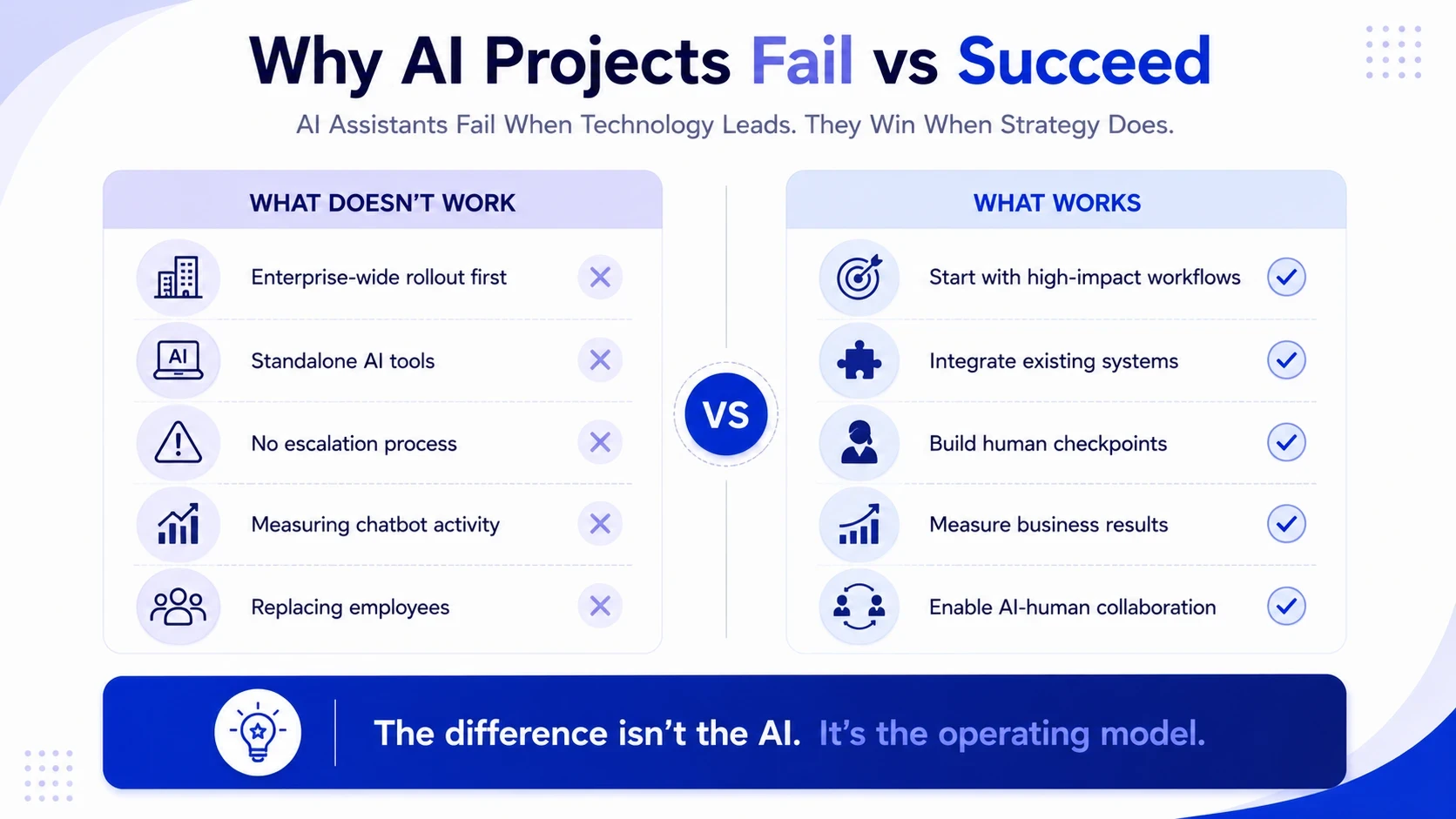
The organizations extracting real value from AI virtual assistants share a common pattern:
The businesses seeing the strongest results aren't the ones buying a virtual assistant license and hoping it works. They're the ones treating AI-powered virtual assistance as a redesign of how work moves through their organization; where the assistant, the workflow, and the people around it are architected together from day one.
This is precisely where FBSPL operates: not as a vendor dropping in a chatbot, but as a strategic consulting partner that helps businesses map the right use cases, integrate AI-driven virtual assistants into existing operational systems, and build the governance structures that keep the transformation sustainable rather than risky. The goal isn't automation for its own sake; it's operational transformation that shows up in cost-to-serve, response times, and the capacity of your teams to focus on work that actually needs a human. 
A limited pilot may take several weeks, while a production deployment can take several months. The timeline depends on workflow complexity, data readiness, system integrations, security requirements, testing, governance, and employee training.
Get the latest insights on insurance operations, policy management, and industry best practices.