
9 MIN READ·Jun 12, 2026·Written by Bhavishya Bharadwaj

Summary: Modern businesses expect outsourcing partners to deliver far more than cost savings. Success now depends on strategic alignment, AI-enabled operations, industry expertise, measurable outcomes, and strong governance. The most valuable partnerships help organizations scale faster, innovate continuously, and build lasting competitive advantage.
The old outsourcing playbook is dead. Not obsolete. Not outdated. Dead.
For decades, the pitch was simple: hand over your non-core processes, reduce your headcount, and watch your operating costs shrink. That pitch worked — until it didn't. Today's B2B decision-makers aren't evaluating outsourcing partners on labor arbitrage alone. They're asking harder, sharper, more strategic questions: Can this partner transform how we operate? Can they integrate AI into our workflows? Can they scale with us without breaking?
The businesses that treat outsourcing as a transaction are falling behind. The ones treating it as a strategic relationship are pulling ahead.
This shift isn't anecdotal; the data confirms it. And if you're evaluating outsourcing partnerships in 2025, understanding this new reality is non-negotiable.
Let's address the elephant in the room: the myths about outsourcing that still quietly sabotage decision-making at the executive level.
Myth 1: Outsourcing is primarily about cost reduction. According to Deloitte's Global Outsourcing Survey, only 34% of businesses now cite cost savings as their primary outsourcing driver; down from 70% just five years ago. The primary motivation has shifted to operational agility, access to specialized talent, and accelerated digital transformation.
Myth 2: Outsourcing is for back-office tasks only. The same Deloitte survey reveals that 50% of executives are now leveraging outsourced services for front-office capabilities including sales, marketing, and R&D; functions once considered too strategic to hand off.
Myth 3: More vendors mean more risk. Modern outsourcing ecosystems are deliberately multidimensional; combining third-party providers, global in-house centers (GICs), and AI-driven digital workers. Organizations that cling to a single-vendor, single-function view of outsourcing consistently underperform in both efficiency and innovation.
Breaking free from these myths is step one. Step two is understanding what businesses actually want right now
The expectations placed on outsourcing partners have evolved dramatically. Businesses now evaluate providers based on their ability to deliver innovation, agility, scalability, and measurable results; not simply execute predefined tasks.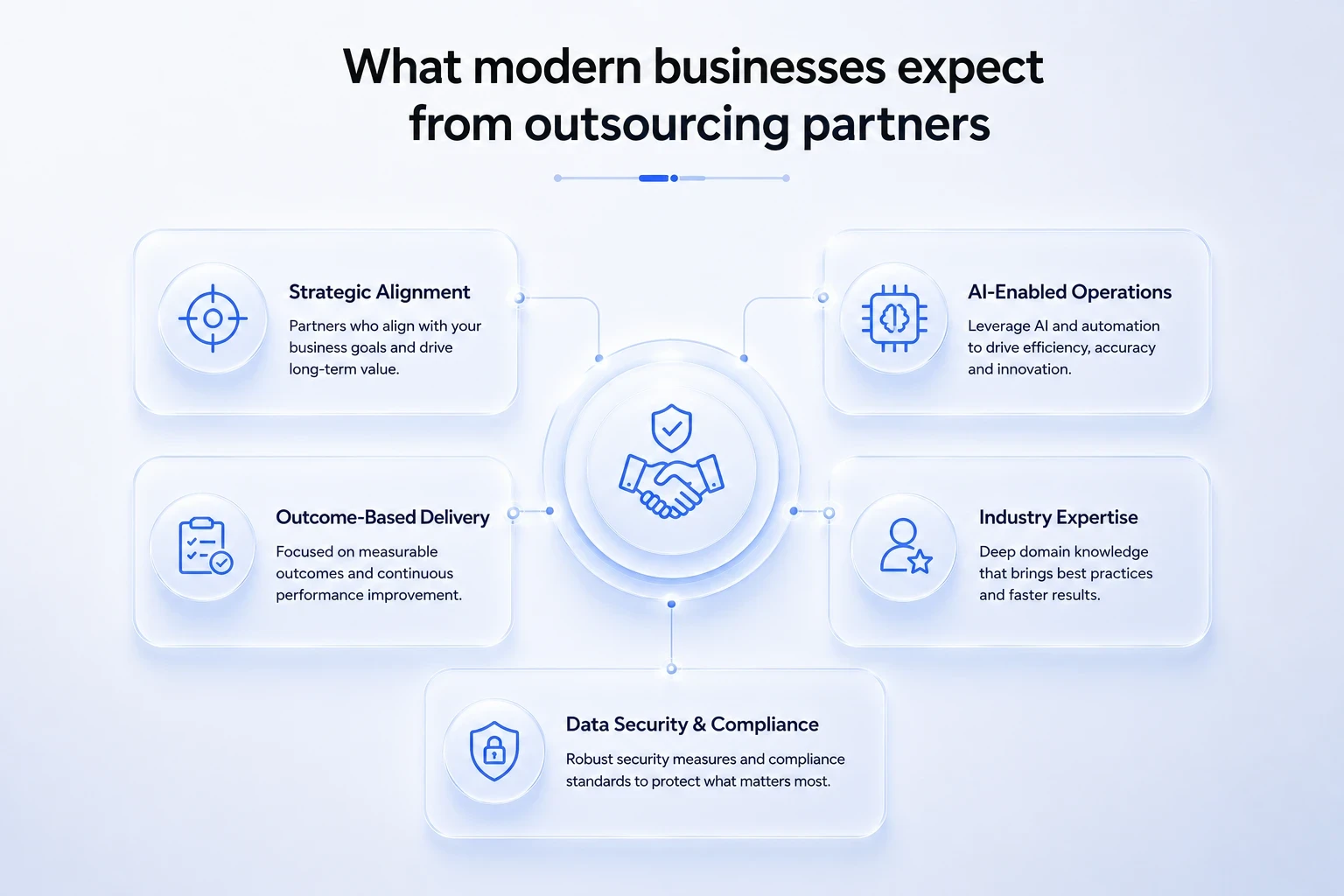
The transactional era; where an outsourcing partner simply "executes tasks"; is over. Decision-makers today want partners who understand their business objectives, not just their process workflows. They want vendors who sit in on strategy conversations, contribute insights, and proactively flag inefficiencies.
This is the difference between a service vendor and a strategic consulting partner. The former delivers outputs. The latter drives outcomes.
Artificial intelligence and outsourcing are no longer separate conversations. They are the same conversation. The integration of AI into business operations outsourcing is now a baseline expectation, not a premium feature.
Deloitte's Global Outsourcing Survey found that 83% of surveyed executives are already leveraging AI as part of their outsourced services. Meanwhile, one in five organizations has developed a formal strategy to manage AI-enabled "digital workers" alongside their human workforce. The demand isn't for AI demonstrations; it's for AI deployment, embedded into live processes, delivering measurable improvements in speed, accuracy, and decision quality.
The outsourcing partners thriving in this environment aren't the ones promising AI integration "down the road." They are the ones who have already operationalized it; through RPA-enhanced claims processing, ML-driven underwriting support, AI-powered document extraction, and intelligent workflow automation.
Perhaps the most significant structural shift in outsourcing today is the move from input-based contracts (pay per seat, pay per hour) to outcome-based models (pay for performance, quality benchmarks, SLA guarantees).
Deloitte's findings reinforce this: 67% of organizations are now adopting outcome-based outsourcing relationships. This change signals a deeper maturity in how businesses evaluate partner success. The conversation has moved from "how many FTEs are dedicated to my account?" to "what business results can you guarantee?"
For B2B decision-makers, this is an important litmus test when choosing the right outsourcing partner: Does the partner hold themselves accountable to your outcomes; or only to activity metrics?
Generalist BPO is losing ground to specialized, industry-native partners. A business in insurance doesn't want a partner who also happens to serve retail and logistics with the same team. They want a partner whose operational DNA is built around insurance workflows; policy administration, first notice of loss, claims adjudication, compliance reporting.
This is especially relevant for industries like BFSI, healthcare, and insurance; sectors that are data-sensitive, regulation-heavy, and operationally complex. The question businesses are increasingly asking is: "Do you know my industry deeply enough to challenge my current process design?"
The answer to that question separates commoditized BPO from true operational transformation partners.
In an era of escalating data breaches, rising regulatory scrutiny (GDPR, HIPAA, SOC 2, ISO certifications), and increasingly sophisticated cyber threats, data governance is no longer a back-page concern in outsourcing RFPs. It is front and center.
Businesses want partners who don't just check compliance boxes; they want partners who have embedded security-first thinking into their operational culture. Governance frameworks, access control protocols, audit readiness, data residency management; these are now baseline qualifications, not differentiators.
The global BPO market tells its own story. According to Data Bridge Market Research, the market is projected to grow from USD 285.76 billion in 2024 to USD 544.77 billion by 2032, at a CAGR of 8.5%. This growth is not simply volume expansion; it reflects a qualitative deepening of what outsourcing partners are being asked to deliver.
Key trends reshaping the outsourcing landscape:
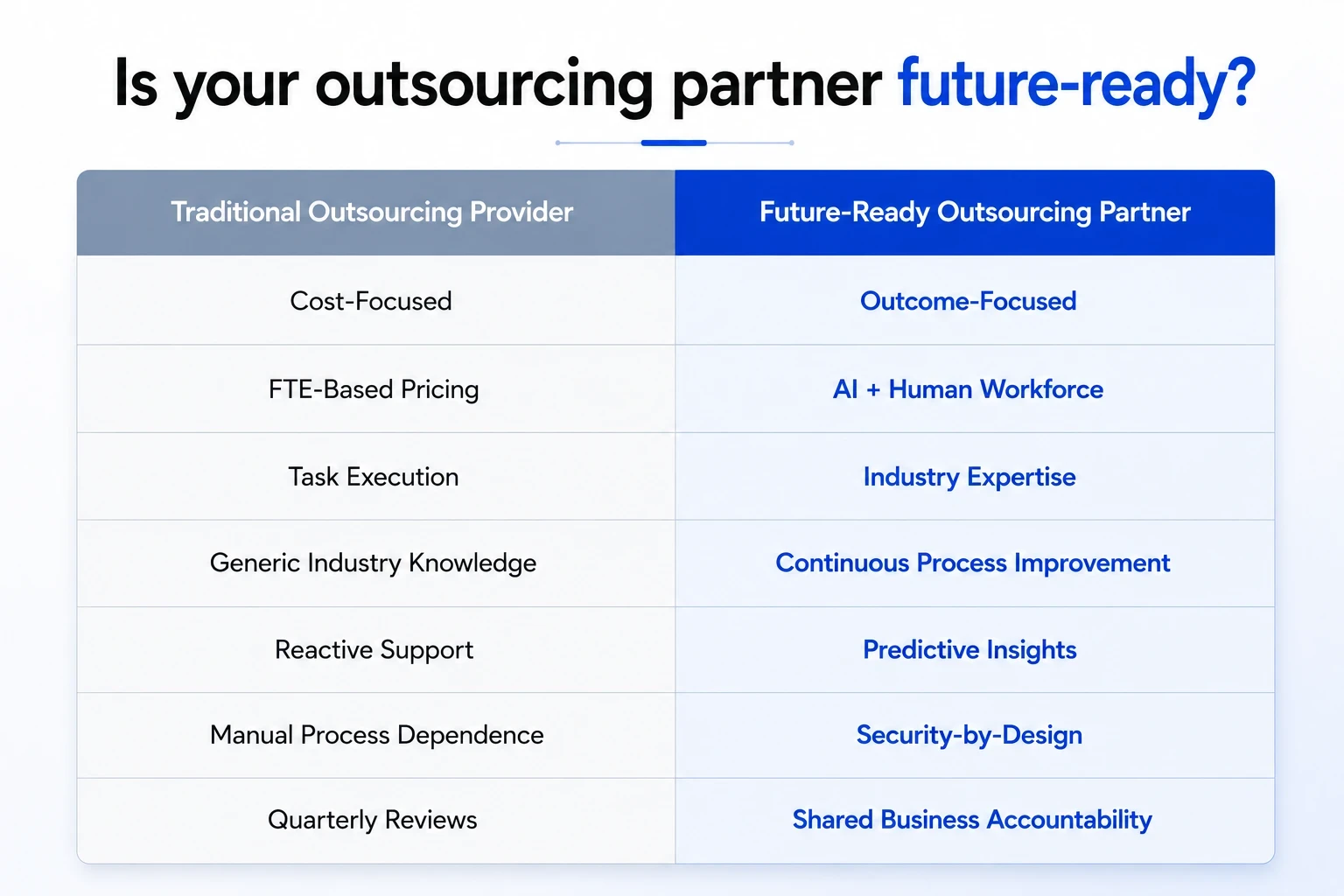
Given the complexity of today's outsourcing landscape, choosing the right partner demands rigor. The following framework helps B2B decision-makers cut through vendor noise:
Evaluate the partner's concentration in your industry. Ask for process-level case studies; not generic service brochures. How have they specifically improved claims turnaround times, reduced underwriting cycle times, or enhanced policy servicing accuracy?
Demand visibility into the partner's current AI and automation capabilities. Are they using RPA for rule-based automation? Do they have NLP capability for document processing? Is their technology proprietary, or are they packaging third-party tools? The answer defines what kind of transformation is actually possible.
Understanding the partner's internal governance model tells you more about operational reliability than any SLA document. How are exceptions handled? How are process deviations escalated? Who is your operational counterpart at the senior level?
Insist on outcome-based KPIs from day one. TAT improvements, accuracy benchmarks, first-call resolution rates, cost-per-transaction trends; these are the numbers that matter. Activity dashboards (calls handled, tickets closed) are necessary but insufficient.
Long-term outsourcing relationships fail at the people level more often than the process level. Evaluate the partner's communication cadence, their willingness to engage in process co-design, and their investment in your account beyond the contract signature.
Insurance is one of the most demanding outsourcing environments in any industry vertical. The combination of regulatory intricacy, data sensitivity, customer lifecycle complexity, and claims volume management means that choosing the right insurance outsourcing partner is a decision with material business consequences.
The wrong partner introduces compliance risk, slows claims cycles, and degrades policyholder experience. The right partner does the opposite; it compresses operational timelines, strengthens regulatory posture, and creates the headroom for internal teams to focus on underwriting excellence and product innovation.
Businesses evaluating insurance outsourcing partners should specifically probe: multi-jurisdiction compliance experience, claims adjudication accuracy rates, integration capability with core insurance platforms (Guidewire, Duck Creek, Applied), and bench strength for surge scenarios.
Modern outsourcing is no longer defined by cost reduction alone. Businesses are increasingly looking for partners that can deliver strategic value, operational agility, industry expertise, and technology-driven innovation. The focus has shifted from simply outsourcing tasks to building partnerships that improve performance, enhance scalability, and support long-term growth.
As AI, automation, and digital transformation continue to reshape business operations, the role of outsourcing partners is becoming more critical. Organizations that treat outsourcing as a strategic capability rather than a transactional service are better positioned to improve efficiency, strengthen resilience, and respond faster to changing market demands.
The question is no longer whether to outsource, but who you choose as your outsourcing partner. FBSPL combines deep domain expertise, AI-enabled delivery, and a partnership-driven approach to help businesses transform operations and achieve measurable outcomes. By aligning technology, talent, and process excellence, FBSPL helps organizations turn operational complexity into a sustainable competitive advantage.
Transition timelines vary based on process complexity, technology integration requirements, and knowledge transfer needs. Most organizations see initial operational stabilization within a few weeks, while full optimization can take several months.
Get the latest insights on insurance operations, policy management, and industry best practices.