9 MIN READ·Jun 11, 2026·Written by Bhavishya Bharadwaj

Summary: Insurance operations often struggle with manual processes, disconnected systems, and slow turnaround times that limit efficiency and visibility. This blog highlights key warning signs of outdated workflows and explains how modernization improves speed, compliance, accuracy, and operational control across insurance functions.
Critical indicators showing your insurance operations are ready for workflow modernization and automation.
There's a telling moment that most insurance operations leaders know well. A renewal slips through the cracks. A claims adjuster spends half their day rekeying data between systems that don't talk to each other. A compliance deadline approaches and no one can locate the right version of a document. These aren't isolated incidents; they're symptoms of an operational model that hasn't kept pace with the demands of today's insurance environment.
The pressure to evolve isn't new. But what has changed dramatically is the cost of standing still. In a market where policyholders expect faster decisions, regulators expect tighter documentation, and competitors are investing heavily in intelligent automation, inefficient insurance operations are no longer just a productivity problem; they are a business risk.
This blog breaks down the concrete warning signs that your insurance workflow is due for modernization, the operational toll of inaction, and the strategic path forward.
Before examining the signs, it's worth understanding the scale of what inefficiency actually costs.
According to a landmark report from Accenture, Why AI in insurance claims and underwriting?, underwriters currently spend up to 40% of their time on non-core and administrative activities; an annual efficiency loss estimated between $17 billion and $32 billion across the industry. The same report found that process inefficiencies in underwriting could cost the industry $160 billion by 2027, while poor claims experiences alone put up to $170 billion in global premiums at risk over the same period.
These aren't projections from a distant future. They are operational realities playing out right now in agencies, carriers, and MGAs that haven't prioritized insurance workflow automation as a strategic imperative.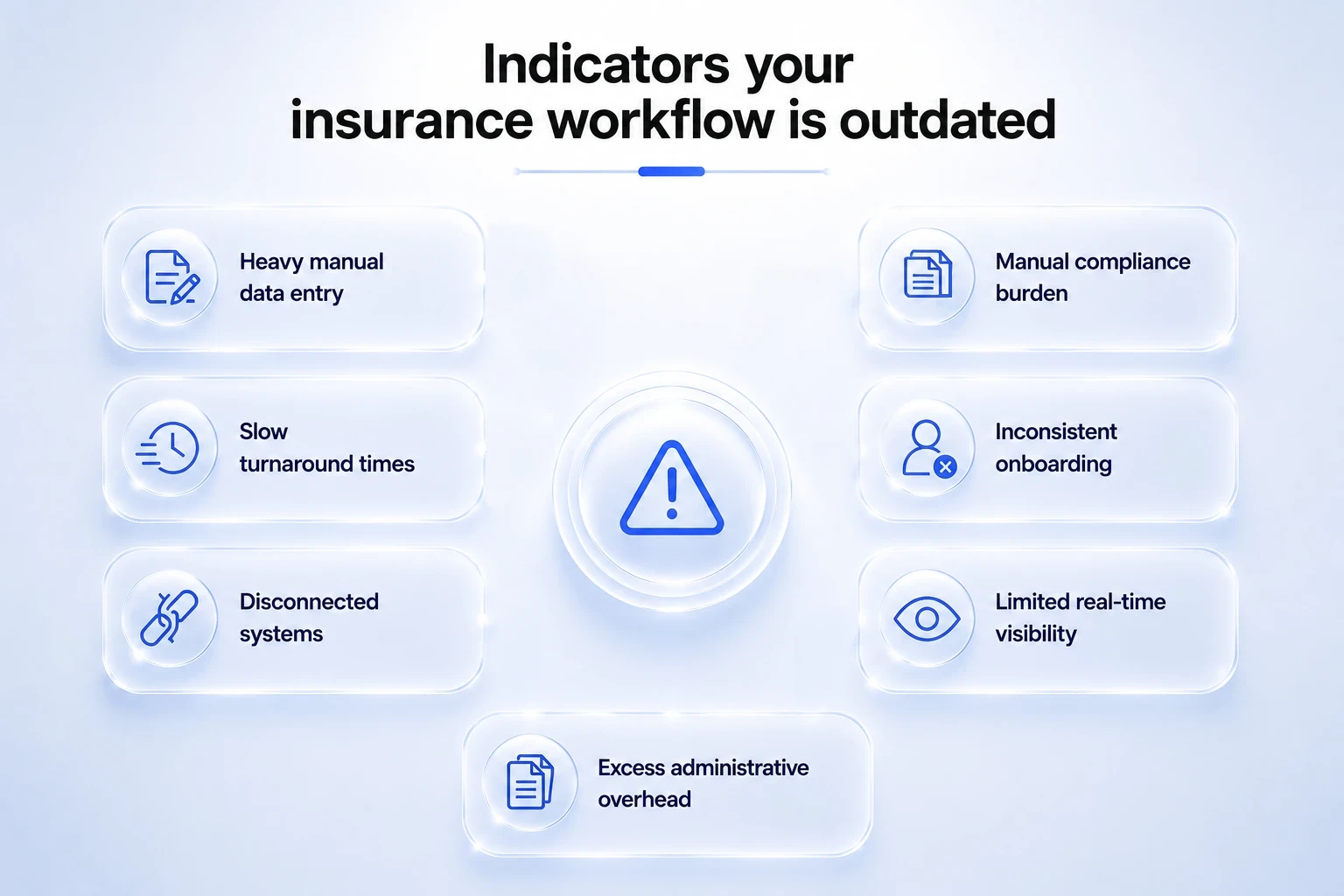
Insurance operations are becoming increasingly complex, and legacy workflows are struggling to keep up. Manual processes, disconnected systems, and delayed decisions often signal deeper inefficiencies within the organization. Recognizing these early warning signs is critical to improving speed, accuracy, compliance, and overall operational performance.
If your underwriters, processors, or account managers are spending significant portions of their day manually transferring information from emails to spreadsheets, from spreadsheets to your policy management system, or from one platform to another; you have a workflow problem, not a staffing problem.
Manual data entry doesn't just create bottlenecks. It introduces error rates that compound downstream: incorrect policy data, misrouted claims, inaccurate invoicing, and compliance gaps. In a business built on precision, manual processes are a structural vulnerability.
Modern insurance workflow automation replaces these repetitive steps with intelligent data extraction, validation, and routing; freeing your teams to focus on higher-value judgment calls rather than clerical execution.
Speed has become a competitive differentiator. Policyholders who experience friction during the claims process don't stay quietly frustrated; they leave. Accenture's research found that nearly one-third of dissatisfied claimants had already switched carriers, and another 47% were considering doing so; with settlement speed cited as the primary driver of dissatisfaction.
If your first notice of loss process takes days rather than hours, or if your renewal workflow requires multiple manual touchpoints before a quote can be issued, you're not just losing efficiency; you're losing customers.
Insurance workflow modernization addresses this by redesigning the end-to-end process: digitizing intake, automating triage, and enabling straight-through processing for routine transactions. The result is faster cycle times without compromising accuracy or oversight.
A common sign of an outdated insurance agency workflow is the proliferation of disconnected systems; a CRM that doesn't integrate with the policy management platform, a claims system that can't pull from the underwriting database, a compliance tool that runs in complete isolation.
This fragmentation doesn't just create friction; it creates invisibility. When data lives in silos, leadership can't get a real-time view of operational performance. Renewals are missed. Exposure accumulates undetected. Audit trails are incomplete.
Deloitte's analysis of the reinsurance segment found that 38% of executives cited analytics as a significant pain point, with siloed functions and outdated technology directly hindering the ability to derive actionable insights from data.
Workflow modernization involves not just automating tasks but integrating systems so information flows seamlessly across functions; underwriting, claims, finance, and compliance; creating the operational transparency that decision-makers need.
Regulatory requirements in insurance are growing in complexity. State filings, data privacy mandates, claims handling regulations, and documentation standards demand rigorous process controls and complete audit trails. If your team scrambles before every audit; gathering documentation from disparate sources, reconciling records, or manually creating compliance reports; your workflow is not built for the regulatory environment you're operating in.
A modernized insurance operations framework embeds compliance into the workflow itself. Audit trails are generated automatically. Regulatory checkpoints are built into process triggers. Documentation is stored, versioned, and retrievable on demand. Compliance stops being a reactive exercise and becomes a continuous, automated discipline.
There's a meaningful distinction between productive insurance work; underwriting analysis, client advisory, claims investigation; and the administrative overhead that surrounds it: status updates, approval routing, document chasing, and task coordination.
When employees spend a disproportionate amount of their day on coordination overhead rather than substantive work, it's a clear indicator of workflow gaps. This drain shows up in employee satisfaction scores, error rates during peak periods, and an inability to scale capacity without proportional headcount increases.
Insurance workflow automation directly addresses this by streamlining approvals, automating notifications, routing work intelligently based on rules and priority, and giving employees a single unified workspace rather than a collection of disconnected tools and email chains.
A well-functioning insurance agency workflow should make onboarding a new commercial account or personal lines policy a repeatable, consistent experience; for both the client and the internal team. If your new business process looks different depending on who handles it, or if key steps are documented only in someone's head rather than in a system, you have a process maturity problem.
Inconsistency in onboarding creates risk exposure: coverage gaps, missed cross-sell opportunities, non-standard documentation, and a client experience that varies from excellent to frustrating based on luck of assignment. Modernizing this workflow means standardizing the sequence, automating the checklist, and ensuring every account receives the same rigorous intake process regardless of volume or staffing.
If your operations reports are produced weekly by manually pulling data from multiple systems into a spreadsheet, you are operating with a significant information lag. By the time leadership sees a processing backlog, a compliance gap, or a capacity crunch in a particular function, the opportunity to intervene proactively has often already passed.
One of the most transformative benefits of insurance modernization is the shift from retrospective reporting to real-time operational intelligence. Dashboards that aggregate data across policy administration, claims, and service functions give leadership the visibility to make faster, better-informed decisions; and to hold operations accountable to performance standards that actually matter.
Understanding the signs of a problem is only half the picture. The strategic case for insurance workflow modernization rests on concrete, measurable outcomes:
The McKinsey Global Insurance Report 2025 underscores this directional shift: while where insurers operate matters, the majority of financial performance is driven by how they operate; making operational excellence the primary lever for sustainable competitive advantage.
This is perhaps the most critical strategic insight for operations leaders: workflow modernization is not a software procurement exercise. It's an organizational transformation that requires deep process expertise, change management capability, and a clear-eyed diagnosis of where inefficiency actually lives before any automation is applied.
Technology deployed on top of a broken process doesn't fix the process; it accelerates it in the wrong direction. The organizations that achieve lasting results from insurance workflow automation start with a structured operational assessment: mapping current-state workflows, identifying root-cause inefficiencies, prioritizing transformation opportunities by impact, and designing future-state processes that are genuinely fit for automation.
This is where specialized insurance consulting services become a force multiplier. A strategic consulting partner with deep insurance domain expertise and workflow transformation experience doesn't just implement tools; they help you ask the right questions, build the right foundation, and navigate the organizational complexity of change at scale.
If several of the signs above are familiar, the productive response is not to feel overwhelmed; it's to get specific. Which workflows are costing the most time? Where are errors occurring most frequently? Which processes are creating compliance exposure? Where is your leadership team flying blind?
A structured workflow diagnostic; conducted with experienced insurance operations consultants; translates these observations into a prioritized, actionable transformation roadmap. It surfaces the highest-impact opportunities, defines the right sequence of change, and creates the business case that aligns internal stakeholders around the investment.
The insurance operations landscape in 2025 and beyond rewards organizations that invest in how they operate, not just what they sell. The warning signs of an outdated insurance workflow aren't indicators of failure; they're indicators of opportunity. Every process that is manual, siloed, or inconsistent represents a transformation lever waiting to be pulled.
FBSPL partners with insurance agencies, carriers, and MGAs as a strategic operational transformation partner; bringing deep insurance domain expertise, proven workflow modernization frameworks, and a consulting-led approach that ensures technology serves strategy, not the other way around.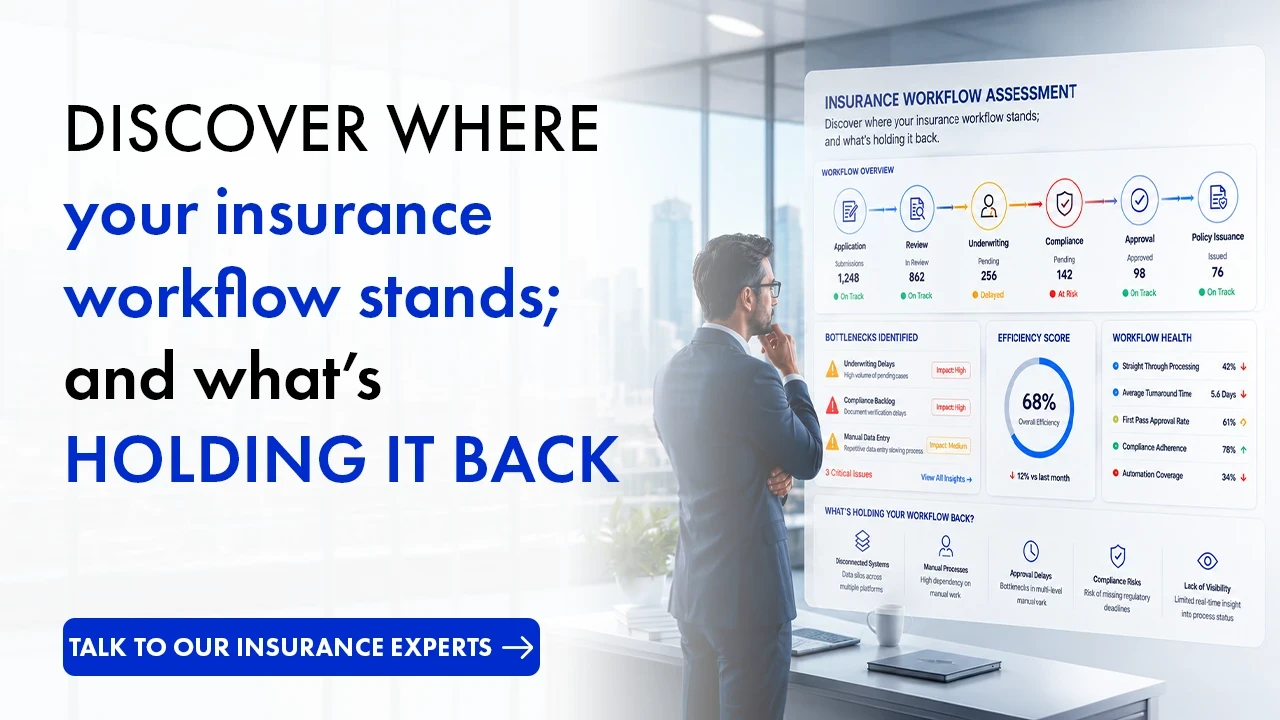
Insurance workflow modernization focuses specifically on improving and automating operational processes, while digital transformation is broader and includes changes in customer experience, business models, and digital channels.
Get the latest insights on insurance operations, policy management, and industry best practices.