



The hidden cost of manual insurance documentation and compliance errors
9 MIN READ/Jun 18, 2026

Summary: Manual insurance documentation creates hidden compliance risks, rising costs, and operational inefficiencies across organizations. The blog highlights how errors, silos, and outdated tracking methods increase exposure, and explains how insurance document automation transforms compliance into a scalable, proactive, and strategic function.
Every operations leader in insurance knows the feeling: a compliance audit is around the corner, and the team is buried in spreadsheets, email threads, and filing cabinets trying to reconcile documentation that was never truly built to scale. The process feels manageable; until it isn't.
The cost of manual insurance documentation rarely appears as a single line item on a budget report. It hides in overtime hours, rework cycles, regulatory penalties, and missed renewal windows. It lives in the friction between departments and in the quiet erosion of institutional trust that happens when a critical certificate of insurance is expired, missing, or misclassified.
For B2B organizations managing complex insurance portfolios, compliance requirements, and vendor relationships, the true cost of manual tracking isn't just operational. It's strategic. And in today's regulatory environment, it's becoming increasingly unaffordable.
Why manual insurance tracking is no longer a viable strategy
Manual insurance compliance was never elegant; but it was once manageable. That is no longer the case.
The regulatory landscape has become dramatically more complex. State-level mandates, sector-specific compliance frameworks, constantly evolving certificate of insurance (COI) requirements, and vendor liability standards now demand real-time accuracy across hundreds; sometimes thousands; of active documents. Yet most mid-market and enterprise organizations continue to manage this through the same combination of Excel, email, and shared drives they used a decade ago.
The result is a system that works precisely until the moment it doesn't.
According to Drata's compliance research citing industry survey data, 83% of organizations report moderate or major delays caused by manual compliance work; and 53% dedicate the equivalent of a full-time employee exclusively to evidence collection alone.
Insurance documentation errors are rarely catastrophic in isolation. A missing endorsement, an outdated policy limit, an incorrectly tracked expiration date; these feel like small administrative oversights. But in aggregate, and at scale, they represent one of the most significant hidden compliance risks in modern business operations.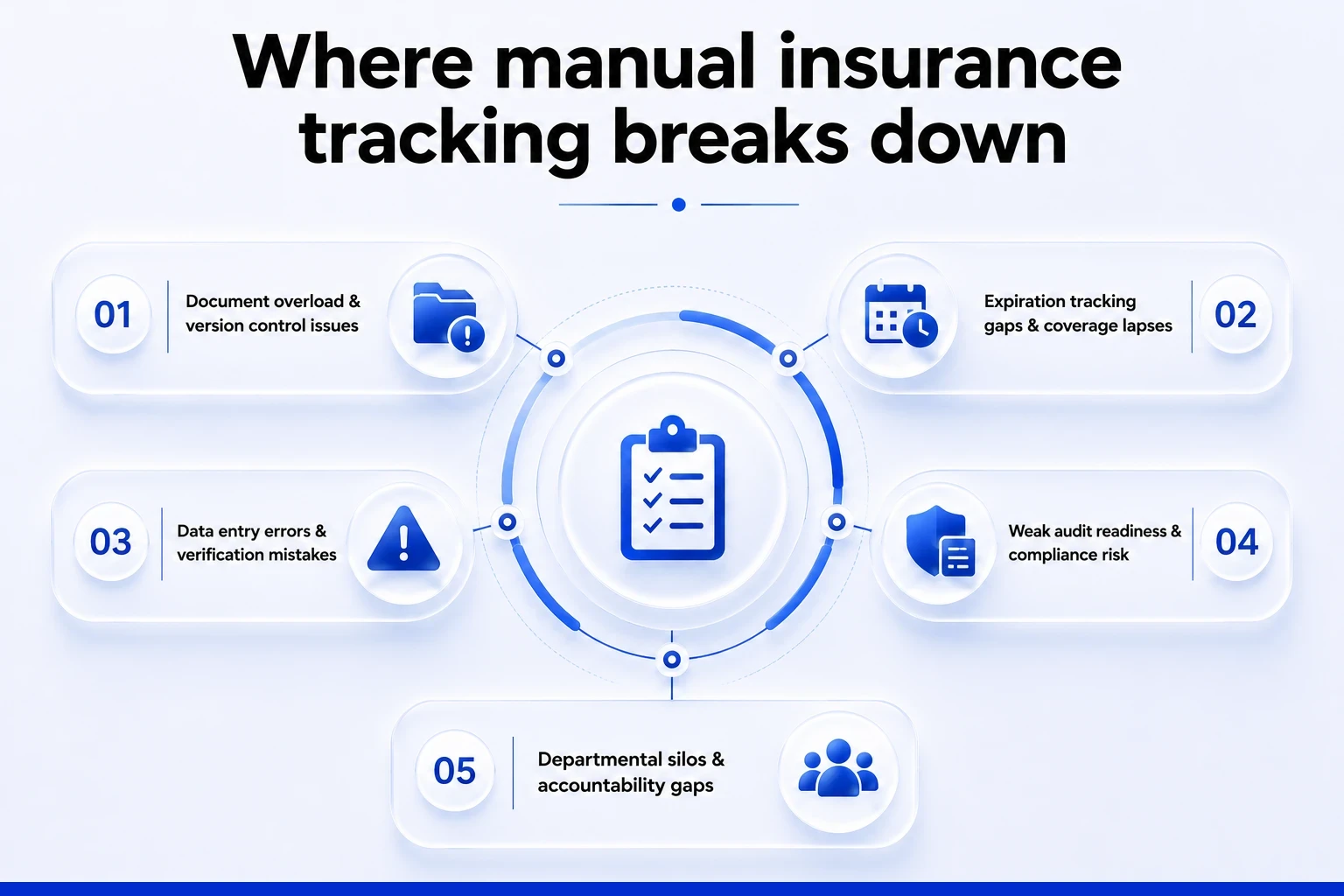
The challenges of manual insurance tracking: Where things break down
Understanding where manual systems fail helps clarify exactly what is at risk; and what needs to change.
1. Document overload and version control failures
Insurance documentation for a mid-sized organization can encompass thousands of active certificates, policies, endorsements, and vendor agreements; each with distinct expiration cycles, coverage thresholds, and compliance requirements. Manual systems cannot maintain real-time visibility across this volume. Files are duplicated, outdated versions remain in circulation, and critical changes to policy terms go unnoticed until an incident forces a review.
2. Expiration tracking gaps and lapsed coverage
One of the most costly consequences of manual compliance is the failure to proactively track and renew coverage before expiration. In vendor and contractor management environments, a lapsed certificate of insurance can expose the organization to uncovered liability claims and trigger contract defaults. When this occurs across hundreds of vendor relationships simultaneously, as is typical in supply chain or construction-adjacent industries, the risk multiplies rapidly.
3. Human error in data entry and verification
Manual data entry introduces inconsistency by design. Policy numbers, coverage limits, named insured entities, and effective dates are frequently transposed or recorded inaccurately. These errors flow downstream into compliance reports, audit submissions, and vendor qualification processes; creating cascading inaccuracies that are difficult and expensive to unwind.
Research firm Gartner estimates the average cost of a single data quality error at $100 across all industries; and for a mid-size operation processing thousands of records daily at a typical 3% error rate, annual error-related costs can reach $2 to $7 million when accounting for investigation time, correction labor, and audit remediation.
4. Audit readiness and regulatory exposure
When a regulator, client, or internal auditor requests documentation on short notice, organizations relying on manual systems often cannot produce accurate, complete records in time. This creates compliance risks that go beyond the underlying documentation failures; it signals systemic weakness in governance and risk management infrastructure.
5. Departmental silos and accountability gaps
In most organizations, insurance documentation sits at the intersection of procurement, legal, finance, and risk management. Without centralized, automated systems, each department maintains partial records that don't reconcile with one another. Accountability for compliance becomes diffuse, and critical gaps fall through the cracks between teams.
The compound effect: How compliance costs multiply over time
It's tempting to view each documentation error as an isolated incident. In reality, they compound.
Consider the operational sequence triggered by a single lapsed vendor certificate: the vendor continues operating under the assumption of coverage; a liability event occurs; the organization discovers the lapsed coverage during claims processing; legal must assess exposure; risk management escalates; the vendor relationship is reviewed; renegotiation costs mount. A documentation error that took seconds to make can take months and hundreds of thousands of dollars to resolve.
Compliance costs accumulate not just from fines and penalties, but from the operational drag of remediation; rework, legal review, audits, and the executive hours consumed by crisis management that should never have been a crisis in the first place.
At the macro level, these inefficiencies translate into a measurable competitive disadvantage. Organizations that are perpetually managing documentation backlogs cannot redirect that capacity toward growth, innovation, or higher-value risk management activities. They are operationally constrained by processes that automation could largely eliminate.
Why AI and automation are becoming essential
The argument for automation in insurance tracking is not primarily a technology argument. It is a risk management argument.
Insurance document automation eliminates the error-prone manual handoffs that create compliance gaps. Automated systems can track expiration dates in real time, flag policy deficiencies before they become liabilities, generate compliant documentation on demand, and produce audit-ready records with a fraction of the effort required by manual teams.
The operational case is equally clear. McKinsey's analysis of the insurance risk and compliance function is direct on this point: in a sector still defined by a high degree of manual processes and legacy systems, deploying generative AI is expected to deliver a 10 to 30 percent increase in productivity across risk and compliance functions; a gain that manual-first organizations are systematically leaving on the table.
When your team is not chasing expired certificates, correcting data entry errors, or preparing for audits with incomplete records, they are doing work that actually builds business value. Benefits of insurance compliance automation include not just cost reduction, but the organizational capacity to manage risk proactively rather than reactively.
Key advantages organizations gain when they transition from manual to automated insurance compliance include:
- Real-time document monitoring with automated expiration alerts and renewal workflows
- Centralized documentation repositories that eliminate version control failures and departmental silos
- Standardized verification processes that reduce human error and improve audit readiness
- Scalable compliance infrastructure that grows with vendor and policy volume without proportional staffing increases
- Data-driven risk visibility that enables proactive decision-making rather than reactive crisis management
The strategic shift: From compliance cost to competitive edge
Organizations that have successfully modernized their insurance documentation and compliance infrastructure consistently report the same transformation: compliance stops being a reactive, labor-intensive burden and becomes a proactive strategic function.
This shift matters beyond the balance sheet. In B2B environments, your compliance posture is visible to clients, partners, and regulators. Organizations that can demonstrate robust, automated insurance compliance processes signal operational maturity, risk management discipline, and reliability; characteristics that directly influence procurement decisions, partnership qualifications, and contract terms.
Insurance consulting services play a critical role in this transformation; not as vendors deploying software, but as strategic partners who understand the intersection of regulatory requirements, operational workflows, and technology enablement. The goal is not just to digitize a broken process. It is to redesign it around accuracy, visibility, and proactive risk management.
A strategic path forward: What smart organizations do differently
Organizations that are ahead of this curve share a common approach. They have stopped treating insurance documentation as a back-office administrative function and started treating it as a core risk management capability.
Specifically, they have invested in three areas:
Process architecture: Redesigning documentation workflows from the ground up, eliminating redundant manual steps and building in automated verification and escalation logic.
Technology enablement: Deploying insurance document automation platforms that integrate with existing procurement, legal, and risk management systems; creating a single source of truth for all coverage documentation.
Ongoing governance: Establishing clear accountability frameworks, performance metrics, and regular compliance reviews to ensure the system remains accurate and current as regulatory requirements evolve.
This is where the right consulting partner makes a measurable difference. Rather than managing symptoms; a failed audit here, a lapsed certificate there; strategic partners help organizations build the infrastructure that prevents those failures from occurring in the first place.
The cost of waiting is higher than the cost of acting
The hidden cost of manual insurance tracking is not hypothetical. It is quantified in regulatory penalties, remediation expenses, audit failures, and the ongoing operational drag of processes that were never designed to scale.
The organizations most exposed to these risks are often those that have been managing successfully enough to avoid catastrophic failures; but are quietly accumulating compliance debt that will eventually become visible under regulatory scrutiny, a client audit, or a liability event.
The question is not whether to modernize insurance documentation and compliance infrastructure. The evidence is unambiguous on that point. The question is when; and whether your organization will make that decision proactively or be forced into it reactively.
At FBSPL, we partner with B2B organizations to architect insurance compliance and documentation systems that eliminate manual risk, reduce compliance costs, and build the operational foundation for scalable growth. Our approach is not about deploying tools. It's about transforming compliance from a persistent operational liability into a genuine strategic asset.


Bhavishya Bharadwaj
Bhavishya Bharadwaj is the Digital Marketing Manager at FBSPL, bringing over a decade of experience across insurance, outsourcing, accounting, and digital transformation.
Frequently Asked Questions
Manual processes increase the likelihood of errors, missed renewals, expired coverage, and incomplete records, all of which can lead to compliance failures and financial exposure.