



A complete guide to insurance licensing & compliance workflow management in 2026
17 MIN READ/Jun 09, 2026

Summary: Insurance licensing and compliance have become critical growth enablers for agencies, carriers, and MGAs. This guide explores insurance licensing management, compliance workflow best practices, automation strategies, regulatory challenges, and proven approaches to maintaining compliance while scaling operations efficiently in 2026.
Picture this: your agency is growing. New producers are onboarding across multiple states, your book of business is expanding into new lines of authority, and regulators are asking harder questions about your data governance and cybersecurity protocols. Your compliance team is buried in spreadsheets, chasing license renewal deadlines by email, and manually reconciling producer appointment records across a dozen state portals.
This is not an edge case. This is Tuesday morning for most mid-size insurance agencies and carriers in 2026.
The cost of operational inertia in insurance licensing and compliance has never been higher; nor has the opportunity for agencies and carriers that choose to modernize. Regulatory complexity is accelerating, workforce challenges are mounting, and the gap between organizations that manage compliance proactively and those that react is widening every quarter.
This guide is your definitive operational reference for insurance licensing and compliance workflow management in 2026. Whether you're a compliance officer wrestling with multi-state producer management, an operations leader trying to scale without proportional headcount, or a C-suite decision-maker evaluating your agency's infrastructure risk, what follows is designed to give you clarity, frameworks, and actionable strategy.
The scale of the problem: What the data is actually telling us
Before diving into solutions, it's important to understand the magnitude of what insurance organizations are managing.
According to NIPR operational data cited by Producerflow, the National Insurance Producer Registry processed approximately 185.9 million credentialing and reporting transactions in 2025; a 29% year-over-year increase and more than 150% growth over the past five years. The NIPR database now contains records for roughly 9.2 million producers and entities, while the platform processed approximately $1.38 billion in state licensing and regulatory fees during 2025 alone.
That volume isn't an abstraction. Behind each transaction is a producer, an appointment, a renewal, or a compliance checkpoint that someone in your organization either has; or does not have; a system to manage.
The regulatory side of the insurance industry tracked a grand total of 757 changes across the United States in 2025 alone — and that pace is not expected to slow in 2026. Additional updates are expected, including changes to the NAIC Uniform Application and expanded electronic submission requirements in certain states. Meanwhile, new adjuster licenses dropped by 16% in 2025 and are expected to continue declining, adding another layer of workforce complexity.
For operations leaders, those two data points together tell a clear story: transaction volume is surging while the regulatory environment is growing more complex and the available workforce is contracting. Manual processes cannot absorb that equation.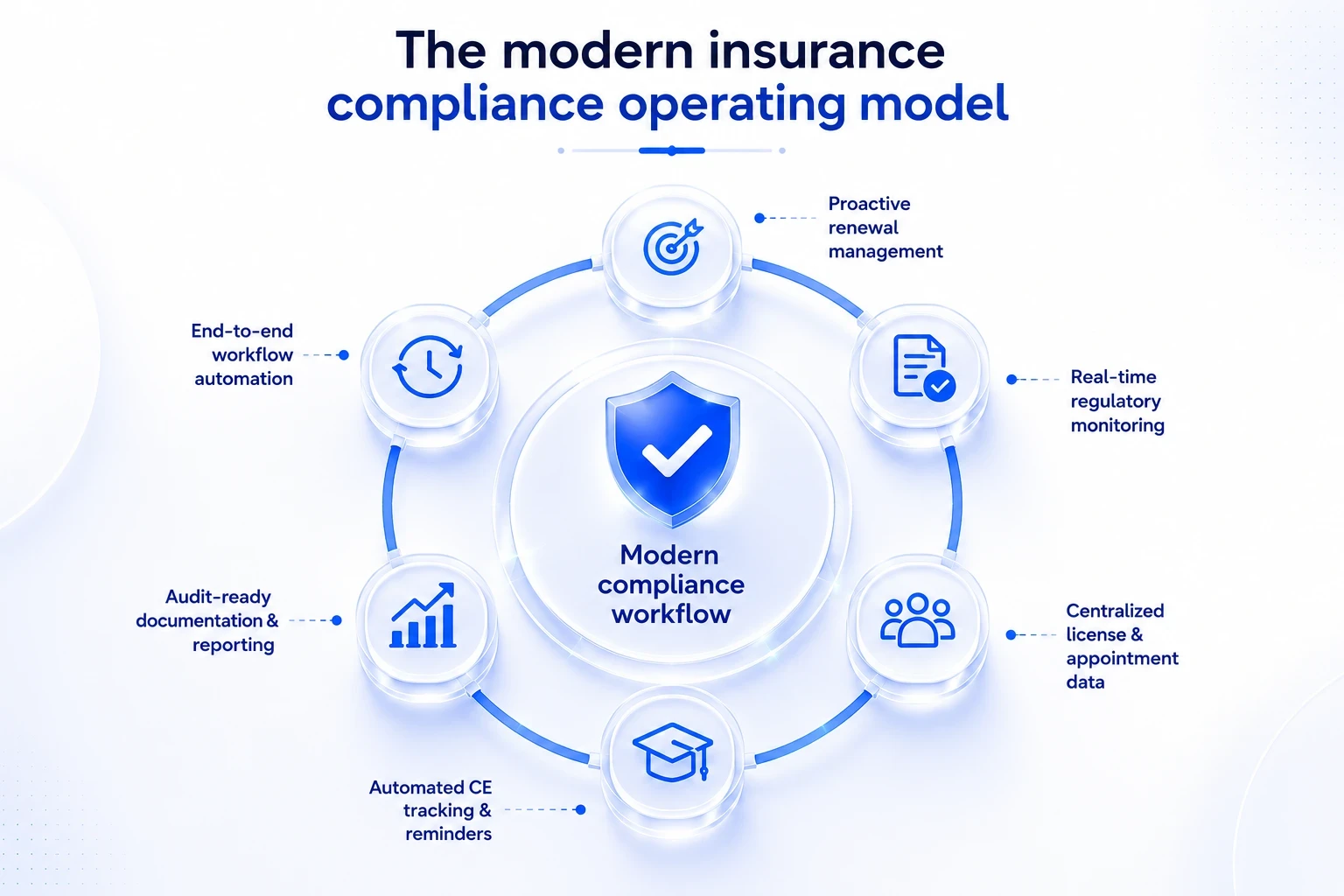
Understanding insurance licensing: The foundational layer
Before compliance workflows can be optimized, the underlying licensing framework must be clearly understood. Insurance licensing in the United States operates on a state-by-state basis, meaning producers, agencies, and adjusters must individually satisfy the requirements of each state in which they operate.
Types of insurance licenses
Understanding the full scope of license types your organization manages is the first step toward building a coherent licensing management system. The major categories include:
- Producer licenses — The most common license type, issued to individuals and business entities authorized to solicit, negotiate, or sell insurance. These licenses are line-of-authority specific, meaning a producer licensed in life insurance is not automatically permitted to sell health or property products.
- Lines of authority — Within a producer license, each line of authority (Life, Health, Property, Casualty, Personal Lines, Surplus Lines, Variable Products, etc.) represents a separate regulatory authorization. A multi-line producer operating in multiple states can carry dozens of active lines of authority across their license portfolio.
- Adjuster licenses — Required in most states for independent adjusters and, in some jurisdictions, staff adjusters. The decline in new adjuster licenses noted in recent industry data signals a meaningful workforce pipeline concern for carriers managing high claims volumes.
- Managing General Agent (MGA) licenses — Entities acting on behalf of carriers in underwriting, binding, and policy administration must maintain proper MGA designations, often alongside producer appointments.
- Business entity licenses — Agencies and corporate entities, not just individual producers, must be separately licensed in each state where they transact business. Many organizations underestimate the volume of entity-level licenses they're responsible for maintaining.
- Surplus lines licenses — For producers placing business in the non-admitted market, surplus lines licensing adds another layer of state-specific requirements and stamping office filings.
- Continuing Education (CE) requirements — Not a license type per se, but an ongoing compliance obligation tightly coupled with license maintenance. CE requirements typically fall within a range of 16 to 24 hours per two-year renewal cycle, with ethics components required in most states.
For agencies with producers operating across 10 or more states; which describes most regional and national distributors; the matrix of license types, lines of authority, renewal cycles, and CE obligations quickly becomes unmanageable without purpose-built infrastructure.
The core challenge: Why insurance licensing management breaks down
Most agencies don't fail at insurance licensing management because their teams lack competence. They fail because the systems and processes they're using were designed for a simpler operating environment that no longer exists.
1. Manual tracking at scale is structurally unsound
Spreadsheet-based license tracking introduces compounding risk at every point of growth. When a producer adds a new state, someone must manually update multiple fields. When a renewal deadline approaches, a human must notice it. When a state changes its requirements; as happened 757 times in 2025 someone must identify the change, assess its impact, and update records accordingly. Each of these moments is an opportunity for an error that could result in a producer operating without valid licensure.
2. Multi-state complexity creates exponential administrative burden
A producer licensed in 15 states with three lines of authority has 45 distinct licensure conditions to track. Add CE requirements, appointment records, and carrier-specific compliance obligations, and you're looking at a compliance profile that no individual can reliably manage manually across a producer force of any meaningful size.
3. Disconnected systems create data integrity gaps
Many agencies have accumulated a patchwork of systems over the years; an agency management system for policy and client data, a separate spreadsheet for licenses, email chains for renewal reminders, and manual submissions to NIPR or state portals. Without integration, these systems create data silos where the compliance record in one location doesn't reflect what's actually on file with the state regulator.
4. Regulatory volatility demands continuous monitoring
In 2026, compliance is not just about policies and audits. It is embedded into workflows across calls, mail, digital documents, and customer interactions. Operations leaders are responsible for ensuring consistency, traceability, and proof across every touchpoint; non-compliance creates real financial and reputational risk. At the same time, overly manual compliance processes slow teams down, forcing leaders to balance rigor with efficiency.
That balance, between rigor and efficiency, is exactly where most organizations currently struggle.
Building an effective insurance compliance workflow
An insurance compliance workflow is not a checklist. It is a systematic, repeatable operational process that ensures every licensing and compliance obligation is identified, assigned, tracked, completed, and documented; regardless of whether it involves one producer or one thousand.
Step 1: License inventory and baseline audit
The foundation of any compliance workflow is a complete and accurate inventory of every license, appointment, line of authority, and CE obligation your organization currently holds or is responsible for. Most organizations discover material gaps during this initial audit; producers whose licenses lapsed quietly, entities with missing state appointments, CE records that exist only in email threads.
A thorough baseline audit should capture:
- All individual and entity licenses by state and line of authority
- Expiration dates and renewal cycles for each
- Appointment records with each carrier for each licensed producer
- CE completion status relative to current renewal periods
- Outstanding or pending applications
Step 2: Standardize the licensing lifecycle workflow
Once inventory is established, the next step is to map and standardize the end-to-end lifecycle workflow for each license type. A well-designed insurance licensing workflow typically includes:
- Pre-licensing phase — Background check initiation, pre-licensing education (where required), application submission through NIPR or state portals, and fee processing.
- Active license management phase — Carrier appointment maintenance, address and contact information updates, line-of-authority additions, and ongoing CE tracking.
- Renewal management phase — Proactive renewal reminders (typically triggered 90, 60, and 30 days ahead of expiration), CE completion verification, renewal application submission, and fee payment.
- Termination and reinstatement phase — When producers depart or licenses lapse, a clear offboarding and reinstatement workflow prevents compliance gaps and unauthorized activity.
Step 3: Assign ownership and accountability
Even the best-designed compliance workflow fails without clear ownership. Each license or producer portfolio should have a designated compliance owner responsible for monitoring its status. This is particularly important for multi-state organizations where the sheer volume of obligations can create diffusion of responsibility.
Step 4: Automate trigger-based workflows
Modern insurance licensing management platforms allow compliance teams to configure automated workflows triggered by specific conditions — a license approaching expiration, a CE deadline falling within a threshold window, a state regulatory change affecting a specific license type. These triggers replace the manual monitoring burden with systematic alerts that ensure nothing falls through the cracks.
Step 5: Build an audit-ready documentation standard
Regulators increasingly expect not just compliance, but documented proof of compliance. Every licensing action; application submission, renewal filing, CE completion, appointment confirmation; should generate a timestamped record stored in a centralized, retrievable system. This documentation posture protects the organization in the event of a state examination or carrier audit.
Insurance workflow management: Scaling without proportional overhead
Insurance workflow management, in the broader sense, encompasses the full operational infrastructure that governs how licensing, compliance, and producer management tasks move through your organization. As agencies scale, the inefficiencies of manual workflow management become increasingly costly.
Insurance workflow automation at scale can enable organizations to reduce operational costs by up to 30% within five years, allowing for better allocation of resources. Many companies have leveraged workflow automation to streamline critical processes including HR onboarding, GDPR compliance, and insurance vetting; significantly improving approval times, enhancing regulatory compliance, and reducing operational costs.
That cost reduction isn't theoretical. It reflects what organizations consistently discover when they move from ad hoc, email-driven workflows to structured, automated process management.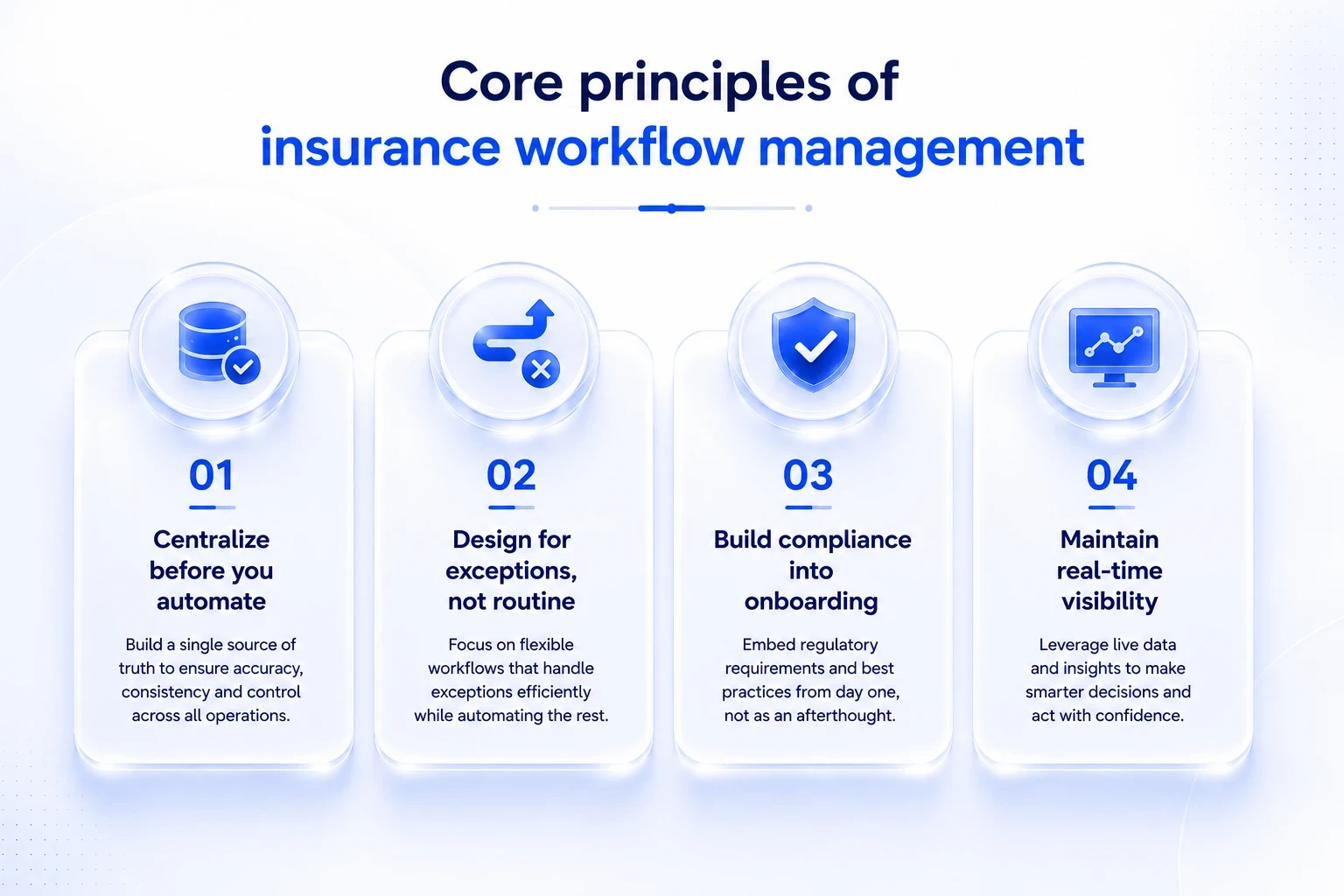
Key insurance workflow management principles
Effective insurance workflow management starts with designing systems, not just processes. Most compliance failures stem from fragmented data, manual handling, and reactive decision-making. The principles below outline how leading organizations build structured, scalable, and low-risk compliance workflows.
- Centralize before you automate — Automation applied to a fragmented process produces faster fragmentation. Before introducing automation, consolidate producer data, license records, and compliance obligations into a single system of record.
- Design for exceptions, not routine — Most licensing transactions are routine. Effective workflow management identifies the routine path and automates it, freeing human attention for exceptions; a producer with an unusual background check result, a state with an unexpected regulatory change, a license that requires manual review.
- Build compliance into onboarding — The most common source of licensing gaps is the producer onboarding process, where licensing steps are treated as separate from the HR and contracting workflow. Integrating licensing requirements directly into onboarding sequences ensures no producer begins transacting business without proper authorization.
- Maintain real-time visibility — Compliance dashboards that provide real-time visibility into the status of every license, renewal, CE obligation, and appointment across the producer force allow compliance teams to operate proactively rather than reactively.
Effective training strategies for insurance license compliance
Training is one of the most underinvested components of insurance license compliance programs. Organizations often ensure their producers meet minimum CE requirements for license renewal but fail to build the deeper compliance knowledge that prevents more costly violations.
1. Role-specific compliance onboarding
New producers should complete structured compliance onboarding that covers not just the regulatory minimums but the organization's specific compliance standards, documentation requirements, and escalation protocols. Generic compliance training delivered once at hire is not sufficient in an environment of 757 annual regulatory changes.
2. Ongoing regulatory update communications
When state regulations change; and they change constantly; producers and compliance staff need to know what changed, how it affects their specific licenses and lines of authority, and what action, if any, is required. A structured regulatory update communication cadence, tied to a monitored change-tracking function, keeps the producer force informed without overwhelming them.
3. Digital CE tracking and reminders
Continuing education compliance should be monitored continuously, not reactively. Producers who are close to a renewal cycle with incomplete CE hours represent a predictable, preventable problem. Digital tracking tools that flag CE gaps well in advance give producers the time to complete requirements without disrupting their production activity.
4. Compliance culture and leadership reinforcement
Effective training strategies in high-performing compliance organizations go beyond content delivery. They embed compliance as a professional standard, reinforced by leadership behavior, performance expectations, and clear accountability. Producers who see compliance treated as a genuine organizational priority; not a back-office burden; are more likely to engage with it seriously.
Security & compliance practices in insurance licensing management
The intersection of cybersecurity and insurance license compliance is receiving significantly more regulatory attention in 2026. State insurance regulators, guided by NAIC model laws and frameworks like the NYDFS Cybersecurity Regulation, are increasingly treating data governance and information security as direct compliance obligations.
What this means for licensing and compliance systems
The systems your organization uses to manage producer data, licensing records, and compliance workflows contain sensitive personal information; Social Security numbers, background check results, financial disclosures, and regulatory correspondence. These systems must meet the same security standards applied to policyholder data.
Key security and compliance practices for insurance licensing management systems include:
- Role-based access controls — Not every member of the compliance team needs access to every producer's full compliance file. Access should be granted based on organizational role, with sensitive data visible only to those with a legitimate need.
- Encrypted data transmission and storage — Licensing data transmitted to NIPR, state portals, or carrier appointment systems must be encrypted. Data at rest should be protected by enterprise-grade encryption standards.
- Audit trail maintenance — Every action taken in a licensing management system; a record updated, a document uploaded, a deadline modified; should generate an immutable audit log. This protects the organization in the event of a regulatory inquiry and establishes the accountability structure that regulators increasingly expect.
- Third-party vendor risk management — If your licensing management is handled through a third-party platform or outsourced compliance partner, that vendor's security posture is your compliance risk. Appropriate vendor due diligence, contractual security requirements, and ongoing monitoring are essential components of a mature compliance program.
- Incident Response Planning — In the event of a data breach affecting producer records, your organization needs a defined incident response protocol that includes regulatory notification obligations. State breach notification laws vary, and insurance-specific data has specific handling requirements that general-purpose incident response plans may not address.
According to Deloitte's 2025 Insurance Regulatory Outlook, insurance agencies should expect continued and intensifying compliance pressure, with regulators zeroing in on AI usage, cybersecurity threats, and climate risk. Agencies will face more oversight around how they manage customer data, maintain solvency, and navigate affordability concerns; requiring stronger partnerships with regulators and readiness to adapt to faster-moving, more complex requirements.
How to grow your insurance agency with licensed account management
One of the least discussed but most strategically significant aspects of insurance licensing management is its direct connection to agency growth capacity. The ability to rapidly and accurately license new producers, expand into new states, and add lines of authority is a direct competitive differentiator; and a constraint on growth when it isn't managed well.
1. Licensed account management as a growth engine
Organizations that have built mature licensing management infrastructure can execute expansion decisions quickly. When a business opportunity requires a licensed presence in a new state, a well-managed agency can initiate and complete the licensing process in days; not weeks; because the data, workflows, and submission protocols are already in place.
By contrast, agencies without systematic licensing management often miss market windows because the administrative burden of expansion is too high. Compliance delay becomes competitive delay.
2. Producer recruitment and retention
The quality of your compliance and licensing management infrastructure increasingly affects your ability to recruit and retain top producers. Experienced producers evaluate the operational quality of agencies they consider joining. An agency that can clearly articulate its licensing support process, CE tracking system, and regulatory change communication cadence demonstrates operational maturity that attracts professionals who take their practice seriously.
3. Multi-state expansion planning
For agencies pursuing geographic expansion, a licensing management strategy should be developed before the first application is filed in a new state. This means understanding the licensure requirements for each state, mapping the timeline from application to authorization to appointment, and ensuring internal workflows can support producer activity in the new market without compliance gaps.
4. Carrier relationship management
Carrier appointments are a licensing component that agencies often manage informally. As agencies grow and work with more carriers across more states, appointment management; ensuring every producer is properly appointed with every carrier they represent, in every state where they'll place business; becomes a genuine operational discipline. Appointment gaps create E&O exposure and can result in commission disputes or regulatory violations.
Common pitfalls to avoid in compliance workflow management
Even organizations that invest in licensing and compliance infrastructure commonly encounter several avoidable operational pitfalls:
- Treating compliance as a one-time event — Licensing is not a checkbox. It requires ongoing management, monitoring, and adaptation to regulatory changes. Organizations that treat initial licensure as the end of the compliance obligation routinely discover gaps when audits, E&O claims, or carrier reviews prompt closer examination.
- Underestimating entity-level licensing requirements — Many organizations focus on individual producer licenses while neglecting the parallel requirement to maintain current business entity licenses in each operating state. Entity license lapses can have broader operational consequences than individual producer gaps.
- Ignoring non-resident license obligations — Producers who conduct business across state lines require non-resident licenses in each state where they transact. Organizations that assume only resident-state licensure is required frequently find themselves with unlicensed activity exposure.
- Failing to sunset inactive licenses — Maintaining licenses in states where a producer no longer transacts business creates unnecessary renewal costs and compliance overhead. A regular license portfolio review and sunset process keeps the organization's compliance obligations manageable and focused.
- Reactive CE management — Waiting until a producer's CE deadline is imminent to confirm completion is a high-risk practice. Organizations that build CE progress into routine compliance monitoring avoid the scramble; and the occasional license lapse; that reactive CE management produces.
The case for strategic compliance partnership
Many insurance organizations reach a point where internal compliance capacity cannot keep pace with operational growth, regulatory complexity, and the technology investment required to manage both effectively. This is the moment where the question shifts from "how do we do this better" to "who can help us do this at the level it actually needs to be done."
The decision to engage a strategic compliance partner is not a signal of organizational weakness. It is a recognition that insurance licensing and compliance workflow management has become a specialized operational discipline; one that requires deep regulatory expertise, purpose-built technology, and dedicated capacity that is difficult to maintain in-house while simultaneously running a growing insurance business.
The right strategic partner doesn't simply execute compliance tasks. They help you understand your full compliance exposure, architect workflows that are resilient to regulatory change, train your team on standards that prevent violations before they occur, and provide the operational infrastructure to support growth at scale.
The difference between a service vendor and a strategic compliance partner is the difference between having someone who files your license applications and having someone who helps you build an organization that never has a licensing gap.
Compliance isn't a cost center. It's the infrastructure of growth
Compliance is no longer a back-office function; it is a critical business capability that supports growth, expansion, and operational resilience. In 2026, insurance licensing and compliance workflow management play a central role in helping agencies, carriers, and MGAs onboard producers efficiently, enter new markets faster, and meet increasing regulatory expectations with confidence.
As transaction volumes continue to rise and regulatory requirements become more complex, manual compliance processes create unnecessary risk and administrative burden. Organizations that invest in structured licensing management, automated workflows, and proactive compliance monitoring are better positioned to avoid disruptions, maintain audit readiness, and scale without adding proportional overhead.
The most successful insurance organizations view compliance as a strategic advantage rather than a regulatory obligation. At FBSPL, we help agencies, carriers, and MGAs strengthen their compliance infrastructure through multi-state licensing management, producer onboarding support, CE tracking, carrier appointment management, and regulatory monitoring; creating the foundation for efficient, scalable, and compliance-driven growth.


Bhavishya Bharadwaj
Bhavishya Bharadwaj is the Digital Marketing Manager at FBSPL, bringing over a decade of experience across insurance, outsourcing, accounting, and digital transformation.
Frequently Asked Questions
There is no fixed limit on the number of states where an insurance producer can hold licenses. Many producers maintain resident and non-resident licenses across dozens of states, provided they meet each state's licensing, renewal, and continuing education requirements.

.png&w=3840&q=75)